


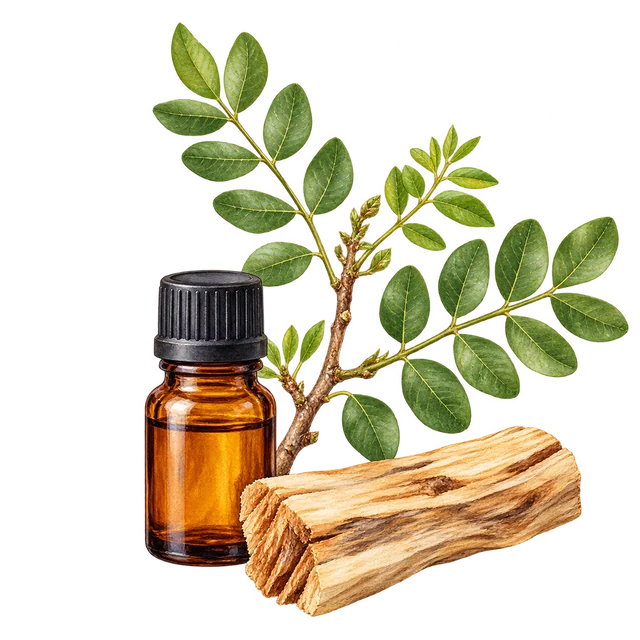
Key cautions
- Do not swallow the oil or apply undiluted oil to skin or eyes.
- Fragrance can provoke irritation or symptoms in sensitive people; stop use if it does
- A sustainability claim needs traceable evidence; species-level research does not certify a seller’s harvest.
What’s inside
Limonene and alpha-terpineol are prominent in a studied Manabí stem oil; other batches and plant parts may differ.
Uses in brief

- Aromatic distillate
- Fruit-oil production
History, folklore and reported uses
History, folklore and traditional uses
The cited production and chemistry evidence comes from Ecuador. The name palo santo has broader cultural and commercial usage; no single Indigenous ceremonial practice or universal sustainability story is asserted.
Traditional, historical and reported uses
- Aromatic distillate
Food or household practiceWhy this label?
The source documents an aromatic or manufacturing material, without establishing therapeutic benefit.
A primary Ecuadorian study characterizes oil from Manabí stems. This supports the existence and chemical identity of the aromatic material without proving a medical indication.
- Fruit-oil production
Food or household practiceWhy this label?
Source documents this specific material, culinary use or attributed practice; no clinical efficacy is inferred.
A separate study examines residues left after fruit-oil extraction in Ecuador. Fruit-derived oil and wood-derived oil should be distinguished rather than presumed chemically identical.
2 bounded uses; regional records do not establish treatment effects.
Historical-use additions reviewed 2026-10-09
Story sources
- Fon-Fay et al.: Bursera graveolens essential oil from Manabí, Ecuador
- Vermicomposts from palo santo fruit-oil extraction residues
- Poison Control: Essential oils can be poisonous when misused
- Chemical profiling and sensory qualities of Aloysia citrodora and Bursera graveolens essential oils from Ecuador
Regional reading paths
These sourced notes describe cultivation, trade, food traditions or material history. A regional connection does not claim exclusive origin.
South America
native and distilled; Ecuador, Manabí
Aromatic distillate studied chemically; no medicinal efficacy inference.
Identity & detailed reference
Identity
Bursera graveolens; essential oil distilled from Bursera graveolens; distinguish wood/stem and fruit oils and unrelated woods sold as palo santo.
Ingredient details, preparation and research
Also known as: Bursera graveolens
Source plant or material
Bursera graveolens
Plant family / material: Burseraceae
Forms and route
Traceable aromatic distillate and finished fragrance products; the distillate is not equivalent to incense wood or an herbal drink.
Vitamins and minerals
This is not a culinary fixed oil or a nutrient supplement. No safe oral amount is established by the presence of familiar fragrance compounds.
Absorption and preparation
Chemical composition and antioxidant assays do not establish what is safely absorbed by skin or lungs, or a therapeutic effect from diffusion.
Practical preparation
Select a finished product with botanical identity, plant part and intended use stated. Follow its label; avoid home distillation, ingestion and improvised skin mixtures.
Traditional and reported uses
- Aromatic distillate
- Fruit-oil production
Contraindications and cautions
- Do not swallow the oil or apply undiluted oil to skin or eyes.
- Fragrance can provoke irritation or symptoms in sensitive people; stop use if it does. Keep concentrates away from children.
- A sustainability claim needs traceable evidence; species-level research does not certify a seller’s harvest.
Assays are not therapies
The stem-oil study measures composition and antioxidant activity; insect-related work also tests particular oils. These are experimental endpoints, not evidence that the oil treats anxiety, infection or mosquito-borne disease.
Evidence limits
No medicinal dose, insect-repellent recipe or ingestion recommendation is supplied. This card does not establish legal sourcing or a safe exposure level for every user.
Entry sources
- Fon-Fay et al.: Bursera graveolens essential oil from Manabí, Ecuador
- Vermicomposts from palo santo fruit-oil extraction residues
- Poison Control: Essential oils can be poisonous when misused
- Chemical profiling and sensory qualities of Aloysia citrodora and Bursera graveolens essential oils from Ecuador
Reference entry 445 · Recorded content review: 2026-10-09 · Review scope and dates