


Key cautions
- Use culinary-grown flowers, not florist or unknown nursery stock. Washing cannot resolve every pesticide exposure.
- Use pasteurized egg white if an egg-white candied-flower method is chosen.
What’s inside
Pansy-flower studies identify anthocyanins, phenolic acids and other polyphenols; cultivar color and growing conditions affect the profile.
Uses in brief

- Colorful mild-flavored flower decoration for food.
History, folklore and reported uses
History, folklore and traditional uses
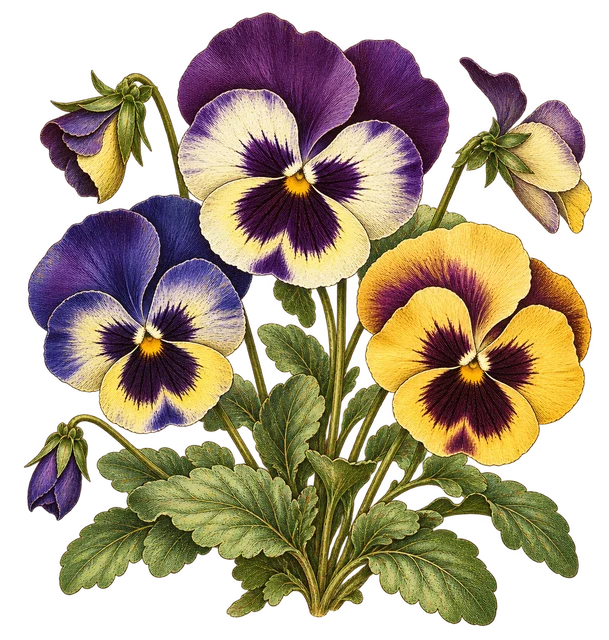
Iowa State describes pansies as a diverse group of garden hybrids, recognizable by their broad color range and often face-like markings. The University of North Florida explicitly records their edible flowers, while Colorado State describes preserving pansies as sugared decorations. This story belongs to the overlap between ornamental breeding and food decoration; a garden-center display alone does not establish that the plants were produced for eating.
Traditional, historical and reported uses
- Fresh food decoration
Food or household practiceWhy this label?
The claim documents fresh food decoration as a culinary, craft, gardening, or practical material use; it reports neither a treatment outcome nor measured nutrient content.
The University of North Florida’s botanical garden records pansy flowers as edible.
- Candied petals
Food or household practiceWhy this label?
The claim documents candied petals as a culinary, craft, gardening, or practical material use; it reports neither a treatment outcome nor measured nutrient content.
Colorado State describes sugared pansy petals and recommends pasteurized egg whites when that method is used.
Only specifically supported uses are included; historical or culinary use is not clinical proof.
Story sources
Identity & detailed reference
Identity
Garden pansy flowers, Viola × wittrockiana, grown for culinary use. This does not designate every ornamental viola or every plant called violet as food.
Ingredient details, preparation and research
Source plant or material
Viola × wittrockiana; Garden pansy flowers, Viola × wittrockiana, grown for culinary use. This does not designate every ornamental viola or every plant called violet as food.
Plant family / material: Violaceae
Forms and route
Fresh flowers or petals; candied food-grade flowers for decoration.
Vitamins and minerals
A garnish-sized flower portion is not a measured vegetable serving. Experimental concentrations per 100 g cannot be assumed for one blossom or for a different cultivar.
Absorption and preparation
Laboratory antioxidant measurements do not demonstrate disease prevention or an absorption advantage in people.
Practical preparation
Gently wash and inspect food-grade blooms. For candied flowers, follow a tested food-handling method, especially when using eggs; keep decoration quantities modest.
Traditional and reported uses
- Colorful mild-flavored flower decoration for food.
Contraindications and cautions
- Use culinary-grown flowers, not florist or unknown nursery stock. Washing cannot resolve every pesticide exposure.
- Use pasteurized egg white if an egg-white candied-flower method is chosen.
Similar items and how they compare
- Sweet violet
Both are Viola flowers.
Viola odorata is fragrant and botanically distinct from the hybrid garden pansy.
- Nasturtium
Another colorful flower food.
Nasturtium is peppery rather than mild.
Composition is not efficacy
A 2023 study measured organic and conventionally grown V. × wittrockiana flowers. Its compound profiles and antioxidant assays do not establish an effective medicinal dose.
Naming boundary
This card covers the garden pansy hybrid, not every member of Viola and not unrelated African violets.
Entry sources
- Iowa State University Extension: Growing pansies and violas
- University of North Florida Botanical Garden: Viola × wittrockiana
- Identification and quantification of bioactive compounds in edible pansy flowers (2023)
- Colorado State University Extension: Candied edible flowers and food-safe egg whites
Reference entry 184 · Recorded content review: 2026-10-07 · Review scope and dates