


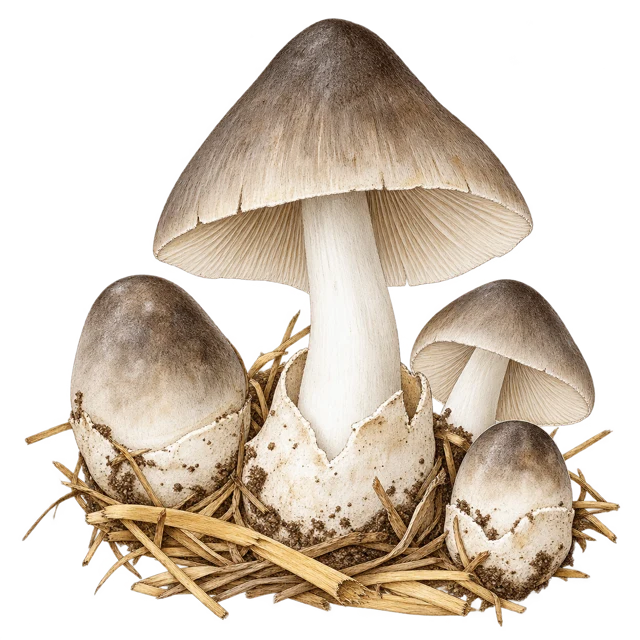
Key cautions
- Buy authenticated cultivated mushrooms: immature wild mushrooms can be fatally misidentified.
- Eat cooked; food-safety handling still matters with cultivated mushrooms.
What’s inside
Food analyses identify carbohydrate, protein and fiber, including polysaccharide-rich fractions. Extract composition changes with processing.
Uses in brief

- Tropical culinary mushroom
- Agricultural livelihood crop
- Manufactured broth and snack ingredients
History, folklore and reported uses
History, folklore and traditional uses
Paddy straw mushroom is deeply connected to warm-climate Asian food production. Historical research examines the early development of cultivation in southern China, while later histories identify written cultivation records in the nineteenth century. Fresh cooked mushrooms and commercially canned forms have carried the crop into wider markets.
Cultivation on agricultural materials also gives it an economic role. FAO presents straw-mushroom production as a livelihood-diversification option, while current food-development work explores products such as broths and crackers. Immature mushrooms sold commercially are cultivated foods; their appearance must never be used to justify eating unidentified wild mushroom “eggs.”
A closer look at its history
A crop made from straw
The paddy straw mushroom is a warm-climate decomposer whose cultivation turns agricultural residues into a short-cycle food crop. This explains both its English name and its importance in small-scale livelihood projects. The commercial practice of harvesting compact young buttons must not be borrowed as a rule for identifying unknown wild eggs.
Additional history reviewed 2026-10-09
Traditional, historical and reported uses
- Tropical culinary mushroom
Food or household practiceWhy this label?
The claim documents tropical culinary mushroom as a culinary, craft, gardening, or practical material use; it reports neither a treatment outcome nor measured nutrient content.
Cultivated fruiting bodies are used as food in tropical and subtropical Asian cuisines.
- Agricultural livelihood crop
Mixed/contextual sourcesWhy this label?
FAO documents crop-based livelihood diversification; the claim is economic and agricultural context.
Cultivation provides an edible crop from agricultural materials and a livelihood-diversification option. This is an economic use, not an extra medicinal claim.
- Manufactured broth and snack ingredients
Laboratory/animal researchWhy this label?
A food-development experiment measures composition and microbial quality of broth/cracker formulations; this is formulation research rather than a nutrient-value claim.
A food-development study evaluated straw-mushroom broth and cracker formulations for composition and microbial quality. This is a manufactured-ingredient application; the study does not establish a household preservation method.
The documented roles here are tropical culinary mushroom, agricultural livelihood crop, manufactured broth and snack ingredients. Fewer than five distinct uses are listed because additional medical claims are not needed to explain this fungus’s importance.
Story sources
- Chang, Economic Botany 1977: origin of straw-mushroom cultivation (FAO AGRIS record)
- Chinese edible-fungi cultivation history, Mycosphere 16 (2025)
- FAO: straw mushroom cultivation for livelihood diversification
- Nutritional and Medicinal Value of Specialty Mushrooms, review
- Vizzini et al.: revised Agaricales classification and Volvariellaceae, 2024
- Primary study: straw-mushroom composition and polysaccharide extraction, 2023
- Primary study: straw-mushroom broth and crackers, 2025
Features and lookalikes to study
Volvariella volvacea (Bull.) Singer.
Common names vary between regions and suppliers; the scientific scope above governs this card.
Morphology described in sources
- Volvariella has a basal sack-like volva and free gills that become pink as spores mature. The unopened cultivated egg stage conceals structures needed for comparison.
- Habitat and substrate
- Decomposing woodchips and compost, gardens and greenhouse substrates in the cited introduced North American settings.
- Geographic scope
- The cited account describes introduced North American occurrences, more frequently east of the Great Plains; it does not define the species’ complete global distribution.
- Season in the cited region
- Outdoors usually in summer in that account; other times can occur where climate or greenhouse conditions permit.
Amanita phalloides and other dangerous Amanita
Death caps also arise from a volva. Mature Amanita gills remain pale, whereas mature Volvariella gills become pink; Amanita often has a ring.
Young straw-mushroom gills are whitish too. Rings may be hidden or lost, and a detached base conceals the volva. Do not identify eggs for eating from photographs, and never use a pink-versus-white rule as a complete test.
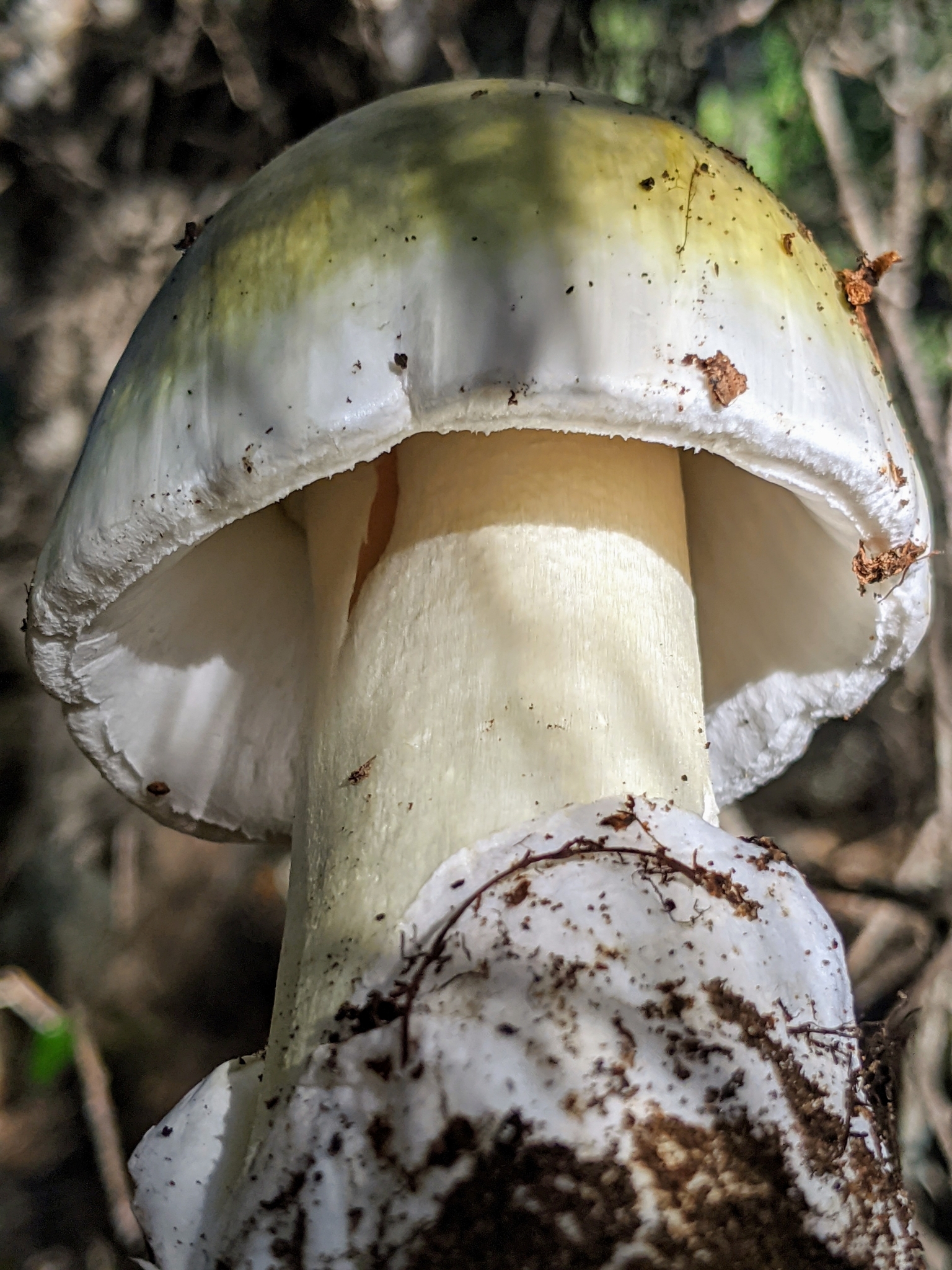
Source-labeled Amanita phalloides, California, 3 February 2020. Photograph by garmonb0zia (Alex Heyman), CC0 1.0. An individual specimen view; it cannot authenticate another mushroom or establish edibility.
This close view shows a pale greenish cap and stem, but not a complete stem base or a clear underside. Those missing views prevent a complete comparison.
Photograph source and attribution · CC0 1.0. Original image, unmodified. Species attribution comes from the source; no independent specimen authentication is claimed.

This limited photo pilot is not a complete atlas or an edibility decision aid. Do not eat a wild mushroom based on this photograph.
Limits and regional differences
- The immature egg stage is a high-risk comparison. Use an authenticated commercial crop; an unfamiliar wild collection needs a complete expert assessment.
- Educational comparison only. Neither this card, an illustration, a photograph, a spore-print colour nor a checklist establishes that a wild collection is safe to eat. A qualified local mycologist must assess uncertain material; do not taste an unknown fungus. Cooking does not reliably eliminate mushroom toxins.
Regional reading paths
These sourced notes describe cultivation, trade, food traditions or material history. A regional connection does not claim exclusive origin.
Asia
Cultivated: Thailand and other Southeast Asian countries.
Cooked cultivated mushroom in regional meals.
Identity & detailed reference
Identity
Volvariella volvacea (Bull.) Singer.
Ingredient details, preparation and research
Also known as: cao gu; Chinese straw mushroom; paddy straw mushroom
Source plant or material
Volvariella volvacea (Bull.) Singer; Authenticated cultivated fruiting bodies, fresh for cooking or commercially canned; immature commercial forms are not a guide to wild mushroom identification.
Fungal family: Volvariellaceae in recent phylogenetic classification; traditionally placed in Pluteaceae
Forms and route
Fresh cooked or commercially canned fruiting bodies. Immature whole mushrooms are a common commercial form; this is not guidance for identifying wild “eggs.”
Vitamins and minerals
Contains protein, carbohydrate and dietary fiber. Published dry-sample analyses cannot be treated as the composition of the same weight of fresh or canned mushroom; canned products may also contain added salt.
Absorption and preparation
Cook authenticated fresh mushrooms and follow the label for canned food. Research extraction using pressure or hot water does not establish a medicinal preparation or absorption advantage.
Traditional and reported uses
- Cultivated fruiting bodies are used as food in tropical and subtropical Asian cuisines.
- Cultivation provides an edible crop from agricultural materials and a livelihood-diversification option. This is an economic use, not an extra medicinal claim.
- A food-development study evaluated straw-mushroom broth and cracker formulations for composition and microbial quality. This is a manufactured-ingredient application; the study does not establish a household preservation method.
Contraindications and cautions
- Buy authenticated cultivated mushrooms: immature wild mushrooms can be fatally misidentified.
- Eat cooked; food-safety handling still matters with cultivated mushrooms.
- Canned products should be handled according to their label after opening.
- This card is not a foraging identification guide. Unknown wild mushrooms should not be eaten.
Identity, fungal material and preparation
Volvariella volvacea (Bull.) Singer. Authenticated cultivated fruiting bodies, fresh for cooking or commercially canned; immature commercial forms are not a guide to wild mushroom identification. Cook authenticated fresh mushrooms and follow the label for canned food. Research extraction using pressure or hot water does not establish a medicinal preparation or absorption advantage.
Constituents and food context
Food analyses identify carbohydrate, protein and fiber, including polysaccharide-rich fractions. Extract composition changes with processing. Contains protein, carbohydrate and dietary fiber. Published dry-sample analyses cannot be treated as the composition of the same weight of fresh or canned mushroom; canned products may also contain added salt.
Traditional uses and evidence boundaries
Food history, crop production and food-development research explain the documented uses. Nutrient composition is food information, not evidence for treating disease.
Safety and product distinctions
Buy authenticated cultivated mushrooms: immature wild mushrooms can be fatally misidentified. Eat cooked; food-safety handling still matters with cultivated mushrooms. Canned products should be handled according to their label after opening.
Entry sources
- Chang, Economic Botany 1977: origin of straw-mushroom cultivation (FAO AGRIS record)
- Chinese edible-fungi cultivation history, Mycosphere 16 (2025)
- FAO: straw mushroom cultivation for livelihood diversification
- Nutritional and Medicinal Value of Specialty Mushrooms, review
- Vizzini et al.: revised Agaricales classification and Volvariellaceae, 2024
- Primary study: straw-mushroom composition and polysaccharide extraction, 2023
- Primary study: straw-mushroom broth and crackers, 2025
Reference entry 217 · Recorded content review: 2026-10-08 · Review scope and dates