


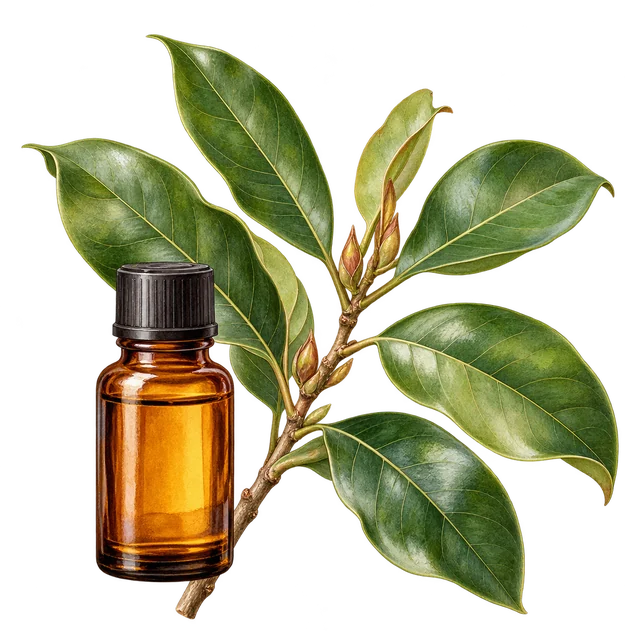
Key cautions
- Do not swallow essential oil or apply it undiluted to skin, eyes or mucous membranes.
- Keep concentrated oils away from children; fragrance exposure can irritate sensitive people.
- Historical conservation reports do not establish that a present shipment is legally and sustainably sourced.
What’s inside
Linalool is often prominent, but studies find chemical variation among sampled populations and plant materials.
Uses in brief

- Perfumery material
- Leaf-based production research
History, folklore and reported uses
History, folklore and traditional uses
The material is associated with the Brazilian Amazon, with rosewood trade names also recorded in the Guianas. This is a regional commercial-botanical connection, not permission to appropriate ritual claims or ignore conservation.
Traditional, historical and reported uses
- Perfumery material
Food or household practiceWhy this label?
The source documents an aromatic or manufacturing material, without establishing therapeutic benefit.
Embrapa documents rosewood’s importance as an aromatic oil and describes pressure from destructive harvesting. The supported use is a fragrance material, not a home remedy.
- Leaf-based production research
Mixed/contextual sourcesWhy this label?
Conservation and production research concerns a material supply chain, not clinical efficacy.
Conservation-oriented research explores leaf and branch material as alternatives to destructive extraction. Such production approaches still need verifiable management and supply-chain controls.
2 bounded uses; regional records do not establish treatment effects.
Historical-use additions reviewed 2026-10-09
Regional reading paths
These sourced notes describe cultivation, trade, food traditions or material history. A regional connection does not claim exclusive origin.
South America
native and distilled; Brazil; source also documents the Guianas
Perfumery material; conservation-conscious traceability essential.
Identity & detailed reference
Identity
Aniba rosaeodora; volatile essential oil from identified Aniba rosaeodora material; distinguish leaf/twig versus wood distillates and unrelated timber species called rosewood.
Ingredient details, preparation and research
Also known as: Aniba rosaeodora
Source plant or material
Aniba rosaeodora
Plant family / material: Lauraceae
Forms and route
Traceable perfumery distillate and finished fragrance products; no culinary-oil or tea use is implied.
Vitamins and minerals
Essential oil is not a nutrient food or a source of dietary fat comparable to seed oils. No ingestion or nutritional serving is recommended.
Absorption and preparation
Volatility, skin exposure and swallowing are different routes. A pleasant aroma does not prove safe absorption or a calming clinical effect.
Practical preparation
Use only a finished product for its labeled purpose. Verify botanical identity and supplier traceability; do not distill harvested wood or formulate a skin product from this card.
Traditional and reported uses
- Perfumery material
- Leaf-based production research
Contraindications and cautions
- Do not swallow essential oil or apply it undiluted to skin, eyes or mucous membranes.
- Keep concentrated oils away from children; fragrance exposure can irritate sensitive people.
- Historical conservation reports do not establish that a present shipment is legally and sustainably sourced.
Variation and laboratory evidence
Chemical/genetic research finds differences between populations. Other experiments test biological activity in vitro, which cannot establish treatment of infection or safe ingestion in humans.
Evidence limits
A fragrance and sourcing reference. No clinical efficacy, legal-trade certification, human dose or DIY topical concentration is established.
Entry sources
- Embrapa: Aniba rosaeodora in Floresta Nacional dos Tapajós
- Embrapa repository: Sustainable rosewood use in Amazonia
- Chemical and genotypic variation of Amazonian rosewood
- Aniba rosaeodora oil chemistry and laboratory activity
- Poison Control: Essential oils can be poisonous when misused
Reference entry 444 · Recorded content review: 2026-10-09 · Review scope and dates