


Key cautions
- Do not eat cosmetic oil or assume a handmade batch meets food-quality criteria.
- Do not use the oil as sun protection.
What’s inside
Triglycerides, carotenoids and tocopherols; free fatty acids and oxidation markers help characterize quality.
Uses in brief

- Food ingredient
- Natural coloring ingredient
History, folklore and reported uses
History, folklore and traditional uses
Buriti is connected with Brazilian Cerrado and Amazonian livelihoods; the Peruvian fruit name aguaje refers to the same palm species. The extracted-oil card is kept separate from the fruit-food card.
Traditional, historical and reported uses
- Food ingredient
Food or household practiceWhy this label?
The cited material is a specified culinary ingredient or beverage, with its own preparation limits; no medical effect is inferred.
Embrapa’s study evaluates oil produced by a northern Minas Gerais family-farmer cooperative. Its quality findings relate to those processed batches rather than all buriti oil.
- Natural coloring ingredient
Laboratory/animal researchWhy this label?
The cited material is a specified culinary ingredient or beverage, with its own preparation limits; no medical effect is inferred.
The same research identifies potential use as a food coloring because of the oil’s carotenoid content. Suitability still depends on product quality and the food’s actual formulation.
2 bounded uses; regional records do not establish treatment effects.
Historical-use additions reviewed 2026-10-09
Regional reading paths
These sourced notes describe cultivation, trade, food traditions or material history. A regional connection does not claim exclusive origin.
South America
native and processed; Brazil, Cerrado
Fruit-derived fixed oil; verify intended product grade.
Identity & detailed reference
Identity
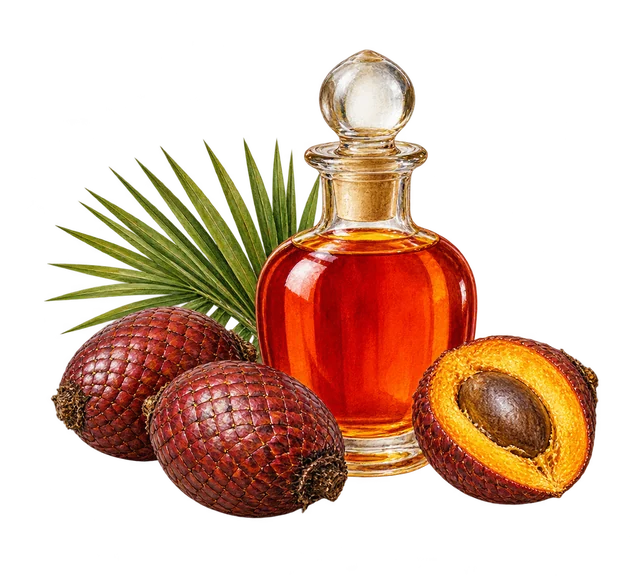
Mauritia flexuosa; fixed oil extracted from Mauritia flexuosa fruit pulp; not the entire aguaje/buriti fruit or a volatile essential oil.
Ingredient details, preparation and research
Also known as: Mauritia flexuosa
Source plant or material
Mauritia flexuosa
Plant family / material: Arecaceae
Forms and route
Qualified food oil, manufacturing ingredient and separately labeled cosmetic oil; grades are not interchangeable.
Vitamins and minerals
Oil lacks the fruit pulp’s complete fiber and water matrix. No universal vitamin A amount is assigned from its orange color or a single analytical batch.
Absorption and preparation
Carotenoids in an oil matrix are not proof of a superior clinical effect. Animal supplementation outcomes cannot establish human nutrient requirements or medical dosing.
Practical preparation
Use a food-grade product only for food and follow storage instructions. Keep closed and protected from heat and light; do not use spoiled or rancid oil.
Traditional and reported uses
- Food ingredient
- Natural coloring ingredient
Contraindications and cautions
- Do not eat cosmetic oil or assume a handmade batch meets food-quality criteria.
- Do not use the oil as sun protection.
Quality is part of identity
The study measured fatty-acid composition, pigments and stability, and highlighted free-fatty-acid control. Separate animal-model work does not turn this food technology evidence into human treatment proof.
Evidence limits
No medicinal dose or universal nutrient amount is inferred. Food-quality, storage and route specifications take precedence over general claims about natural oils.
Entry sources
- Embrapa: Quality and stability of buriti derivatives from the Cerrado
- Buriti pulp-oil characterization and animal-model supplementation
- Buriti products evaluated in vitro and ex vivo
Reference entry 442 · Recorded content review: 2026-10-09 · Review scope and dates