


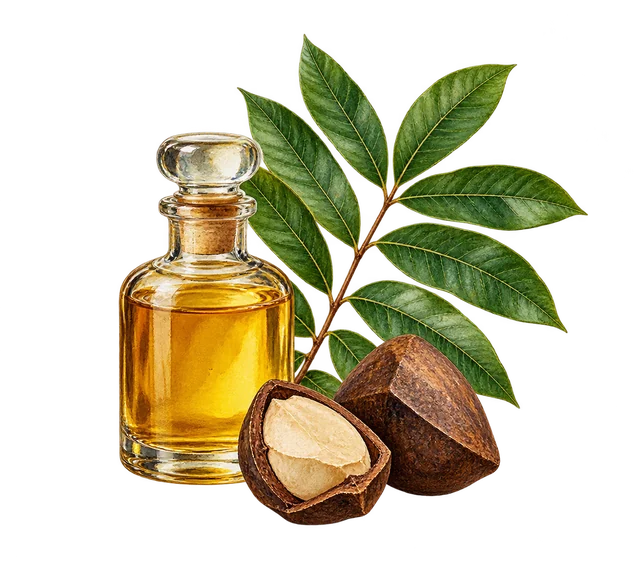
Key cautions
- Do not swallow cosmetic or unqualified andiroba oil
- Do not use homemade oil as infection treatment or as sole mosquito protection where disease transmission is a concern.
What’s inside
Seed lipids and characteristic non-fat components including limonoids; extraction and source affect the resulting product.
Uses in brief

- Traditional external material
- Documented repellent tradition
History, folklore and reported uses
History, folklore and traditional uses
Embrapa documents community-managed seed collection and oil extraction in Parintins, Amazonas. That particular production setting should be credited without inventing one uniform Amazonian recipe or medical system.
Traditional, historical and reported uses
- Traditional external material
Traditional accountWhy this label?
Source documents this specific material, culinary use or attributed practice; no clinical efficacy is inferred.
Primary research describes andiroba’s use in Brazilian traditional practice for skin-related and other complaints. The historical record is acknowledged without treating it as clinical proof or a wound-care instruction.
- Documented repellent tradition
Traditional accountWhy this label?
Source documents this specific material, culinary use or attributed practice; no clinical efficacy is inferred.
The toxicology paper records insect-repellent use among reported traditional applications. It does not establish duration of protection, a regulated repellent formulation or equivalence to tested public-health products.
2 bounded uses; regional records do not establish treatment effects.
Historical-use additions reviewed 2026-10-09
Regional reading paths
These sourced notes describe cultivation, trade, food traditions or material history. A regional connection does not claim exclusive origin.
South America
native and traditional processing; Brazil, Amazonas
Fixed seed oil used as a topical-product material.
Identity & detailed reference
Identity
Carapa guianensis; fixed seed oil of Carapa guianensis, andiroba or crabwood; not an essential oil or an ordinary culinary oil.
Ingredient details, preparation and research
Also known as: Carapa guianensis
Source plant or material
Carapa guianensis
Plant family / material: Meliaceae
Forms and route
Traceable seed oil and manufactured external-use products; bark, leaf decoctions and oral preparations are outside this scope.
Vitamins and minerals
This card makes no food or nutrient-serving recommendation. Fatty-acid analysis does not establish that an externally marketed oil is suitable to swallow.
Absorption and preparation
Topical exposure differs from oral exposure. Animal oral-toxicity studies cannot establish a safe human medicinal dose or safety on damaged skin.
Practical preparation
Prefer a finished product labeled for its intended external use and follow its directions. Do not improvise wound, eye, ear or oral treatments.
Traditional and reported uses
- Traditional external material
- Documented repellent tradition
Contraindications and cautions
- Do not swallow cosmetic or unqualified andiroba oil. Stop topical use if irritation or rash develops.
- Do not use homemade oil as infection treatment or as sole mosquito protection where disease transmission is a concern.
Experimental safety has limits
Laboratory genotoxicity work and animal oral-toxicity testing concern specified oils and test conditions. Neither makes all artisanal batches safe, nor establishes a human benefit or a DIY concentration.
Evidence limits
An external-material reference, not an ingestion, wound-healing or disease-prevention recommendation. Human efficacy and route-specific safety remain insufficiently established for broad claims.
Entry sources
- Embrapa: Extração do óleo de andiroba sob manejo comunitário em Parintins
- Antioxidant and genotoxic assessment of andiroba seed oils
- Acute and subacute toxicity of andiroba seed oil
Reference entry 441 · Recorded content review: 2026-10-09 · Review scope and dates