


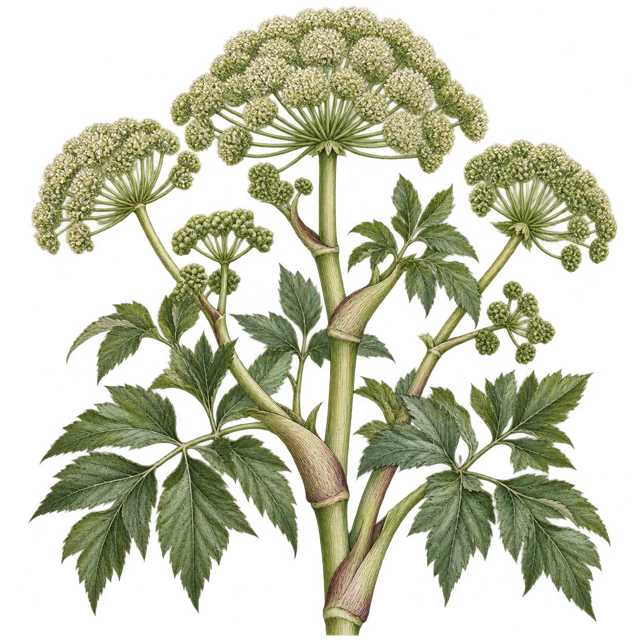
Key cautions
- For medicinal use: avoid in pregnancy; seek professional advice with breastfeeding or peptic ulcers.
- Contact can cause photosensitive dermatitis; medicinal products also carry sunlight/UV precautions.
What’s inside
Root contains aromatic volatile compounds and coumarins, including furanocoumarins. Analyses of the separated root oil identify pinenes and phellandrenes; oil profiles do not describe the whole stem or every extract.
Uses in brief

- Candied stems for confectionery and cake decoration.
- Traditional herbal records for digestive and respiratory complaints; evidence is preparation-specific.
- Architectural garden plant; roots are also a source material for fragrance and flavor extracts.
History, folklore and reported uses
History, folklore and traditional uses
Angelica moved between the confectioner’s kitchen and the herbalist’s shelves. Kew records the candied stems associated with Niort in western France, while its tall flowering form also made it an ornamental. Those stem uses are distinct from the dried underground parts and other materials found in medical preparations.
Its name also carried a protective religious story: Kew recounts the belief that an archangel revealed the plant’s virtues. A firmer documentary link comes from the College of Physicians’ London advice of 1665, which named angelica among personal aromatics. This records an intended plague precaution, not successful protection.
Traditional, historical and reported uses
- Candied stems and culinary decoration
Food or household practiceWhy this label?
The claim documents candied stems and culinary decoration as a culinary, craft, gardening, or practical material use; it reports neither a treatment outcome nor measured nutrient content.
The cultivated stems are documented confectionery material, particularly as green decorations for cakes and trifles. This is a food tradition, separate from root medicines.
- Garden structure
Food or household practiceWhy this label?
The claim documents garden structure as a culinary, craft, gardening, or practical material use; it reports neither a treatment outcome nor measured nutrient content.
RHS documents garden angelica in herb and cottage gardens. Its tall stems and rounded flower heads give it an ornamental role as well as a culinary one.
- Traditional digestion and flatulence remedies
Traditional accountWhy this label?
The monograph explicitly records traditional digestive use for named preparations, not a clinical cure claim.
Health Canada records traditional herbal use for digestion and flatulent dyspepsia. Its monograph covers named dry plant parts and oral preparations, not confectionery or a clinical cure claim.
- Traditional cough and fever records
Traditional accountWhy this label?
The monograph records expectorant, sweating, and urinary traditions rather than controlled treatment outcomes.
The same monograph records expectorant, sweating and diuretic traditions. These are documented historical purposes rather than advice to treat infection or induce sweating at home.
- Root as a fragrance and flavor source
Food or household practiceWhy this label?
The claim documents root as a fragrance and flavor source as a culinary, craft, gardening, or practical material use; it reports neither a treatment outcome nor measured nutrient content.
The root supplies aromatic extracts used in flavor and fragrance industries. This is source-plant context: the separated oil is not the same product as the dried herb or candied stem.
- London plague precautions, 1665
Historical recordWhy this label?
A dated 1665 College of Physicians recommendation is identified through RCP historical interpretation; no preventive efficacy follows.
The College of Physicians named angelica among personal aromatics; the RCP identifies the garden species as A. archangelica. No preventive benefit was established.
Historical-use additions reviewed 2026-10-08
Story sources
- Kew: Angelica archangelica, species profile and uses
- RHS: Angelica growing guide
- Health Canada: Angelica – Angelica archangelica monograph, 2025
- Pharmacological and phytochemical insights on pancreatic beta-cell modulation by Angelica roots (2024)
- Linking weed control techniques to anti-inflammatory potential: Angelica archangelica root essential-oil profiles (2024)
- Royal College of Physicians: Plague remedies from the garden
- College of Physicians: Certain necessary directions (1665), Wellcome digitized copy
- CDC: Clinical Care of Plague
Regional reading paths
These sourced notes describe cultivation, trade, food traditions or material history. A regional connection does not claim exclusive origin.
Europe
Native and culinary: northern European source plant; Kew documents candied stems from Niort, France, and selected sweet-stem angelica from Voss, Norway.
Cultivated tender stems in confectionery and regional foods. Root medicines and distilled oil are different preparations.
Identity & detailed reference
Identity
European garden angelica, Angelica archangelica. Candied stem, dried root/rhizome, leaf, seed and distilled oil are distinct preparations. This entry is not dong quai (Angelica sinensis).
Ingredient details, preparation and research
Also known as: European angelica; Garden angelica; Archangel; Angelique
Source plant or material
Angelica archangelica; stems in confectionery, and separately identified leaf, root/rhizome and seed in herbal records.
Plant family / material: Apiaceae (carrot family)
Forms and route
Candied stems; cultivated ornamental plant; dried root/rhizome, leaf and seed; labeled oral herbal preparations. Root essential oil is a concentrated derivative and is not interchangeable with the herb.
Vitamins and minerals
Candied stems are confectionery with added sugar; their label and portion determine nutritional intake. Root, leaf and extract products do not share a single food nutrition profile.
Absorption and preparation
A candied stem is eaten as confectionery. Oral herbal extracts differ by plant part and extraction; neither food use nor analysis of distilled oil establishes an absorption-enhancing combination or dose.
Traditional and reported uses
- Candied stems for confectionery and cake decoration.
- Traditional herbal records for digestive and respiratory complaints; evidence is preparation-specific.
- Architectural garden plant; roots are also a source material for fragrance and flavor extracts.
Contraindications and cautions
- For medicinal use: avoid in pregnancy; seek professional advice with breastfeeding or peptic ulcers.
- Contact can cause photosensitive dermatitis; medicinal products also carry sunlight/UV precautions.
- Do not substitute dong quai, an unidentified wild umbellifer, or undiluted essential oil for garden angelica.
Species and plant part
European angelica is an Apiaceae herb. Keep the stem confection, herbal plant parts and concentrated derivatives separate; A. sinensis is a different species.
Chemistry is not efficacy
Root chemical research identifies volatile compounds and coumarins. A constituent list or laboratory result cannot establish that a household preparation treats disease.
Medicinal safety scope
The Canadian monograph is for adult oral herbal products, excludes food-like dosage forms, and cautions about pregnancy, breastfeeding, ulcers and UV exposure. Persistent or worsening symptoms require assessment.
Historical plague claims and present care
No historical plant or material here is established to prevent or cure plague. Suspected plague requires urgent medical assessment and prompt antibiotics.
Entry sources
- Kew: Angelica archangelica, species profile and uses
- RHS: Angelica growing guide
- Health Canada: Angelica – Angelica archangelica monograph, 2025
- Pharmacological and phytochemical insights on pancreatic beta-cell modulation by Angelica roots (2024)
- Linking weed control techniques to anti-inflammatory potential: Angelica archangelica root essential-oil profiles (2024)
- Royal College of Physicians: Plague remedies from the garden
- College of Physicians: Certain necessary directions (1665), Wellcome digitized copy
- CDC: Clinical Care of Plague
Reference entry 232 · Recorded content review: 2026-10-08 · Review scope and dates