


Key cautions
- Emmer, spelt and einkorn are wheats and contain gluten. They are unsuitable for celiac disease and should not be treated as safe alternatives for wheat allergy.
- Check what farro means on the package and whether the grain is whole, semi-pearled or pearled; cooking time and composition differ.
What’s inside
Starch, protein including gluten, fiber, B vitamins and minerals; amounts depend on species, growing conditions, hull removal and polishing.
Uses in brief

- Modern emmer or spelt as cooked kernels, porridge grain or flour, with the purchased species identified.
- Historical comparison for ancient hulled-wheat foods, including bread and brewing.
In the King James Bible
In the King James Bible
Probable botanical identification
The Gutenberg KJV spelling rie is preserved in Exodus 9:32. This word and fitches in Ezekiel 4:9 translate an ancient grain term often rendered spelt; emmer is a leading botanical candidate. Neither modern Secale rye nor one modern spelt variety is certain. Ezekiel’s grain fitches are not Isaiah’s spice fitches, and the ration bread is part of a siege sign-act.
But the wheat and the rie were not smitten: for they were not grown up.
Exodus 9:32 (KJV)
Take thou also unto thee wheat, and barley, and beans, and lentiles, and millet, and fitches, and put them in one vessel, and make thee bread thereof, according to the number of the days that thou shalt lie upon thy side, three hundred and ninety days shalt thou eat thereof.
Ezekiel 4:9 (KJV)
Scripture and identification sources
Words & their stories
WORDS & THEIR STORIES
The name behind the KJV
Biblical Hebrew · Exodus 9:32 (KJV)
וְהַכֻּסֶּמֶתwəhakkussemet
The grain rendered “rie” in the historical KJV spelling.
Dictionary form: כֻּסֶּמֶת · kussemet
The opening elements mean “and the.” The noun is singular here.
Biblical Hebrew · Ezekiel 4:9 (KJV)
וְכֻסְּמִיםwəkussəmīm
The grain rendered “fitches” among the bread ingredients.
Dictionary form: כֻּסֶּמֶת · kussemet
This is a plural form of the same grain name, preceded by “and.”
What the language reveals
Two English renderings, one Hebrew grain
KJV “rie” in Exodus and grain “fitches” in Ezekiel represent the same Hebrew lexeme.
Why emmer remains a candidate
The older BDB lexicon calls the grain spelt; botanist Michael Zohary argues for emmer. A dictionary gloss alone cannot settle the modern species.
An ancient hulled-wheat identification is probable; modern rye and a particular modern spelt variety are not certain. This grain term must not be confused with Isaiah’s spice “fitches.”
History, folklore and reported uses
History, folklore and traditional uses
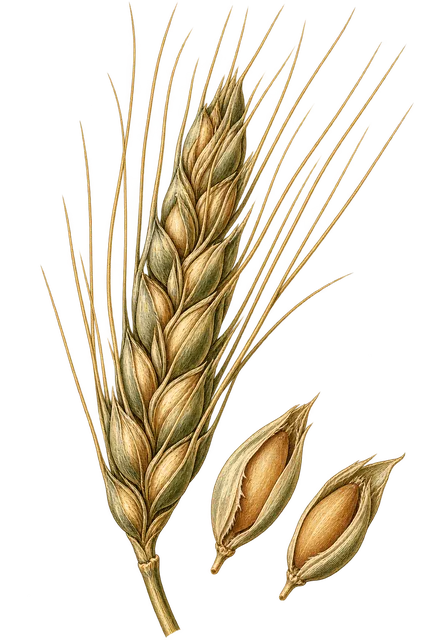
A small spelling can conceal a large botanical problem. The KJV’s rie in Exodus and fitches in Ezekiel represent a grain term long rendered spelt, while archaeobotanical scholarship gives emmer a prominent place in the ancient crop world. Both are hulled wheats, with kernels that need freeing from their enclosing husks. That practical labor mattered to the people pounding, grinding and storing them. It also explains why a modern bag marked farro needs a clearer identity than a romantic claim that it is simply the grain of the Bible.
Hulled wheats belong to several histories rather than one unbroken recipe. Emmer appears in Egyptian bread and brewing evidence; European communities also cooked older wheats as porridge. Today, the named emmer crop of Monteleone di Spoleto has its own protected identity and local food traditions. These examples illuminate the versatility of the grain family, while leaving the translation question open. Ancient reputation does not make these wheats nutritionally identical or suitable for people avoiding gluten.
Traditional, historical and reported uses
- Bread from hulled wheat
Food or household practiceWhy this label?
Hulled wheats used in bread and cereal-food traditions.
Archaeological and agricultural literature documents hulled wheats in bread traditions. The Green Museum places older wheats within a long Northern European repertoire of bread and boiled cereal foods.
- Egyptian emmer brewing
Food or household practiceWhy this label?
Specific reconstructed emmer beer-making practice.
The British Museum’s reconstruction used emmer and drew on grain identified at the Amarna brewery excavations. This is a specific emmer example, not proof that every ancient beer used the same wheat.
- Porridge and groats
Food or household practiceWhy this label?
Boiled grain dishes, porridge and groats.
The hulled-wheat proceedings discuss the Roman cereal foods puls and alica. Boiling prepared grain is a distinct use from baking and preserves a different texture and cooking method.
- A local feast and food identity
Food or household practiceWhy this label?
Regional feast food and named emmer-crop tradition.
Regional accounts associate Monteleone di Spoleto’s farro with the feast of Saint Nicholas. Its PDO specification identifies a local Triticum dicoccum emmer crop, showing why a named regional tradition is more precise than the broad market word farro.
- Emmer as livestock fodder
Food or household practiceWhy this label?
Regional agricultural use as livestock fodder.
Slow Food’s regional account identifies Kars Kavılca wheat as emmer and records its cultivation for fodder. This agricultural use is separate from bread and bulgur traditions and does not settle the grain identity in every KJV passage.
- Cereal-processing residues as fuel
Food or household practiceWhy this label?
Practical use of crop-processing residues as fuel.
AERA’s archaeobotanical account of Kom el-Fahkry, Egypt, identifies cereal-processing residues associated with emmer and barley among fuel remains. Straw, chaff and harvested field plants supplied fuel, a secondary crop use distinct from grain foods.
The documented contexts include bread, brewing, boiled grain, regional ritual, livestock fodder and processing residues used as fuel. These records describe food, cultural and material practices rather than medicinal indications.
Historical-use additions reviewed 2026-10-08
Story sources
- Padulosi, Hammer and Heller: Proceedings of the First International Workshop on Hulled Wheats
- The Green Museum: Living cultural heritage, cereals
- British Museum: A sip of history, ancient Egyptian beer
- Umbria regional tourism: Farro di Monteleone di Spoleto DOP
- European Commission: Farro di Monteleone di Spoleto product specification, Official Journal C269, 7 July 2021
- FAO AGRIS: Hulled wheats, proceedings of the First International Workshop on Hulled Wheats
- Slow Food Foundation: Kars Kavılca wheat
- Ancient Egypt Research Associates: Plants from the past
Identity & detailed reference
Identity
An identity-focused card for the ancient grain translated rie/rye or fitches in relevant KJV passages. An ancient hulled wheat, especially emmer, is a leading identification; the text does not securely establish modern rye (Secale cereale) or one modern spelt cultivar.
Ingredient details, preparation and research
Also known as: Emmer candidate; Spelt in many translations; KJV rie / rye; KJV grain fitches; Farro (a variable modern trade name)
Source plant or material
Triticum turgidum subsp. dicoccum (emmer); Triticum aestivum subsp. spelta (spelt), a related but distinct comparison; An identity-focused card for the ancient grain translated rie/rye or fitches in relevant KJV passages. An ancient hulled wheat, especially emmer, is a leading identification; the text does not securely establish modern rye (Secale cereale) or one modern spelt cultivar.
Plant family / material: Poaceae (grass family)
Forms and route
Modern emmer or spelt kernels, flour and cooked grain foods. The hull must be removed for food; further pearling removes additional layers. Farro labels may refer to different wheats. The nutrient reference is explicitly modern cooked spelt, not measured biblical emmer.
Vitamins and minerals
Comparison only: 1/2 US cup modern cooked spelt, about 97 g, provides approximately 123 kcal, 5.3 g protein, 25.6 g carbohydrate, 3.8 g fiber, 1.6 mg iron and 48 mg magnesium. Calculated from USDA SR28 NDB 20141 (1 cup = 194 g; pages 401–402). USDA identifies this food as Triticum aestivum subsp. spelta. It is not a nutrient analysis of the uncertain biblical grain, ancient emmer, every farro product or an Ezekiel-style loaf.
Absorption and preparation
Follow the label for the actual species and degree of pearling. Cooked kernels pair well with lentils and vegetables; vitamin C in the same meal can help nonheme-iron uptake. Soaking or fermentation effects depend on the process and do not remove gluten. No added oil or spice is necessary to unlock the grain’s nutrients.
Traditional and reported uses
- Modern emmer or spelt as cooked kernels, porridge grain or flour, with the purchased species identified.
- Historical comparison for ancient hulled-wheat foods, including bread and brewing.
Contraindications and cautions
- Emmer, spelt and einkorn are wheats and contain gluten. They are unsuitable for celiac disease and should not be treated as safe alternatives for wheat allergy.
- Check what farro means on the package and whether the grain is whole, semi-pearled or pearled; cooking time and composition differ.
- Cook flour and dough thoroughly; ancient-grain flour is not inherently safe to eat raw.
Similar items and how they compare
- Wheat
Emmer and spelt belong within the wheat crop group.
This card isolates a disputed ancient term rather than making all biblical wheat into one hulled species.
- Black cumin seed (KJV fitches candidate)
The KJV uses the English word fitches in more than one context.
Isaiah’s spice-seed term and Ezekiel’s grain term are different Hebrew words and should not be merged.
What the biblical words can establish
The historical lexicons connect the Hebrew grain word kussemeth with spelt and the KJV renderings fitches and rie. Botanical identifications are less secure than that lexical link. Emmer is an important candidate; this card does not equate it with Secale rye or Isaiah’s separate Nigella-type spice term.
Species and processing are not marketing details
Emmer, spelt and einkorn are related wheats but not one species. A protected emmer product can have a precise identity; generic farro can be less clear. Hulled does not mean that the inedible husk is meant to be eaten.
Gluten boundary
Ancient wheats still contain gluten and do not become appropriate for celiac disease through home soaking, sprouting or ordinary fermentation. Wheat allergy requires its own avoidance advice.
Food portion and nutrition
Comparison only: 1/2 US cup modern cooked spelt, about 97 g, provides approximately 123 kcal, 5.3 g protein, 25.6 g carbohydrate, 3.8 g fiber, 1.6 mg iron and 48 mg magnesium. Calculated from USDA SR28 NDB 20141 (1 cup = 194 g; pages 401–402). USDA identifies this food as Triticum aestivum subsp. spelta. It is not a nutrient analysis of the uncertain biblical grain, ancient emmer, every farro product or an Ezekiel-style loaf.
Preparation and meal pairing
Follow the label for the actual species and degree of pearling. Cooked kernels pair well with lentils and vegetables; vitamin C in the same meal can help nonheme-iron uptake. Soaking or fermentation effects depend on the process and do not remove gluten. No added oil or spice is necessary to unlock the grain’s nutrients.
Evidence limits
- The ancient species is unresolved; modern cooked spelt is a clearly labeled comparison only.
- The heritage examples span distinct times and places and are not all claimed as biblical practices.
- The hulled-wheat proceedings were checked through indexed primary-text excerpts and the FAO bibliographic record; the linked CiteSeer full PDF could not be retrieved in this review.
Entry sources
- Brown-Driver-Briggs / Strong’s lexicon: Hebrew 3698, kussemeth
- Michael Zohary: Plants of the Bible
- Padulosi, Hammer and Heller: Proceedings of the First International Workshop on Hulled Wheats
- The Green Museum: Living cultural heritage, cereals
- British Museum: A sip of history, ancient Egyptian beer
- Umbria regional tourism: Farro di Monteleone di Spoleto DOP
- European Commission: Farro di Monteleone di Spoleto product specification, Official Journal C269, 7 July 2021
- NIDDK: Eating, Diet, & Nutrition for Celiac Disease
- FDA: Food Allergens/Gluten-Free Guidance Documents & Regulatory Information
- FDA: Handling Flour Safely, What You Need to Know
- USDA Standard Reference 28 (2015): cereal grains and pasta, food group 20
- NIH Office of Dietary Supplements: Iron, Health Professional Fact Sheet
- King James Bible: Project Gutenberg eBook 10
- FAO AGRIS: Hulled wheats, proceedings of the First International Workshop on Hulled Wheats
- Slow Food Foundation: Kars Kavılca wheat
- Ancient Egypt Research Associates: Plants from the past
Reference entry 148 · Recorded content review: 2026-10-06 · Review scope and dates