


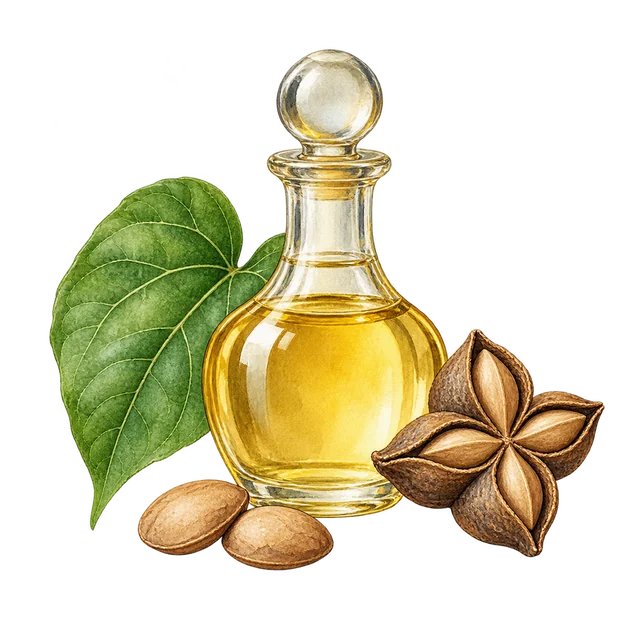
Key cautions
- Cosmetic-grade oil and experimental extraction products are not food substitutes.
What’s inside
Triglycerides rich in unsaturated fatty acids, including alpha-linolenic and linoleic acids; profile and quality depend on the batch and processing.
Uses in brief

- Culinary fixed oil
- Oilseed processing
History, folklore and reported uses
History, folklore and traditional uses
Sacha inchi production is rooted in Amazonian agriculture, including Peru. Keeping oil separate from roasted seed preserves useful material distinctions without counting every package format as a new plant.
Traditional, historical and reported uses
- Culinary fixed oil
Food or household practiceWhy this label?
The cited material is a specified culinary ingredient or beverage, with its own preparation limits; no medical effect is inferred.
Peruvian research and promotion records characterize oils made from seeds collected in Amazonian departments. The separated oil is a culinary ingredient when supplied to food standards.
- Oilseed processing
Food or household practiceWhy this label?
The cited material is a specified culinary ingredient or beverage, with its own preparation limits; no medical effect is inferred.
IIAP/INIA documents genetic and agronomic variation in seed-oil production. Pressing leaves a different residual material, which must not automatically be considered ready-to-eat protein flour.
2 bounded uses; regional records do not establish treatment effects.
Historical-use additions reviewed 2026-10-09
Regional reading paths
These sourced notes describe cultivation, trade, food traditions or material history. A regional connection does not claim exclusive origin.
South America
cultivated and processed; Peru
Food-grade fixed seed oil.
Identity & detailed reference
Identity
Plukenetia volubilis; fixed oil separated from Plukenetia volubilis seeds; not an essential oil, whole seed or raw press cake.
Ingredient details, preparation and research
Also known as: Plukenetia volubilis
Source plant or material
Plukenetia volubilis
Plant family / material: Euphorbiaceae
Forms and route
Food-grade pressed or refined oil, labeled culinary blends and separately formulated supplements or cosmetics.
Vitamins and minerals
The oil supplies fat and energy but does not retain the whole seed’s protein and fiber. Plant alpha-linolenic acid is not nutritionally identical to preformed EPA or DHA.
Absorption and preparation
Conversion of plant fatty acids is not complete equivalence to marine omega-3 products. No special absorption-enhancing mixture or medicinal dose is established here.
Practical preparation
Use only oil labeled for food in meals and follow its storage and heating directions. Protect from light, heat and air; discard rancid oil.
Traditional and reported uses
- Culinary fixed oil
- Oilseed processing
Contraindications and cautions
- Cosmetic-grade oil and experimental extraction products are not food substitutes.
Seed safety does not describe every derivative
The primary safety assessment distinguishes seeds, leaves and their products. The intended route, manufacturing controls and exact ingredient remain necessary when evaluating an oil, snack or supplement.
Evidence limits
No clinical treatment benefit or dosing schedule is adopted. Food, supplement and topical products require their own specifications and route-specific assessment.
Entry sources
- PROMPERÚ: Química del aceite de sacha inchi
- IIAP/INIA: El cultivo del sacha inchi en la Amazonía
- Safety assessment of Plukenetia volubilis seeds, leaves and products
Reference entry 440 · Recorded content review: 2026-10-09 · Review scope and dates