


Key cautions
- Avoid the product if allergic; a different plant family does not guarantee tolerance.
- Do not eat unidentified Dipteryx seeds or treat research extracts as ordinary food.
What’s inside
Protein, unsaturated lipids, fiber and phenolic compounds have been measured in roasted kernels.
Uses in brief

- Roasted kernels
- Food-ingredient development
History, folklore and reported uses
History, folklore and traditional uses
The baru tree is associated with Brazil’s Cerrado. Embrapa highlights possibilities to use more of the harvested fruit and support agroextractive food chains; this should not be turned into a claim that commercial consumption alone guarantees conservation.
Traditional, historical and reported uses
- Roasted kernels
Food or household practiceWhy this label?
Source documents this specific material, culinary use or attributed practice; no clinical efficacy is inferred.
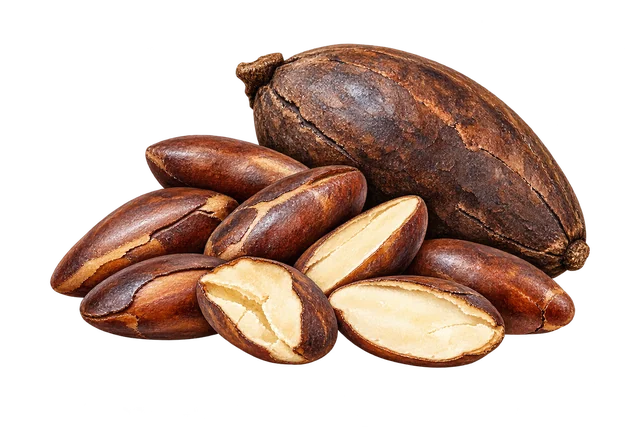
Primary research describes roasted baru nuts consumed and produced in Brazil. Their culinary identity is the prepared seed rather than the woody fruit shell.
- Food-ingredient development
Laboratory/animal researchWhy this label?
This use entry describes a laboratory, pilot-scale or nonhuman experiment; it does not establish an ordinary household practice, clinical benefit or safe home protocol.
Embrapa investigates use of the pulp remaining after kernel extraction for new food ingredients. This is a separate fraction and a research application, not proof that any raw residue is ready to eat.
2 bounded uses; regional records do not establish treatment effects.
Historical-use additions reviewed 2026-10-09
Regional reading paths
These sourced notes describe cultivation, trade, food traditions or material history. A regional connection does not claim exclusive origin.
Identity & detailed reference
Identity
Dipteryx alata; the processed edible seed kernel of Dipteryx alata, sold as baru nut or almond; not a botanical almond.
Ingredient details, preparation and research
Also known as: Dipteryx alata
Source plant or material
Dipteryx alata
Plant family / material: Fabaceae
Forms and route
Roasted kernels, chopped seed foods and labeled ingredients. Fruit pulp and separated oil are distinct materials.
Vitamins and minerals
A specific laboratory sample does not establish the composition of every commercial snack. Salt, sugar and chocolate coatings belong to the finished product.
Absorption and preparation
In-vitro antioxidant or cell-growth assays are not measurements of absorption, disease prevention or cancer treatment from eating nuts.
Practical preparation
Use commercially prepared food-grade kernels. Store sealed away from heat and humidity and discard rancid, moldy or damaged products.
Traditional and reported uses
- Roasted kernels
- Food-ingredient development
Contraindications and cautions
- Avoid the product if allergic; a different plant family does not guarantee tolerance.
- Do not eat unidentified Dipteryx seeds or treat research extracts as ordinary food.
Laboratory outcomes need boundaries
The roasted-kernel study measured composition and tested extracts in antioxidant and cell assays. Those experiments do not establish an anticancer benefit of the snack or a medicinal dose.
Evidence limits
This is a food-form review, not a treatment recommendation. Composition and laboratory findings apply to the material actually studied; no medicinal dose, universal nutrient ranking or preservation guarantee is inferred.
Entry sources
- Embrapa: Baru
- Nutritional and chemical characterization of roasted baru nuts
- Embrapa: Food ingredients from baru processing residues
Reference entry 439 · Recorded content review: 2026-10-09 · Review scope and dates