


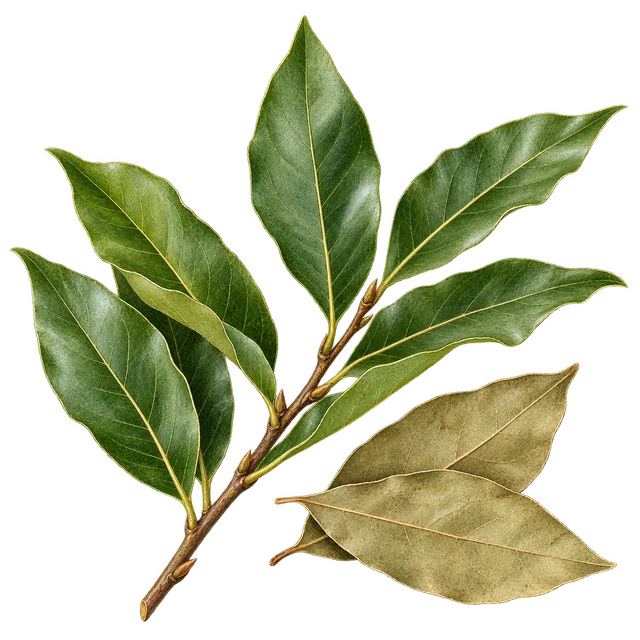
Key cautions
- Identify culinary Laurus nobilis; ornamental laurel may be poisonous.
- Remove whole leaves before serving.
- Bay-rum cosmetics and concentrated oils are not culinary leaves.
What’s inside
Aromatic volatile constituents provide flavor. No analyzed serving of a finished bay-leaf infusion is used here to support a vitamin, mineral or fiber claim.
NC State Extension Plant Toolbox: Laurus nobilis, identity and whole-leaf cautions · NC State Extension Plant Toolbox: Prunus laurocerasus, poisonous cherry laurel
Uses in brief

- Soups, stews and sauces
- Bouquet garni
- Laurel-wreath imagery in Greek material culture
History, folklore and reported uses
A leaf in the cooking pot
Fresh or dried culinary bay flavours slow-cooked foods, including soups, stews, gravies and sauces. RHS identifies it as a key leaf in bouquet garni, a collection of herbs used to flavour a dish and then removed. Lift out or strain whole leaves before serving.
Royal Horticultural Society: How to Grow Bay, culinary leaves and bouquet garni · University of Florida IFAS: Shopping for Health, Herbs and Spices
Laurel in Greek material culture
A Greek lidded container, an Attic pyxis, in the British Museum is dated about 420–400 BCE and depicts the mythological figure Harmonia holding a laurel wreath. The object records a cultural laurel motif without botanically identifying every ancient wreath.
British Museum: Attic pyxis 1893,1103.2, depicting a laurel wreath, circa 420–400 BCE
A different bay in Dominica
Emanuel Finn recalls helping his grandfather distill Pimenta racemosa leaves in La Plaine, Dominica, and describes local seasoning uses. This first-person Caribbean account belongs to West Indian bay, not the Mediterranean culinary Laurus nobilis of this card. Other plants also share the names bay or laurel, so their individual botanical identities matter.
Kew POWO: Pimenta racemosa, accepted name and Caribbean range · Emanuel Finn (2021): First-person account of bay-oil distillation in La Plaine, Dominica
Regional reading paths
These sourced notes describe cultivation, trade, food traditions or material history. A regional connection does not claim exclusive origin.
Europe
Cultivated and traditional processing: Mediterranean herb also grown in UK gardens.
Leaves flavour stocks and stews; remove whole leaves before serving.
Identity & detailed reference
Identity
The culinary leaves of true bay or bay laurel, Laurus nobilis. Caribbean West Indian bay, Pimenta racemosa, is a different myrtle-family tree; its leaves and bay-rum products are compared separately here, not merged with culinary laurel.
Ingredient details, preparation and research
Also known as: Bay laurel; Sweet bay; True laurel; Culinary laurel; Laurus nobilis
Source plant or material
Laurus nobilis L.
Plant family / material: Lauraceae
Forms and route
Fresh or dried food-grade leaves infused into dishes and removed before serving. Whole leaves, powders, essential oils and cosmetic bay-rum products are not interchangeable.
Vitamins and minerals
Bay is ordinarily infused in small amounts and the whole leaf is removed. A dried-leaf food table would not describe the amount transferred into a soup or sauce. No numerical nutrient values or nutrient-source tags are assigned to that infusion.
Absorption and preparation
No clinically established nutrient-absorption advantage is claimed for culinary bay. Extraction into a dish depends on the recipe, rather than on the nutrient content of a whole dried leaf.
Practical preparation
Use labeled food-grade leaves in a recipe. Keep them whole or in a removable herb bundle when practical, then remove the leaves and fragments before serving. Do not forage an ornamental hedge on the basis of this card.
Combination context
No required nutrient-absorption pairing is established.
Combination notes
Bay can accompany other cooking herbs in bouquet garni. The flavor combination does not establish a medicinal effect.
Traditional and reported uses
- Soups, stews and sauces
- Bouquet garni
- Laurel-wreath imagery in Greek material culture
Contraindications and cautions
- Use correctly identified culinary Laurus nobilis from a food source. Never substitute unidentified hedge or ornamental “laurel”; cherry laurel, Prunus laurocerasus, contains toxic cyanogenic compounds.
- Remove whole leaves and fragments before serving. They remain stiff and may cause choking or injury if swallowed.
- Bay-rum aftershave, cologne and essential oil are separate products. Do not drink cosmetics or use concentrated bay oil as a substitute for a culinary leaf.
- This card supplies no medicinal tea, oil or supplement dose. A historical use or pleasant aroma does not establish a treatment.
Similar items and how they compare
- West Indian bay, Pimenta racemosa
Shares the common name bay leaf.
A Caribbean myrtle-family species with separately documented leaf seasoning and bay-oil uses. It is not Laurus nobilis; culinary leaves do not make bay-rum cosmetics drinkable.
- Cherry laurel, Prunus laurocerasus
An ornamental with a laurel-like common name and leaves.
Its leaves, seeds and stems contain cyanogenic compounds. It must not be substituted in food.
- Bay essential oil and bay-rum toiletries
May have a bay aroma.
Concentrated oils and finished cosmetics have a different composition, purpose and exposure from a food-grade leaf.
Separate Caribbean bay from culinary laurel
Kew accepts Pimenta racemosa as a distinct species native from the Caribbean to Venezuela. USDA describes its leaves as a source of bay oil used in fragrance and flavoring industries. This comparison is not permission to interchange an unidentified leaf or cosmetic with food.
The concentrated-oil warning has a different scope
Health Canada’s 2024 bay-oil page concerns Pimenta racemosa oil. Its draft assessment raises concerns about certain DIY inhaled or skin-applied uses, while distinguishing those exposures from the food exposures assessed. This is not evidence that normal Laurus nobilis seasoning causes the same risk.
Identification and texture are practical safety issues
NC State distinguishes culinary bay from poisonous cherry laurel and warns that whole bay leaves can injure the mouth or digestive tract. Buy a known food ingredient; the artwork and leaf smell are not identification tests.
Evidence limits
The primary card covers Laurus nobilis leaves only. The Caribbean comparison preserves separate species and product identities. No safe medicinal dose, disease-treatment benefit or nutrient amount in an infusion was established.
Entry sources
- Royal Horticultural Society: How to Grow Bay, culinary leaves and bouquet garni
- NC State Extension Plant Toolbox: Laurus nobilis, identity and whole-leaf cautions
- NC State Extension Plant Toolbox: Prunus laurocerasus, poisonous cherry laurel
- University of Florida IFAS: Shopping for Health, Herbs and Spices
- Kew POWO: Pimenta racemosa, accepted name and Caribbean range
- USDA Forest Service: Pimenta racemosa var. racemosa species profile, p. 45
- Health Canada: Bay oil and your health, distinct Pimenta racemosa essential-oil exposure
- Emanuel Finn (2021): First-person account of bay-oil distillation in La Plaine, Dominica
- British Museum: Attic pyxis 1893,1103.2, depicting a laurel wreath, circa 420–400 BCE
Reference entry 273 · Recorded content review: 2026-10-09 · Review scope and dates