


Key cautions
- Barley contains gluten and is unsuitable for a gluten-free diet for celiac disease. Barley malt is also a relevant ingredient to check.
- Avoid if you have a diagnosed barley allergy; do not assume a product is safe just because it contains no wheat.
What’s inside
Starch, fiber including beta-glucans, modest protein, B vitamins and minerals. Hull removal, polishing, milling and malting change composition.
Uses in brief

- Cooked grain for soups, stews and grain bowls; flour or meal in breads and other cereal foods.
- A historical food and brewing grain; barley-water traditions belong to the history of food care, rather than a treatment dose.
In the King James Bible
In the King James Bible
Named material
The KJV explicitly names barley in Deuteronomy 8:8 and barley loaves in John 6:9. Hordeum vulgare is the conventional crop identification. The feeding narrative does not establish a medical benefit, recipe or ideal modern diet.
A land of wheat, and barley, and vines, and fig trees, and pomegranates; a land of oil olive, and honey;
Deuteronomy 8:8 (KJV)
There is a lad here, which hath five barley loaves, and two small fishes: but what are they among so many?
John 6:9 (KJV)
Scripture and identification sources
Words & their stories
WORDS & THEIR STORIES
The name behind the KJV
Biblical Hebrew · Deuteronomy 8:8 (KJV)
וּשְׂעֹרָהūśəʿōrāh
“And barley,” among the land’s crops.
Dictionary form: שְׂעֹרָה · śəʿōrāh
Ū- means “and”; the singular crop name is used collectively.
Koine Greek · John 6:9 (KJV)
κριθίνουςkrithínous
Made of barley, describing the five loaves.
Dictionary form: κρίθινος · kríthinos
An accusative masculine plural adjective agreeing with “loaves.” Checked in Scrivener’s 1894 Textus Receptus, a later reconstruction of the KJV’s Greek textual basis.
What the language reveals
Crop and prepared food
Deuteronomy names the crop; John uses an adjective identifying the material of the loaves.
A detail of harvest timing
Exodus 9:31 describes barley already in the ear when the hail strikes, contrasting it with the later crops in the following verse.
The barley identification is strong. Neither passage specifies a modern cultivar, milling method or bread recipe.
Language and identification bibliography
- Hebrew text: Deuteronomy 8:8 (Mechon-Mamre)
- Brown–Driver–Briggs: שְׂעֹרָה, barley (H8184; Bible Hub transcription)
- Greek text: John 6:9, Scrivener’s Textus Receptus 1894 (Bible Hub)
- Thayer’s Greek Lexicon: κρίθινος, made of barley (G2916; Bible Hub transcription)
- Hebrew text: Exodus 9:31–32 (Mechon-Mamre)
History, folklore and reported uses
History, folklore and traditional uses
Barley appears in Scripture both as part of the land’s agricultural plenty and as the very ordinary loaves a boy brings in John 6. The grain’s wider history reaches beyond that scene: it became a staple in places where dependable harvests mattered, and it remains important in Ethiopian and North African cooking. Flour, intact grain and malt each carry a different set of skills from field to table. A barley loaf and a modern polished grain bowl belong to this broad story without being nutritionally identical.
Travel across that food world and barley changes its character. It can become couscous in Morocco, part of injera in Ethiopia, or tsampa in Tibetan foodways. Brewing uses another transformation, germinating and fermenting grain. Classical medical writers also discussed barley gruels for sick people, leaving a record of care shaped by the foods they could prepare. That historical use is valuable context, while the biblical narratives themselves make no medicinal claim for barley.
Traditional, historical and reported uses
- Loaves and staple bread
Food or household practiceWhy this label?
Barley bread as everyday food across written and continuing traditions.
John 6:9 explicitly names barley loaves. Barley also continues in Ethiopian bread traditions, including injera made with barley, illustrating its role as everyday nourishment.
- Couscous and grain dishes
Food or household practiceWhy this label?
Regional grain dishes and soups.
Moroccan food traditions use barley for couscous as well as soups. Rolling or cooking the grain produces a different texture and meal role from baking a loaf.
- Tsampa in Tibetan foodways
Food or household practiceWhy this label?
Preparation of barley as a Tibetan staple food.
The Smithsonian documents tsampa as a staple and cultural marker on the Tibetan Plateau, prepared from highland barley with butter and water.
- Malt and brewing
Food or household practiceWhy this label?
Malting and brewing use; archaeological reconstruction provides context.
Barley has a long role as malt and a brewing grain. The British Museum’s Egyptian food collections preserve ancient barley alongside emmer; its experimental brewery used emmer, so that reconstruction should not be described as exclusively barley beer.
- Barley gruel in ancient sick-room care
Historical recordWhy this label?
Named Hippocratic writings document barley preparations during illness.
Hippocratic writings discuss ptisan, a barley preparation, and how thick or strained cereal drinks were used during illness. This records a historical dietary-care practice, not an instruction to treat a fever at home.
Women’s Health: traditions, evidence and cautions
Historical use does not establish benefit or safety. Pregnancy, breastfeeding and fertility care require particular caution: food, tea, essential oil and concentrated extract are not interchangeable. These records are not treatment, dosing or pregnancy-management instructions. Discuss supplements with a qualified clinician or pharmacist; do not delay evaluation of persistent symptoms.
Barley grain and malt
Hordeum vulgare L.
- Plant part / material
- Grain; malted grain separately
- Preparation studied or reported
- Food grain, nonalcoholic barley preparations; studied malt/lemon-balm supplement is a combination.
LactMed records milk-supply use across several cultures without implying a single origin.
Lactation / milk-supply tradition
Limited combination-product evidence
Reported or traditional useBarley-based foods or drinks are consumed with the intention of increasing milk.
What the evidence supportsA barley-malt/lemon-balm product showed a milk-volume signal in preterm-infant mothers; later evidence was low or very low certainty. This does not prove ordinary barley alone works.
Ordinary barley is compatible with breastfeeding except with celiac disease or barley allergy. Its tradition does not justify using alcoholic beer as a galactagogue.
- This concerns an ordinary food, not a recommendation for medicinal quantities in pregnancy or lactation. The cited studies do not establish safety of concentrated extracts.
Health topics: evidence and cautions
These notes describe a specific research context and preparation. A topic link is not a treatment recommendation.
Cardiovascular health · Risk reduction
Form and route: Cooked barley · oral
Barley beta-glucan can support LDL lowering.
Evidence: established_risk_factor_evidence
FDA recognizes beta-glucan from specified barley sources.
Limits
Strained barley water is not the studied fiber-rich grain. This does not prove barley alone prevents heart attacks.
Cautions
- Contains gluten.
Regional reading paths
These sourced notes describe cultivation, trade, food traditions or material history. A regional connection does not claim exclusive origin.
Asia
Cultivated/traditional food: Tibetan Plateau, Nepal and wider West/Central Asia.
Cooked grain and roasted-grain flour; retain species-level overview.
Europe
Cultivated and processed: Ireland and other European cereal-growing regions.
Pearled or whole grain for cooked foods and malting; contains gluten.
Identity & detailed reference
Identity
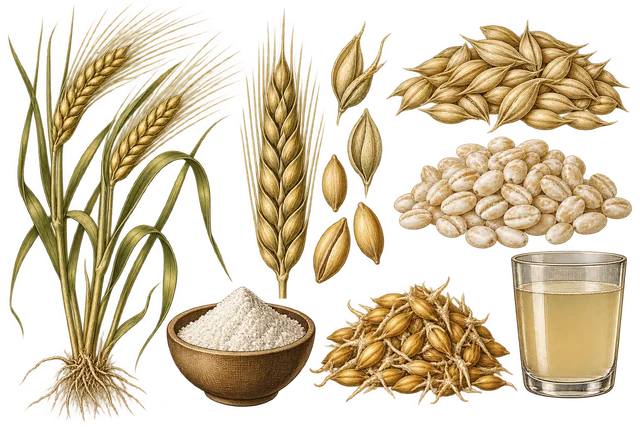
The edible cereal grain of barley. Hulled grain, polished pearl barley, flour, malt and strained barley water are different preparations.
Ingredient details, preparation and research
Also known as: Barley grain; Pearl barley (a polished form); Hulled barley (a less-refined form)
Source plant or material
Hordeum vulgare L.; The edible cereal grain of barley. Hulled grain, polished pearl barley, flour, malt and strained barley water are different preparations.
Plant family / material: Poaceae (grass family)
Forms and route
Cooked hulled or pearl barley; flakes and flour; malt made by controlled germination; barley-containing breads, soups and couscous. Nutrients below refer only to cooked pearl barley.
Vitamins and minerals
Modern food reference: 1/2 US cup cooked pearl barley, about 78.5 g, supplies approximately 97 kcal, 1.8 g protein, 22.2 g carbohydrate, 3.0 g fiber, 1.0 mg iron and 17 mg magnesium. Calculated from USDA SR28 NDB 20006 (1 cup = 157 g; report pages 18–20). This is cooked polished grain, not dry grain, hulled barley, malt, beer or strained barley water; it does not reconstruct a biblical loaf.
Absorption and preparation
Cook until tender using the package directions. Add lentils or beans for a more substantial mixed meal; add peppers or another vitamin-C-rich vegetable to help absorption of the meal’s nonheme iron. This is ordinary meal planning, not a special barley synergy. A strained drink retains much less of the grain’s fiber than eating the grain.
Traditional and reported uses
- Cooked grain for soups, stews and grain bowls; flour or meal in breads and other cereal foods.
- A historical food and brewing grain; barley-water traditions belong to the history of food care, rather than a treatment dose.
Contraindications and cautions
- Barley contains gluten and is unsuitable for a gluten-free diet for celiac disease. Barley malt is also a relevant ingredient to check.
- Avoid if you have a diagnosed barley allergy; do not assume a product is safe just because it contains no wheat.
- Cook flour and dough thoroughly. Raw flour can carry pathogens, including in homemade grain mixtures.
Similar items and how they compare
- Wheat
Both are biblical cereal staples and contain gluten.
Barley generally makes a different dough and has its own malt and beta-glucan traditions.
- Millet
Another cereal used in cooked grain dishes.
The biblical millet identity is uncertain; modern millet foods are distinct from gluten-containing barley.
Which barley preparation?
Pearl barley has been polished; hulled barley keeps more of the original grain layers. Bread, malt, beer and strained barley water should not inherit the nutrient values of boiled pearl barley. The household portion is a comparison for an actual modern food.
Evidence boundary
Barley contains beta-glucan fiber, but the amount in a particular serving depends on grain and processing. This card does not infer a therapeutic beta-glucan dose, cholesterol treatment or illness cure from a biblical loaf or historical barley drink.
Gluten and preparation safety
Celiac disease requires avoiding barley, including barley malt. Flour remains a raw ingredient until properly cooked; biblical or traditional status does not change that requirement.
Food portion and nutrition
Modern food reference: 1/2 US cup cooked pearl barley, about 78.5 g, supplies approximately 97 kcal, 1.8 g protein, 22.2 g carbohydrate, 3.0 g fiber, 1.0 mg iron and 17 mg magnesium. Calculated from USDA SR28 NDB 20006 (1 cup = 157 g; report pages 18–20). This is cooked polished grain, not dry grain, hulled barley, malt, beer or strained barley water; it does not reconstruct a biblical loaf.
Preparation and meal pairing
Cook until tender using the package directions. Add lentils or beans for a more substantial mixed meal; add peppers or another vitamin-C-rich vegetable to help absorption of the meal’s nonheme iron. This is ordinary meal planning, not a special barley synergy. A strained drink retains much less of the grain’s fiber than eating the grain.
Evidence limits
- Barley variety and degree of pearling are not fixed by these verses.
- No nutrient profile for an ancient barley loaf or strained barley drink is inferred from the cooked-grain reference.
Entry sources
- Kew Plants of the World Online: Hordeum vulgare
- Michael Zohary: Plants of the Bible
- Lee et al. (2020): Clinical and Laboratory Findings of Barley Allergy in Korean Children
- Whole Grains Council: Types of Barley
- FDA: Review of the Scientific Evidence on the Physiological Effects of Certain Non-Digestible Carbohydrates
- Grando: Food uses of barley (ICARDA, 2005), FAO AGRIS record
- Smithsonian National Museum of Asian Art: Tibetan Foodways
- British Museum: A sip of history, ancient Egyptian beer
- Hippocrates: On Regimen in Acute Diseases, Francis Adams translation
- NIDDK: Eating, Diet, & Nutrition for Celiac Disease
- FDA: Handling Flour Safely, What You Need to Know
- FDA: Food Allergens/Gluten-Free Guidance Documents & Regulatory Information
- USDA Standard Reference 28 (2015): cereal grains and pasta, food group 20
- NIH Office of Dietary Supplements: Iron, Health Professional Fact Sheet
- FAO: Nature’s nutritious seeds, 10 reasons why you should opt for pulses
- King James Bible: Project Gutenberg eBook 10
Reference entry 142 · Recorded content review: 2026-10-06 · Review scope and dates