


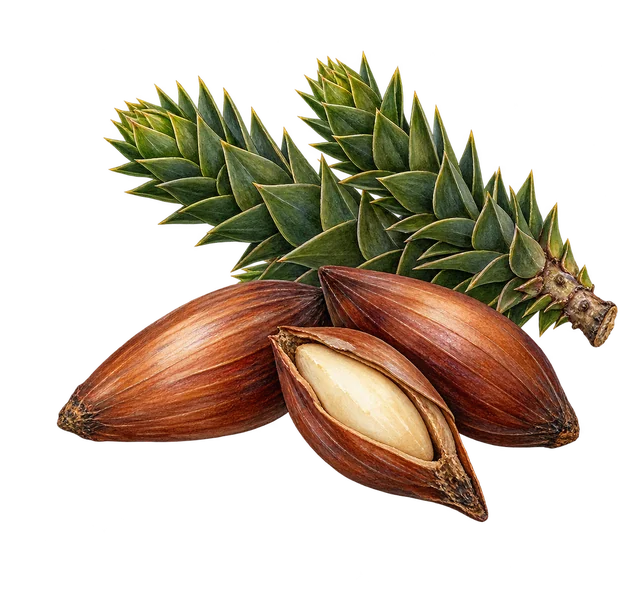
Key cautions
- Do not identify edible seeds from this description or harvest protected trees without authorization.
- Seed collection can affect forest regeneration and community access; choose traceable lawful supply.
What’s inside
Starch is a principal seed reserve. Composition of another Araucaria species must not be substituted automatically.
Uses in brief

- Cooked seed food
- Regional seed-food ingredient
History, folklore and reported uses
History, folklore and traditional uses
Pehuén piñón belongs to southern Chilean forest-food traditions. INFOR’s cited work concerns particular Chilean landscapes and sustainable collection, not a claim that all pine-like seeds or all South American forest practices are interchangeable.
Traditional, historical and reported uses
- Cooked seed food
Food or household practiceWhy this label?
Source documents this specific material, culinary use or attributed practice; no clinical efficacy is inferred.
INFOR describes piñón as a valued non-timber forest product and examines sustainable supply. Use the seed in its established prepared food form rather than consuming planting material.
- Regional seed-food ingredient
Food or household practiceWhy this label?
Source documents this specific material, culinary use or attributed practice; no clinical efficacy is inferred.
INFOR’s work in Lonquimay and Curacautín evaluates the resource available for local utilization. This supports a regional food-material role without assigning one recipe to all communities.
2 bounded uses; regional records do not establish treatment effects.
Historical-use additions reviewed 2026-10-09
Regional reading paths
These sourced notes describe cultivation, trade, food traditions or material history. A regional connection does not claim exclusive origin.
South America
native and harvested; Chile
Edible seed; sustainable collection matters.
Identity & detailed reference
Identity
Araucaria araucana; edible seed of Araucaria araucana, pehuén; distinct from Pinus pine nuts and Brazilian A. angustifolia pinhão.
Ingredient details, preparation and research
Also known as: Araucaria araucana
Source plant or material
Araucaria araucana
Plant family / material: Araucariaceae
Forms and route
Properly identified food-grade seeds and prepared seed foods; not ornamental-tree seed sold for planting.
Vitamins and minerals
This is not simply an oil-rich pine nut under a different name. No serving-specific vitamin, mineral or protein amount has been established in this card.
Absorption and preparation
Research on seed germination and amylase describes plant metabolism, not human glycemic response or a special digestive benefit.
Practical preparation
Obtain identified culinary seed from a reputable supplier and follow its cooking directions. Remove the inedible covering and store the prepared food as directed.
Traditional and reported uses
- Cooked seed food
- Regional seed-food ingredient
Contraindications and cautions
- Do not identify edible seeds from this description or harvest protected trees without authorization.
- Seed collection can affect forest regeneration and community access; choose traceable lawful supply.
Starch reserve, not a human trial
Primary enzyme studies establish starch as a major reserve in A. araucana seed and investigate its breakdown during germination. They do not test diabetes outcomes or establish a human absorption advantage.
Evidence limits
This is a food-form review, not a treatment recommendation. Composition and laboratory findings apply to the material actually studied; no medicinal dose, universal nutrient ranking or preservation guarantee is inferred.
Entry sources
- INFOR: Recolección sustentable de semilla de araucaria
- INFOR: Araucaria araucana, un recurso promisorio
- Starch digestion by enzymes in germinating Araucaria araucana seeds
Reference entry 438 · Recorded content review: 2026-10-09 · Review scope and dates