


Key cautions
- Pecan is a major tree-nut allergen; avoid it when allergic and check cross-contact information.
- Whole nuts can be a choking hazard for young children or people with swallowing difficulty; use an appropriate texture.
- Discard moldy, rancid or insect-damaged nuts; keep kernels cool and protected from moisture.
What’s inside
Predominantly fat, including unsaturated fatty acids, with protein, fiber and minerals. Natural oils make storage conditions important.
Uses in brief

- Kernel ingredient
- Baked desserts
History, folklore and reported uses
History, folklore and traditional uses
University of Georgia documents the growth of commercial pecan orchards in Georgia and the crop’s continuing regional importance. Pecan’s southern food identity combines a native North American tree with modern orchard selection and processing.
Traditional, historical and reported uses
- Kernel ingredient
Food or household practiceWhy this label?
Label describes the stated practice or evidence, not an efficacy grade. Exact form and cautions remain attached.
Whole or chopped pecans provide flavor and crunch in foods; shelling is a necessary boundary between the edible kernel and the hard covering.
- Baked desserts
Food or household practiceWhy this label?
Label describes the stated practice or evidence, not an efficacy grade. Exact form and cautions remain attached.
UGA uses pecan pies to illustrate the crop’s culinary market. This familiar dessert is a mixed food, not nutritionally equivalent to the plain nut.
2 supported uses; records describe the named form and are not treatment recommendations.
Historical-use additions reviewed 2026-10-09
Regional reading paths
These sourced notes describe cultivation, trade, food traditions or material history. A regional connection does not claim exclusive origin.
North America
Native/cultivated: North America; United States southern orchards documented.
Edible kernels used in baking and other foods.
Identity & detailed reference
Identity
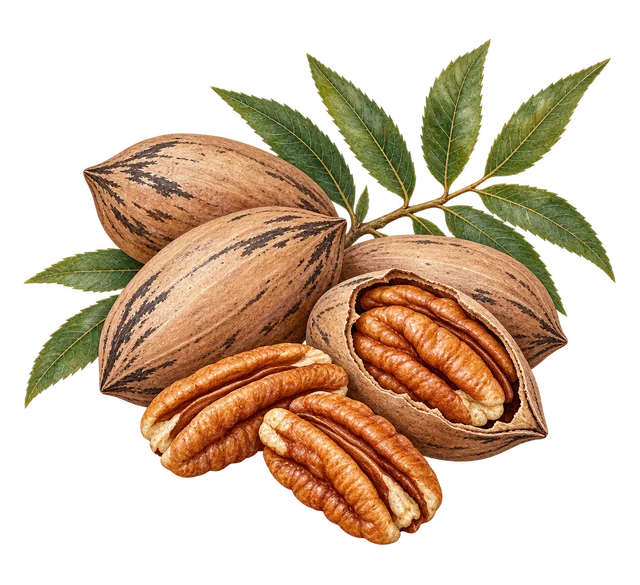
Kernels of Carya illinoinensis. Pecan belongs to the tree-nut food group; it is not a peanut or a source of edible shell powder.
Ingredient details, preparation and research
Also known as: Pecan nut
Source plant or material
Carya illinoinensis
Plant family / material: Juglandaceae
Forms and route
In-shell nuts, shelled kernels, roasted nuts and ground or chopped food ingredients. Candied nuts, pies and extracted oil have different composition.
Vitamins and minerals
Energy-dense food; portion and recipe matter. Candied pecans and pecan pie add sugar and other ingredients absent from a plain kernel.
Absorption and preparation
Chewing and grinding change the food matrix, but no therapeutic pairing is required. Nutrient content does not remove allergy risk.
Practical preparation
Buy sound food-grade nuts, remove all shell fragments and store airtight in cool conditions or freeze for longer storage. Follow the supplier’s directions for raw or roasted products.
Traditional and reported uses
- Kernel ingredient
- Baked desserts
Contraindications and cautions
- Pecan is a major tree-nut allergen; avoid it when allergic and check cross-contact information.
- Whole nuts can be a choking hazard for young children or people with swallowing difficulty; use an appropriate texture.
- Discard moldy, rancid or insect-damaged nuts; keep kernels cool and protected from moisture.
Storage protects quality
UGA’s extension work identifies moisture and temperature as major influences on stored nut quality. Those controls do not make spoiled nuts safe or remove allergens.
Allergen identity matters
FDA lists pecans among major tree-nut allergens. Being a plant food or containing unsaturated fats does not lessen the potential for serious allergic reactions.
Evidence limits
Regional history and food/material practice do not establish treatment efficacy. Composition depends on the named species, part and preparation; no medicinal dose or universal nutrient ranking is inferred.
Entry sources
- UGA Cooperative Extension: Pecans
- UGA Pecan Extension: Storing Pecans
- FDA: Food Allergies, What You Need to Know
Reference entry 410 · Recorded content review: 2026-10-09 · Review scope and dates