


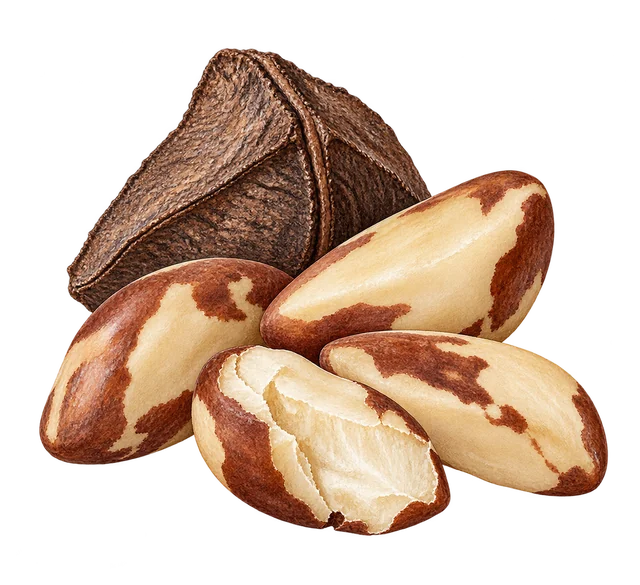
Key cautions
- Avoid with Brazil-nut allergy; mixed-nut products can contain additional allergens.
- Repeated large amounts can lead to excessive selenium exposure
What’s inside
Fat, protein, fiber and selenium, whose concentration can vary widely between seeds and origins.
Uses in brief

- Edible forest kernels
- Chopped ingredient
History, folklore and reported uses
History, folklore and traditional uses
Regional context: native and harvested; Brazil, Bolivia, Peru. These examples describe specific food or material traditions and production settings; they do not establish exclusive ownership, a single continent-wide recipe, or therapeutic effectiveness.
Traditional, historical and reported uses
- Edible forest kernels
Food or household practiceWhy this label?
Source documents this specific material, culinary use or attributed practice; no clinical efficacy is inferred.
FAO describes Brazil nuts as a globally traded forest seed harvested across the Amazon basin. Eating the kernel is distinct from using its shell or an extracted oil.
- Chopped ingredient
Food or household practiceWhy this label?
Source documents this specific material, culinary use or attributed practice; no clinical efficacy is inferred.
Food-grade kernels can be chopped into meals or nut mixtures. The amount actually eaten, rather than the number of pieces in a recipe, determines exposure to selenium.
2 bounded uses; regional records do not establish treatment effects.
Historical-use additions reviewed 2026-10-09
Regional reading paths
These sourced notes describe cultivation, trade, food traditions or material history. A regional connection does not claim exclusive origin.
South America
native and harvested; Brazil, Bolivia, Peru
Edible forest seed, traded as a nut.
Identity & detailed reference
Identity
Bertholletia excelsa; the edible seed kernel of Bertholletia excelsa, commonly sold as a Brazil nut; the hard outer shell is not eaten.
Ingredient details, preparation and research
Also known as: Bertholletia excelsa
Source plant or material
Bertholletia excelsa
Plant family / material: Lecythidaceae
Forms and route
Shelled kernels, chopped nuts and labeled nut foods; seed oil is a separate lipid product.
Vitamins and minerals
Brazil nuts can supply substantial selenium, but a fixed number of nuts is not a reliable supplement dose. Consider selenium from the whole diet and any supplements.
Absorption and preparation
Selenium form and food composition influence utilization; high content is not a reason to seek maximal intake. More selenium can be harmful.
Practical preparation
Buy sound food-grade kernels, store sealed and cool, and discard moldy or rancid nuts. Use as an ordinary food ingredient rather than a daily dosing device.
Traditional and reported uses
- Edible forest kernels
- Chopped ingredient
Contraindications and cautions
- Avoid with Brazil-nut allergy; mixed-nut products can contain additional allergens.
- Repeated large amounts can lead to excessive selenium exposure. Do not combine frequent large portions with selenium supplements without professional guidance.
Variation matters for safe interpretation
A primary study examined selenium concentration, speciation and localization in Brazil nuts. Its variability reinforces NIH’s caution about very high selenium foods and prevents a universal nut-count prescription.
Evidence limits
This is a food-form review, not a treatment recommendation. Composition and laboratory findings apply to the material actually studied; no medicinal dose, universal nutrient ranking or preservation guarantee is inferred.
Entry sources
- FAO: Brazil nuts
- NIH ODS: Selenium, health-professional fact sheet
- Selenium accumulation and variation in Brazil nuts
Reference entry 436 · Recorded content review: 2026-10-09 · Review scope and dates