


Key cautions
- Do not assume colorful bracts, true flowers, leaves or garden hybrids are interchangeable edible materials.
- No household safe dose or long-term oral safety is established; avoid self-treatment, especially in pregnancy, breastfeeding or children.
What’s inside
Betalain pigments, including betacyanins and betaxanthins, have been analyzed in B. glabra bracts.
Uses in brief

- Botanical and cultural reference only; no routine eating or tea recommendation.
History, folklore and reported uses
History, folklore and traditional uses
Trigueros-Vázquez and Ruiz-Rosado’s 2020 account of Kakchikel plant knowledge in Mazapa de Madero, Chiapas, records bugambilia tea for strong cough, throat infection and flu-like illness. The authors identify B. glabra and call the used part flowers while separately explaining the bracts. That wording leaves a material-detail gap. Preserving the community-specific record is worthwhile, but it does not justify rewriting it as a proven cough remedy or a recipe for all bougainvilleas.
Traditional, historical and reported uses
- Respiratory-remedy tradition
Traditional accountWhy this label?
A named Kakchikel ethnobotanical account attributes flower tea to respiratory complaints; the claim reports practice rather than outcomes.
The Kakchikel ethnobotanical record attributes flower tea to cough, throat infection and flu-like complaints. These are reported uses, not demonstrated treatment outcomes.
- Mexican digestive-remedy reports
Traditional accountWhy this label?
The review attributes digestive-remedy use to Mexican tradition and specifies bracts; it does not report an intervention result.
Ornelas García and colleagues’ 2023 Bougainvillea glabra review records Mexican traditional use for diarrhea and dysentery. It identifies colorful bracts as commonly used material and distinguishes them from true flower petals. This is a report of practice, not evidence for treating infection at home.
- Mexican wound-cleansing reports
Traditional accountWhy this label?
The review documents Mexican wound-cleansing and pimple practices, with no demonstrated safe preparation or therapeutic outcome.
The same Bougainvillea glabra review records Mexican reports of wound cleansing and pimple remedies. These reports do not establish a safe home preparation or treatment benefit; the colorful bracts should not be confused with true flowers.
Only specifically supported uses are included; historical or culinary use is not clinical proof.
Historical-use additions reviewed 2026-10-08
Story sources
- NC State Extension: Bougainvillea
- Trigueros-Vázquez and Ruiz-Rosado (2020): Plantas medicinales usadas por el grupo étnico Kakchikel del municipio de Mazapa de Madero, Vol. I, p.14
- Rodríguez-Herrera et al. (2023): Betalains from Bougainvillea glabra bracts
- Ornelas García et al. (2023): Bougainvillea glabra review
Identity & detailed reference
Identity
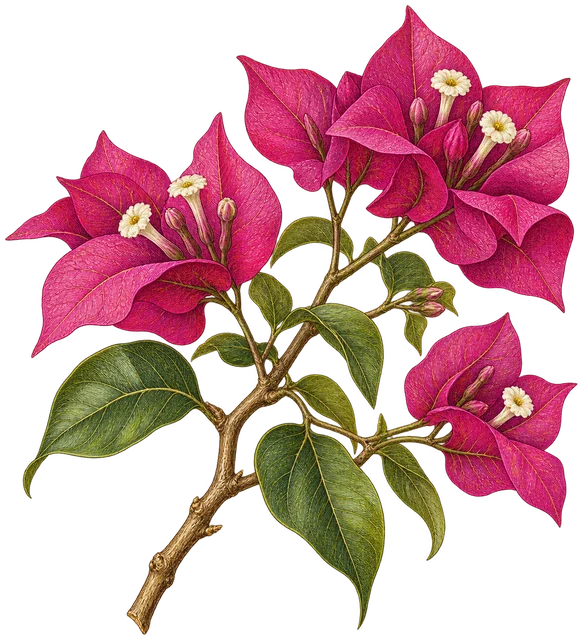
Bougainvillea glabra reference card: showy papery bracts surround the small true flowers. Routine food-use safety is not established here.
Ingredient details, preparation and research
Source plant or material
Bougainvillea glabra Choisy; other species and hybrids are separate; Bougainvillea glabra reference card: showy papery bracts surround the small true flowers. Routine food-use safety is not established here.
Plant family / material: Nyctaginaceae
Forms and route
Recorded traditional infusion of material called flowers; bract extracts studied as pigments. These are not automatically equivalent ingredients.
Vitamins and minerals
No validated culinary serving or dependable nutrient contribution is assigned. A pigment extraction experiment does not create a food-composition label.
Absorption and preparation
No human absorption advantage or clinical benefit from home bract tea is established. Laboratory antioxidant/color data do not prove oral safety.
Practical preparation
No recipe is supplied. Handle the thorny plant carefully; do not convert ornamental stock into tea on the basis of this cultural record.
Traditional and reported uses
- Botanical and cultural reference only; no routine eating or tea recommendation.
Contraindications and cautions
- Do not assume colorful bracts, true flowers, leaves or garden hybrids are interchangeable edible materials.
- No household safe dose or long-term oral safety is established; avoid self-treatment, especially in pregnancy, breastfeeding or children.
Similar items and how they compare
- Hibiscus / roselle
Both are associated with vividly colored plant drinks.
Roselle’s fleshy calyx is a different tissue and species with its own food-use record.
- Nasturtium
Another conspicuous garden flower.
Its established culinary use cannot be generalized to bougainvillea.
Bracts are not petals
NC State describes small tubular true flowers surrounded by showy modified leaves called bracts. The illustration should show both structures.
Pigment work is preclinical
The 2023 B. glabra study separated betalains from bracts. Its extraction findings are not human feeding evidence, approval of a homemade colorant, or a safe-dose determination.
Entry sources
- NC State Extension: Bougainvillea
- Trigueros-Vázquez and Ruiz-Rosado (2020): Plantas medicinales usadas por el grupo étnico Kakchikel del municipio de Mazapa de Madero, Vol. I, p.14
- Rodríguez-Herrera et al. (2023): Betalains from Bougainvillea glabra bracts
- Ornelas García et al. (2023): Bougainvillea glabra review
Reference entry 187 · Recorded content review: 2026-10-07 · Review scope and dates