


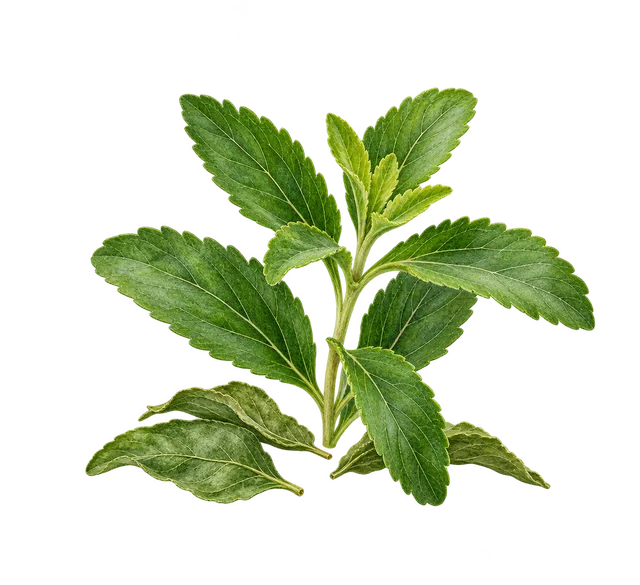
Key cautions
- FDA distinguishes purified steviol-glycoside products from whole leaf and crude extracts, which it does not consider GRAS for sweetening use in the United States.
- Do not assume a product labeled natural or stevia has one standardized composition; check carriers and other sweeteners.
What’s inside
Steviol glycosides contribute sweetness; whole leaves also contain other plant constituents not present in the same proportions in purified products.
Uses in brief

- Sweet-leaf crop
- Raw material for purified sweeteners
History, folklore and reported uses
History, folklore and traditional uses
The regional connection is Paraguay and southeastern Brazil. This card retains the crop’s South American identity while avoiding an invented continent-wide tradition or a generic claim that every leaf product is an approved sweetener.
Traditional, historical and reported uses
- Sweet-leaf crop
Traditional accountWhy this label?
Source documents this specific material, culinary use or attributed practice; no clinical efficacy is inferred.
FAO documents the plant’s origin in northeastern Paraguay and southeastern Brazil and its cultivation. This is botanical and agricultural context, not blanket permission to add leaves to foods in every jurisdiction.
- Raw material for purified sweeteners
Traditional accountWhy this label?
Source documents this specific material, culinary use or attributed practice; no clinical efficacy is inferred.
FDA describes defined steviol-glycoside sweeteners separately from crude leaf materials. The commercial purified ingredient is a different, specified product rather than a synonym for dried leaves.
2 bounded uses; regional records do not establish treatment effects.
Historical-use additions reviewed 2026-10-09
Regional reading paths
These sourced notes describe cultivation, trade, food traditions or material history. A regional connection does not claim exclusive origin.
South America
native; Paraguay, southeastern Brazil
Sweet leaf; distinct from purified steviol-glycoside additives.
Identity & detailed reference
Identity
Stevia rebaudiana; leaves of Stevia rebaudiana; whole leaf, crude extract and highly purified steviol-glycoside sweeteners are different products.
Ingredient details, preparation and research
Also known as: Stevia rebaudiana
Source plant or material
Stevia rebaudiana
Plant family / material: Asteraceae
Forms and route
Dried botanical leaf, crude leaf preparations and separately specified refined sweeteners; regulatory permissions depend on form and jurisdiction.
Vitamins and minerals
Sweetness does not establish a nutritionally complete sugar substitute, and a spoon of leaf powder does not match a spoon of sugar in a recipe.
Absorption and preparation
Safety evaluations for defined purified glycosides cannot automatically establish absorption or safety of every whole-leaf or crude-extract preparation.
Practical preparation
For food sweetening, choose a product permitted for that use where you live and follow its label. This card does not provide a home-extraction or medicinal leaf-tea procedure.
Traditional and reported uses
- Sweet-leaf crop
- Raw material for purified sweeteners
Contraindications and cautions
- FDA distinguishes purified steviol-glycoside products from whole leaf and crude extracts, which it does not consider GRAS for sweetening use in the United States.
- Do not assume a product labeled natural or stevia has one standardized composition; check carriers and other sweeteners.
Form-specific decisions
The official US distinction illustrates why safety and legal status must attach to the exact preparation. Crop-production guidance and historical use cannot substitute for a current ingredient specification.
Evidence limits
Regulatory information is a dated form-specific example, not legal advice for all countries. No diabetes treatment or medicinal dose is proposed.
Entry sources
- FAO Ecocrop: Stevia
- FDA: Aspartame and other sweeteners in food
- University of Kentucky: Stevia crop profile
Reference entry 431 · Recorded content review: 2026-10-09 · Review scope and dates