


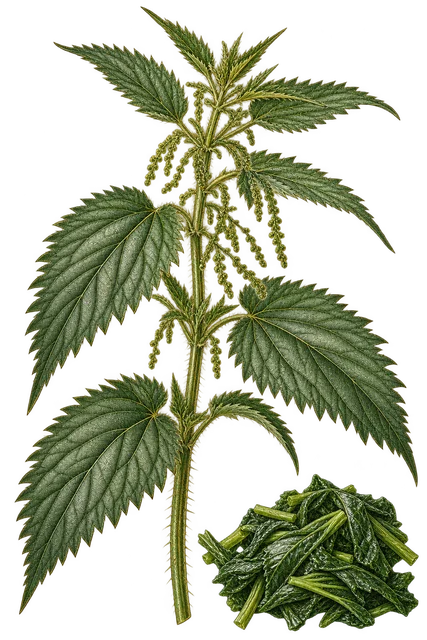
Key cautions
- Handle fresh nettles with gloves; raw stinging leaves can irritate skin and mouth.
- Avoid medicinal urinary use with fluid restriction; review concentrated products with diabetes medicines. Keep whole-leaf vitamin K intake consistent with warfarin.
What’s inside
Leaf/aerial herb contains quercetin, kaempferol and isorhamnetin glycosides, phenolic compounds, sterols and mineral salts. Stinging hairs contain irritant substances including histamine, acetylcholine and serotonin. Harvest, drying and solvent alter the mixture; root chemistry differs.
Uses in brief

- Food: young leaves, properly blanched or cooked.
- Traditional medicinal use: minor joint discomfort and urinary complaints with adequate fluid intake.
In the King James Bible
Related KJV name: nettles
Uncertain botanical connection
Nettles cover a neglected field and vineyard in Proverbs, making their growth part of a lesson about diligence. Biblical nettles are often linked with Urtica pilulifera; the verse leaves the species uncertain and does not specifically identify this card’s U. dioica or U. urens.
And, lo, it was all grown over with thorns, and nettles had covered the face thereof, and the stone wall thereof was broken down.
Proverbs 24:31 (KJV)
Scripture and identification sources
Words & their stories
WORDS & THEIR STORIES
The name behind the KJV
Biblical Hebrew · Proverbs 24:31 (KJV)
חֲרֻלִּיםḥărullīm
The weeds rendered “nettles” by the KJV in an overgrown field and vineyard.
Dictionary form: חָרוּל · ḥārūl
This is a plural form. Brown–Driver–Briggs treats the plant identification as uncertain rather than a precise species label.
What the language reveals
Two weed names
The verse also contains qimməśōnīm, which the KJV renders “thorns.” Similar English plant names should not erase the distinction between the Hebrew words.
A picture of neglect
The ruined wall and overgrowth illustrate neglected work. The passage neither recommends harvesting the plants nor records a remedy.
This wording does not securely identify Urtica dioica, the stinging nettle on this card. Retain this as an uncertain name connection.
Language and identification bibliography
History, folklore and reported uses
Minor urinary complaints
European leaf and aerial-herb preparations, including teas, expressed juices and extracts, were used to encourage urine flow in minor urinary complaints. EMA’s herb assessment preserves this longstanding tradition.
Aching joints and rheumatic complaints
European practice used nettle-herb teas, juices and extracts for minor joint pain. Grieve also records nettle beer for rheumatic complaints and urtication, the practice of deliberately stinging the skin.
EMA: Nettle aerial-herb assessment, revision 1, 2025 · Maud Grieve: A Modern Herbal (1931), Stinging Nettles
Seborrhoeic skin conditions
EMA records oral powdered nettle aerial herb, the parts growing above ground, for seborrhoeic skin conditions involving oily, flaky or inflamed skin. This differs from the external lotions of nettle hair-care folklore.
A spring tonic
Grieve describes tea from young nettles as a rural spring medicine and calls it a blood purifier, an older herbal term rather than an established detoxification effect. Young cooked tops also linked seasonal food with tonic traditions after winter.
Hair and scalp care
Grieve records nettle-herb lotions and expressed juice as external hair preparations, credited with keeping hair glossy and preventing loss. This grooming tradition is distinct from the oral powdered-herb skin use.
Stem fibre for textiles
Kew records the tough stem fibres of Urtica dioica used for cloth, especially in Germany and Austria during the First World War. This is a fibre use of the stems, extending the leaf-and-herb story beyond food and medicine.
A garden liquid feed
Nettles also have a practical place in gardening: Kew records their use to make a nutrient-rich liquid plant feed. The intended recipient is the garden crop, a different purpose from nettle teas drunk as human spring tonics.
Food and fabric across centuries
Prepared nettle leaves appear in soups, teas and other foods. Archaeological finds also document nettle textiles from the Bronze Age, long before the wartime stem-fibre uses recorded by Kew.
Roman soldiers and the sting
The Natural History Museum recounts tales of Roman soldiers stinging themselves with nettles to feel warmer. This is a story about deliberate skin irritation, not evidence that nettles protect against dangerous cold.
Women’s Health: traditions, evidence and cautions
Historical use does not establish benefit or safety. Pregnancy, breastfeeding and fertility care require particular caution: food, tea, essential oil and concentrated extract are not interchangeable. These records are not treatment, dosing or pregnancy-management instructions. Discuss supplements with a qualified clinician or pharmacist; do not delay evaluation of persistent symptoms.
Stinging nettle leaf/herb
Urtica dioica L.; Urtica urens L.
- Plant part / material
- Leaf and aerial herb
- Preparation studied or reported
- Oral leaf/herb preparations; not root products.
LactMed describes postpartum tonic/anemia and galactagogue use, with California midwifery and Turkish/other practice sources; it does not establish a single origin.
Lactation / milk-supply tradition
Limited human evidence
Reported or traditional useUsed as a postpartum tonic and purported milk stimulant.
What the evidence supportsOnly minimal efficacy support exists. A small drops trial used imperfectly described preparations; multi-herb tea findings cannot establish nettle alone.
A breastfed newborn developed an allergic rash after maternal nipple application. Avoid breast/nipple nettle preparations. A tonic tradition does not establish treatment for postpartum anemia.
- The cited lactation evidence does not establish medicinal-use safety during pregnancy; postpartum traditions must not be extrapolated to pregnancy.
Regional reading paths
These sourced notes describe cultivation, trade, food traditions or material history. A regional connection does not claim exclusive origin.
Europe
Native/wild-collected and traditional processing: Finland and other European countries.
Young leaves are cooked into soups and breads; handling raw plants can sting.
Identity & detailed reference
Identity
Urtica dioica L. or Urtica urens L., Urticaceae. Medicinal leaf (folium), aerial herb (herba) and root (radix) are separately defined materials. This entry covers leaf and relevant aerial-herb preparations, not prostate root products.
Ingredient details, preparation and research
Source plant or material
Urtica dioica L. or Urtica urens L.; leaf/aerial herb, with young cooked leaves as food.
Plant family / material: Urticaceae (nettle family).
Forms and route
Cooked or blanched young leaves as a vegetable; dried-leaf/herb infusions, powders, fresh-herb juices and specified liquid or dry extracts for oral use. Root extracts are separate. Direct contact with the fresh stinging plant is not equivalent to taking processed leaf products.
Vitamins and minerals
USDA blanched nettle record 169819: one-half cup (44.5 g, about 45 g) supplies about 214 mg calcium, 222 micrograms vitamin K, 3.1 g fibre and 1.2 g protein. That is roughly 16% Daily Value for calcium, 185% for K and 11% for fibre. These data are for whole blanched leaves, not tea, tincture or root.
Absorption and preparation
EMA found no human pharmacokinetic data for nettle aerial herb. Leaf tea, herb juice, powder and alcohol/water extracts are not established as interchangeable or ranked for absorption. Nutrient measurements in blanched leaves describe composition, not the fraction absorbed, and do not establish the content of strained tea.
Practical preparation
For food-grade, correctly identified young leaves, wear gloves, rinse, then blanch in boiling water for 1.5–2 minutes; cool promptly and drain, following Oregon State Extension. Its approximate yield is 4–5 cups fresh to 1 cup blanched. This is a kitchen-volume yield, not a fresh-to-dried medicinal equivalence. Follow the named product's directions for dried-leaf tea or extract.
Combination notes
Nettle and dandelion are sometimes combined in urinary teas, but shared traditional use does not prove synergy. Avoid combining multiple full-strength urinary products or adding them to prescribed diuretics without an individual review. In food, cooked nettles can replace spinach in soups or other cooked dishes.
Traditional and reported uses
- Traditional European leaf/aerial-herb use: minor joint discomfort and urinary complaints with adequate fluid intake.
- EMA's 2025 aerial-herb monograph includes an oral powdered-herb preparation for seborrhoeic skin conditions; that is not a general claim for leaf tea or nettle creams.
- Food: properly blanched/cooked young leaves. Small extract studies in diabetes do not establish tea as diabetes treatment.
Contraindications and cautions
- Fresh stinging hairs can cause painful irritation; handle with gloves and cook/blanch properly for food. Avoid with known nettle allergy.
- Urinary-use products are unsuitable when fluid restriction has been advised. Fever, painful urination or blood in urine requires assessment.
- Digestive upset, rash and hives are possible. EMA reports no established medicine interactions; concentrated leaf extracts deserve review with glucose-lowering medicines because a small human trial found lower glucose.
- Keep vitamin-K-rich whole-leaf food intake consistent with warfarin. This caution cannot be quantified for an untested tea or tincture.
- Pregnancy and breastfeeding medicinal safety is unestablished. Age limits depend on preparation and use: several aerial-herb uses are adult-only, while certain products permit ages 12 and above. Do not generalize a child dose from adult tea instructions.
Similar items and how they compare
- Dandelion
Both are traditional urinary-flushing herbs taken with adequate fluids, and both require distinguishing leaf preparations from the plant’s roots.
Dandelion root also supplies bitter constituents and inulin; nettle herb has different chemistry.
- White willow bark
Both have traditional use for minor joint discomfort, but shared purpose does not establish equivalent dosing or effects.
Willow bark contains salicylate precursors; nettle leaf has distinct constituents and fluid-related cautions.
Leaf, herb and root are distinct
Urtica dioica L. or Urtica urens L., Urticaceae. Medicinal leaf (folium), aerial herb (herba) and root (radix) are separately defined materials. This entry covers leaf and relevant aerial-herb preparations, not prostate root products. Leaf/aerial herb contains quercetin, kaempferol and isorhamnetin glycosides, phenolic compounds, sterols and mineral salts. Stinging hairs contain irritant substances including histamine, acetylcholine and serotonin. Harvest, drying and solvent alter the mixture; root chemistry differs.
Traditional uses and preparation-specific skin wording
EMA supports traditional leaf use for minor joint pain and urinary flushing. Its 2025 aerial-herb monograph separately lists oral powdered herb for seborrhoeic skin conditions. This does not demonstrate that leaf tea, homemade skin rinses or cosmetic oil treat seborrhoeic dermatitis. Different preparations and age limits are specified for different indications.
Human evidence for urinary and joint complaints
EMA's 2025 review found only weak clinical evidence for aerial-herb products. A 32-person juice study and a 114-person expressed-juice study were open and uncontrolled; the latter used non-validated symptom scales. Their observations support research interest, not established effectiveness, prevention of infection, or repair of kidneys or cartilage. Laboratory inflammatory findings do not overcome those study limitations.
Diabetes research and medicine review
One 92-person randomized trial tested nettle LEAF-extract capsules for three months in addition to conventional diabetes medicines. Fasting/post-meal glucose and HbA1c fell compared with placebo. This limited, specific-extract result cannot validate household tea or stopping prescribed treatment; it does justify checking concentrated products with glucose-lowering medicines. EMA still lists no established interactions for its specified traditional herb products.
Root-trial boundary
The 2017 allergic-rhinitis trial specifically used nettle ROOT extract. Forty of 74 enrolled participants completed it, and symptom improvement was seen in both active and placebo groups. It cannot be cited as proof that nettle leaf tea treats hay fever. Prostate-related root products likewise fall outside this entry.
Absorption and extraction
EMA found no human pharmacokinetic data for nettle aerial herb. Leaf tea, herb juice, powder and alcohol/water extracts are not established as interchangeable or ranked for absorption. Nutrient measurements in blanched leaves describe composition, not the fraction absorbed, and do not establish the content of strained tea.
Whole-food portions and comparison
USDA blanched nettle record 169819: one-half cup (44.5 g, about 45 g) supplies about 214 mg calcium, 222 micrograms vitamin K, 3.1 g fibre and 1.2 g protein. That is roughly 16% Daily Value for calcium, 185% for K and 11% for fibre. These data are for whole blanched leaves, not tea, tincture or root. For an equal 44.5 g of boiled, drained unsalted spinach (FDC 168463), the database gives about 61 mg calcium, 220 micrograms K and 1.1 g fibre. This compares food composition, not calcium bioavailability; a conventional half-cup of spinach weighs more.
Safe culinary preparation
For food-grade, correctly identified young leaves, wear gloves, rinse, then blanch in boiling water for 1.5–2 minutes; cool promptly and drain, following Oregon State Extension. Its approximate yield is 4–5 cups fresh to 1 cup blanched. This is a kitchen-volume yield, not a fresh-to-dried medicinal equivalence. Follow the named product's directions for dried-leaf tea or extract. Do not substitute raw stinging leaves into a salad or smoothie.
Cautions and populations
Do not use urinary-flushing preparations if fluid intake must be restricted. Seek care for urinary red flags, or joint pain with swelling, redness or fever. Digestive symptoms and allergic skin reactions can occur. Medicinal pregnancy/breastfeeding use is not recommended; age limits are form- and indication-specific. EMA's aerial-herb urinary tea and joint-pain preparations are adult-only, while some other listed preparations allow ages 12 and above.
Vitamin K is a food-specific medicine issue
A whole-leaf vegetable portion supplies substantial vitamin K. Keep intake consistent with warfarin and discuss a major dietary change with the prescribing team. This is separate from speculative claims of nettle interactions with all anticoagulants, and cannot be transferred quantitatively to strained tea or root extract.
Entry sources
- EMA: Final nettle leaf monograph
- EMA: Nettle aerial-herb monograph, revision 1, January 2025
- EMA: Nettle aerial-herb assessment, revision 1, January 2025
- Kianbakht et al. (2013): Randomized nettle LEAF-extract trial in type 2 diabetes
- Bakhshaee et al. (2017): Allergic-rhinitis trial of nettle ROOT extract
- USDA FoodData Central: Official SR Legacy downloadable composition and portion records
- FDA: Daily Values on nutrition labels
- Oregon State University Extension: Wild Edibles, Stinging Nettle
- NIH Office of Dietary Supplements: Vitamin K and warfarin consistency
- Royal Botanic Gardens, Kew: Urtica dioica species profile
Reference entry 24 · Recorded content review: 2026-10-05 · Review scope and dates