


Key cautions
- Use verified food-grade Illicium verum only.
- Never give star-anise tea to infants.
- Japanese star anise and decorative fruits may be toxic.
What’s inside
Anethole contributes the anise-like aroma. The plant also contains shikimic acid, which can be an industrial starting material for drug manufacture; the spice itself is not an antiviral medicine.
Uses in brief

- Savory meat seasoning
- Chinese five-spice blends
- Food and confectionery flavoring
History, folklore and reported uses
History, folklore and traditional uses
Kew places Illicium verum in southern China and northern Vietnam and records its long cultivation and food use across parts of Asia. The dried fruit supplies the familiar star-shaped spice.
Another history requires caution: clinicians reporting cases in Miami described home use of star-anise tea for infant colic, including Caribbean and Hispanic contexts. A recorded remedy is not proof of benefit; their work documented harm and supports avoiding infant tea.
Traditional, historical and reported uses
- Savory meat seasoning
Food or household practiceWhy this label?
Records a specific culinary preparation of the named material; this is a food-practice category, not evidence of a medical benefit.
Kew records culinary star anise in Chinese pork and chicken dishes. Use authenticated food-grade fruit in normal recipe quantities, and remove hard whole pieces when the recipe calls for straining.
- Chinese five-spice blends
Food or household practiceWhy this label?
Records a specific culinary preparation of the named material; this is a food-practice category, not evidence of a medical benefit.
Star anise is one of the ingredients described in Chinese five-spice mixtures. The blend is a culinary combination; it does not establish a medicinal effect or a safe dose for an extract.
- Food and confectionery flavoring
Food or household practiceWhy this label?
Records a specific culinary preparation of the named material; this is a food-practice category, not evidence of a medical benefit.
India’s Spices Board records the fruit in confectionery and other foods, and its oil in professionally formulated flavorings. These are separate preparations, not permission to swallow essential oil or give tea to an infant.
- Industrial shikimic-acid source
Food or household practiceWhy this label?
An institutional botanical report records a chemical feedstock use. This is an industrial material application, not a clinical study of the spice or an instruction to extract, manufacture or self-administer a medicine.
Kew’s 2020 report describes star anise as a source of shikimic acid used as a starting material to manufacture oseltamivir. Industrial extraction and chemical synthesis are essential steps: eating the spice or drinking its tea is not taking the antiviral medicine.
- Fragrance and decorative materials
Food or household practiceWhy this label?
Kew’s species profile explicitly records oil-fragrance and whole-fruit decorative uses. Neither scent nor star shape authenticates edible Illicium verum, and no home oil or inhalation treatment is recommended.
Kew records star-anise oil in soap and perfume and the dried fruits in potpourri. These are separate fragrance and decorative applications. Potpourri may contain nonfood additives or other species, so a decorative star-shaped fruit must never be treated as a culinary ingredient.
5 distinct supported uses are featured. Culinary, material and attributed historical practices are distinguished from medicinal efficacy; no fixed seven-use quota is imposed.
Historical-use additions reviewed 2026-10-09
Story sources
- Kew POWO species profile: Illicium verum, culinary uses and toxic Japanese star-anise distinction
- Spices Board India: Star Anise, dried fruit and culinary applications
- Ize-Ludlow et al. (2004): Neurotoxicities in infants after star-anise tea, Pediatrics case series
- Ize-Ludlow et al. (2004): Star-anise chemical composition and infant neurotoxicity, JAMA
- Royal Botanic Gardens, Kew: State of the World’s Plants and Fungi 2020, shikimic acid and drug manufacture
Regional reading paths
These sourced notes describe cultivation, trade, food traditions or material history. A regional connection does not claim exclusive origin.
Asia
Native/cultivated: southeastern China; established in Chinese five-spice mixtures.
Culinary dried fruit; exclude toxic Japanese star anise.
Identity & detailed reference
Identity
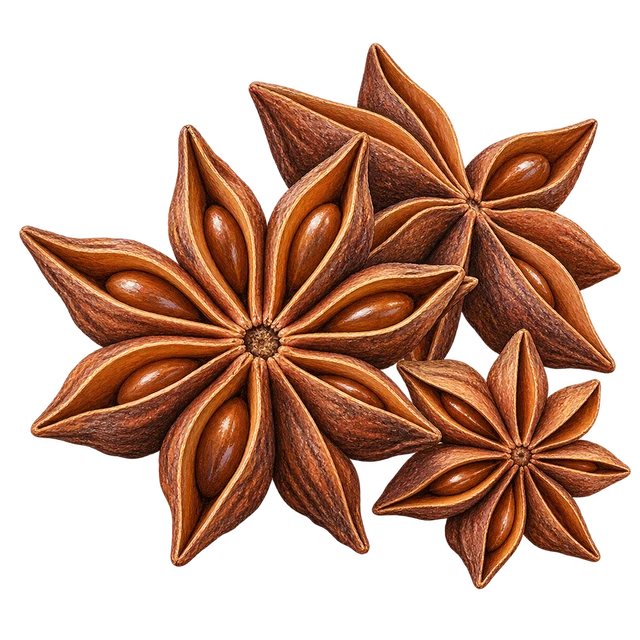
The dried star-shaped fruit of culinary Chinese star anise, Illicium verum. Toxic Japanese star anise, Illicium anisatum, is a different species; ordinary anise, Pimpinella anisum, is also a different plant.
Ingredient details, preparation and research
Also known as: Chinese star anise; Illicium verum; Badiane; Badian; Anís estrellado
Source plant or material
Illicium verum Hook.f.
Plant family / material: Schisandraceae
Forms and route
Food-grade dried whole fruits or ground culinary star anise. Infant colic teas, home medicinal preparations, essential oils and decorative potpourri are outside the edible-seasoning scope.
Vitamins and minerals
No numerical nutrient values or vitamin/mineral-source claim are assigned to this small seasoning use. Ground fruit, a strained dish, an extract and a sweetened beverage do not have interchangeable compositions.
Absorption and preparation
No nutrient-absorption advantage is established for culinary star anise. The presence of anethole or shikimic acid does not demonstrate a health benefit from eating the spice.
Practical preparation
Buy labeled culinary star anise from a reliable food supplier and use the recipe quantity. Keep whole hard fruit in a removable spice sachet when appropriate, or strain it out before serving. Do not substitute decorative material or a foraged look-alike.
Combination context
No special absorption-enhancing pairing is established.
Combination notes
Use in food combinations such as a five-spice blend according to the recipe. No multi-herb mixture is recommended here for colic, flu or another illness.
Traditional and reported uses
- Savory meat seasoning
- Chinese five-spice blends
- Food and confectionery flavoring
- Industrial shikimic-acid source
- Fragrance and decorative materials
Contraindications and cautions
- Use food-grade Illicium verum from a reliable supplier. Do not eat unidentified or decorative star-shaped fruits; Japanese star anise, Illicium anisatum, is toxic and can be confused with the culinary species.
- Do not give star-anise tea to infants or use it as a home treatment for colic. Published infant cases include serious neurological reactions, and contamination with Japanese star anise has been documented.
- This card provides no home medicinal tea, oil or supplement dose for adults or children. A culinary seasoning history does not establish safety for a strong infusion or concentrated preparation.
- If a suspect product causes vomiting, abnormal movements, marked drowsiness or other concerning symptoms, seek urgent medical or poison-service advice. Do not rely on the illustration, aroma or number of points to authenticate a fruit.
Similar items and how they compare
- Japanese star anise, Illicium anisatum
Has superficially similar star-shaped fruit.
It is toxic and is not a culinary substitute. Appearance alone is not a safe identification method.
- Anise, Pimpinella anisum
Shares an anise-like aroma associated with anethole.
It is a parsley-family plant with a different fruit; it is not Illicium verum.
- Shikimic acid and oseltamivir
Star anise has supplied a starting chemical for manufacturing an antiviral drug.
Extraction and chemical manufacture produce a different substance. Eating star anise or drinking its tea is not taking oseltamivir.
Infant poisoning is documented in human cases
Ize-Ludlow and colleagues reported seven infants with neurological reactions after home-administered star-anise tea and found evidence of contamination with Japanese star anise. Their recommendation was to stop giving this tea to infants.
A food tradition is not a botanical safety test
Health Canada’s archived 2004 advisory distinguishes the culinary Chinese species from toxic relatives and reports reactions associated with star-anise teas. Its date is retained as historical regulatory context rather than presented as a newly issued alert.
An industrial precursor is not the finished medicine
Kew’s 2020 report describes extracting shikimic acid as a starting material in oseltamivir manufacture. Further processing is essential; the food or a home infusion is not equivalent to the antiviral drug.
Evidence limits
Food instructions address verified Illicium verum seasoning only; separately identified industrial and decorative uses are not eating or remedy instructions. Case reports establish serious infant risk but do not define a safe home medicinal dose. No antiviral treatment, infant-colic benefit or nutrition-source claim is made.
Entry sources
- Kew POWO species profile: Illicium verum, culinary uses and toxic Japanese star-anise distinction
- Spices Board India: Star Anise, dried fruit and culinary applications
- Health Canada (2004, archived): Advisory distinguishing Chinese star anise from toxic species
- Ize-Ludlow et al. (2004): Neurotoxicities in infants after star-anise tea, Pediatrics case series
- Ize-Ludlow et al. (2004): Star-anise chemical composition and infant neurotoxicity, JAMA
- Royal Botanic Gardens, Kew: State of the World’s Plants and Fungi 2020, shikimic acid and drug manufacture
Reference entry 278 · Recorded content review: 2026-10-09 · Review scope and dates