


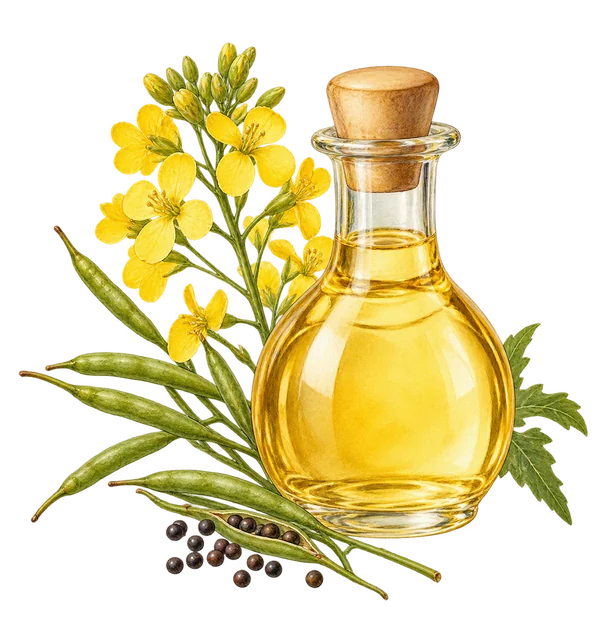
Key cautions
- Use only a product labelled for human food, not industrial rapeseed oil.
- Follow the product’s heating guidance; avoid repeatedly overheating oil or using a rancid-smelling product.
What’s inside
Predominantly unsaturated triglycerides, commonly rich in oleic acid with linoleic and alpha-linolenic acids. Refining and cultivar affect minor constituents and sensory properties.
Uses in brief

- Cooking and baking
- Dressings and cold preparation
History, folklore and reported uses
History, folklore and traditional uses
Cultivated and processed: UK, France, Germany and Poland.
Cultivated/plant breeding: Canada, including Saskatchewan and Manitoba.
Traditional, historical and reported uses
- Cooking and baking
Food or household practiceWhy this label?
The linked sources document this material-specific use; no treatment outcome or universal safety is inferred.
Polish food-quality guidance distinguishes pressed and refined edible oils. Food-grade rapeseed oil can provide the fat component of cooked foods and baking without transferring the seed’s protein or fibre.
- Dressings and cold preparation
Food or household practiceWhy this label?
The linked sources document this material-specific use; no treatment outcome or universal safety is inferred.
Cold-pressed rapeseed oils retain a more characteristic flavour, while refined oils are milder. The choice is culinary and product-specific, not a universal ranking of healthfulness.
2 supported material-specific uses; practices are not proof of treatment efficacy.
Historical-use additions reviewed 2026-10-09
Story sources
- European Commission: Agricultural outlook 2022, oilseed complex
- Polish food-quality inspectorate: ABC olejów roślinnych
- British Heart Foundation: Rapeseed oil, UK cultivation and culinary forms
- Statistics Canada: Canola, a Canadian success story
- NDSU Extension: Are seed oils good or bad for health?
- FAO/WHO Codex: Named vegetable oil identity and fatty-acid composition
Regional reading paths
These sourced notes describe cultivation, trade, food traditions or material history. A regional connection does not claim exclusive origin.
Europe
Cultivated and processed: UK, France, Germany and Poland.
Refined or cold-pressed food oil for cooking and dressings; use a culinary-labelled product.
North America
Cultivated/plant breeding: Canada, including Saskatchewan and Manitoba.
Culinary oil made from food-grade canola cultivars.
Identity & detailed reference
Identity
Food-grade low-erucic rapeseed oil, commonly called canola oil, is a fixed oil from selected Brassica cultivars. Brassica napus is prominent; commercial canola may also derive from B. rapa or B. juncea.
Ingredient details, preparation and research
Also known as: Canola oil; Low-erucic rapeseed oil
Source plant or material
Brassica napus L.
Plant family / material: Brassicaceae
Forms and route
Refined culinary oil or virgin/cold-pressed food oil. High-erucic industrial rapeseed oils and biodiesel are outside this card.
Vitamins and minerals
Oil supplies concentrated energy and fatty acids but essentially none of the whole seed’s fibre. Alpha-linolenic acid is a plant omega-3 and is not identical to EPA or DHA.
Absorption and preparation
Dietary fat can assist uptake of fat-soluble meal constituents. No particular brand, raw-oil ritual or additional supplement is required for that ordinary food role.
Practical preparation
Keep tightly closed away from light and heat. Choose refined or cold-pressed oil according to the recipe and label; the two may have different flavours and cooking applications.
Combination notes
Use as a recipe fat, including in a dressing or baked dish, rather than adding it as an obligatory supplement.
Traditional and reported uses
- Cooking and baking
- Dressings and cold preparation
Contraindications and cautions
- Use only a product labelled for human food, not industrial rapeseed oil.
- Follow the product’s heating guidance; avoid repeatedly overheating oil or using a rancid-smelling product.
Similar items and how they compare
- Sunflower oil
Both are fixed culinary seed oils.
Their fatty-acid profiles and botanical sources differ.
Canadian and European contexts
Statistics Canada records canola as a Canadian breeding and agricultural success, while European Commission reporting documents European rapeseed cultivation and crushing. Both associations can be true.
Composition is not a cure
Codex distinguishes named oils by botanical origin and compositional characteristics. Such specifications help identify the food; they do not establish that consuming extra oil treats a disease.
Evidence limits
No therapeutic dose or claim that all seed oils are harmful or beneficial is inferred. Product identity, dietary substitution and overall eating pattern matter.
Entry sources
- European Commission: Agricultural outlook 2022, oilseed complex
- Polish food-quality inspectorate: ABC olejów roślinnych
- British Heart Foundation: Rapeseed oil, UK cultivation and culinary forms
- Statistics Canada: Canola, a Canadian success story
- NDSU Extension: Are seed oils good or bad for health?
- FAO/WHO Codex: Named vegetable oil identity and fatty-acid composition
Reference entry 371 · Recorded content review: 2026-10-09 · Review scope and dates