


Key cautions
- Use correctly identified food-grade fruit; spoiled or improperly stored cooked portions should be discarded.
- Check mixed flour and baked-product labels for wheat or other allergens rather than assuming every breadfruit product is gluten-free.
- Follow commercial storage instructions for cut, frozen or prepared products.
What’s inside
Starch and fiber are important in mature fruit, alongside water and minerals. Ripening changes the balance of starch and sugars; flour concentrates dry matter.
Uses in brief

- Pacific staple dishes
- Caribbean cooked fruit
History, folklore and reported uses
History, folklore and traditional uses
The National Tropical Botanical Garden documents breadfruit diversity across Oceania, including cultivated Pacific varieties. University of Hawaii food guidance records its regional staple role. UWI’s Trinidad and Tobago account explains Caribbean introduction in the colonial era, a history distinct from Pacific domestication and cultivation.
A closer look at its history
A Pacific crop reached Caribbean botanical gardens
Pacific voyagers had already distributed breadfruit widely before European transport schemes. After the Bounty voyage failed, Bligh’s Providence expedition brought Tahitian varieties and a Timor variety to St. Vincent and Jamaica in 1793. French transfers followed different routes. NTBG’s account makes clear that Caribbean breadfruit diversity reflects particular introductions, not the full diversity conserved across the Pacific.
Timber, cloth and leaves gave the tree several lives
NTBG documents Pacific breadfruit wood in houses and canoes, inner bark in cloth and cordage, and leaves as food wrappers and plates. These material traditions belong alongside its food history, but should not automatically be assigned to every Caribbean island.
Leaf tea is a recorded tradition, not a treatment result
NTBG records West Indian use of yellowing leaves as tea for high blood pressure, asthma and diabetes. This preserves an attributed medicinal tradition; the account is not a clinical trial. It supplies neither proof of benefit nor a safe household dose, and food use of the fruit cannot establish the safety of leaf preparations.
A living collection makes diversity visible
NTBG’s breadfruit database documents named accessions with places of collection, fruit and tree traits, and seasonality. It distinguishes breadfruit, breadnut, dugdug and hybrids. This conservation record helps explain why speaking of one universal breadfruit season or one identical cooking texture erases useful diversity. It is a subset of the crop’s diversity, not a complete census.
Additional history reviewed 2026-10-12
Traditional, historical and reported uses
- Pacific staple dishes
Food or household practiceWhy this label?
Label describes the stated practice or evidence, not an efficacy grade. Exact form and cautions remain attached.
Pacific food guidance places breadfruit among familiar starchy foods. Island cuisines and cultivar preferences differ, so this does not imply one uniform Oceanian recipe.
- Caribbean cooked fruit
Food or household practiceWhy this label?
Label describes the stated practice or evidence, not an efficacy grade. Exact form and cautions remain attached.
UWI records Caribbean use in roasted, boiled and fried preparations. These methods give the same crop different textures and nutritional accompaniments.
2 supported uses; records describe the named form and are not treatment recommendations.
Historical-use additions reviewed 2026-10-09
Growing notes
Artocarpus altilis and explicitly identified cultivated breadfruit hybrids. Breadnut (A. camansi) is a different crop; fermented breadfruit is a preparation.
- Climate and lifecycle
- A long-lived tropical tree, not a seasonal vegetable. Check year-round temperature, water supply, wind exposure and eventual canopy size before planting. A USDA zone alone does not demonstrate that a site can support reliable breadfruit production. [1]
- Cultivar and propagation
- Choose a named, locally suitable nursery tree. Seedless selections require vegetative propagation; seed availability should not be assumed. NTBG records distinct Pacific origins and traits among cultivars, species and hybrids. [2] [1]
- Soil and water
- Choose a suitable well-drained site and maintain moisture during establishment and dry spells. Mulch helps retain water and suppress weeds; keep trunk access clear. Base nutrient additions on soil or leaf testing rather than copying a tropical commercial fertilizer rate. [1] [3]
- Pollination and harvest timing
- Breadfruit can form fruit without pollination. NTBG gives roughly 15–20 weeks for fruit development; that is not time from planting a tree. Its guide reports some micropropagated Maʻafala trees beginning to bear around 2½–3 years after planting. [4] [3]
- Pruning, pests and picking
- Begin size management while the tree is young, and inspect fruit for damage and decay. Match maturity signs to the cultivar. Do not climb untrained or stand beneath dropping fruit; safe harvest access should be planned before the tree becomes large. [3]
Growing sources and regional guidance
Growing notes reviewed 2026-10-12
Regional reading paths
These sourced notes describe cultivation, trade, food traditions or material history. A regional connection does not claim exclusive origin.
North America
Introduced/cultivated: Caribbean, including Trinidad and Tobago and Jamaica.
Starchy fruit cooked by roasting, boiling or frying.
Australia & Oceania
cultivated; Samoa, Hawaiʻi, Fiji and Micronesia
Cooked starchy fruit.
Identity & detailed reference
Identity
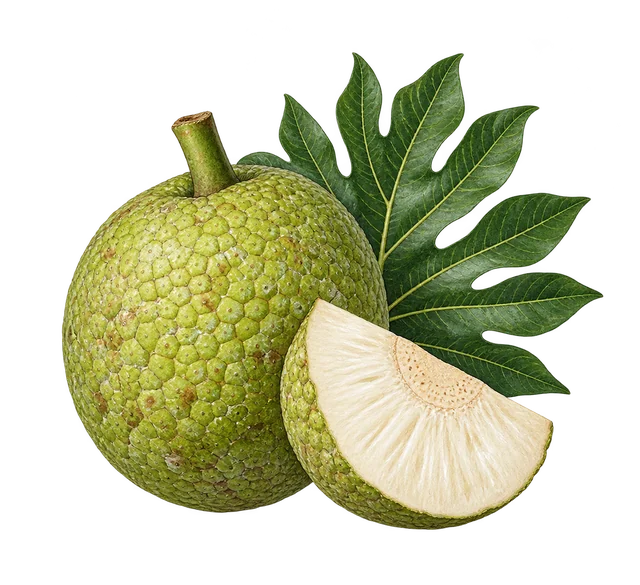
Fruit of Artocarpus altilis. Breadnut, Artocarpus camansi, and Artocarpus mariannensis or their hybrids require accurate separate identification.
Ingredient details, preparation and research
Also known as: Ulu; Breadfruit fruit
Source plant or material
Artocarpus altilis
Plant family / material: Moraceae
Forms and route
Mature firm fruit for cooking, ripe soft fruit, prepared frozen portions and food-grade flour. Cultivar, maturity and processing change texture and composition.
Vitamins and minerals
Breadfruit is primarily a starchy staple rather than a substitute for the protein content of legumes. Fried chips, plain boiled fruit and flour-based products have different nutrient profiles.
Absorption and preparation
Cooking makes a firm staple palatable. No special absorption-enhancing treatment or clinical blood-sugar benefit is established for every cultivar or preparation.
Practical preparation
Use a trusted recipe appropriate to the fruit’s maturity. Prepare mature fruit by boiling, roasting or baking and remove inedible portions as directed. Refrigerate cooked leftovers promptly.
Traditional and reported uses
- Pacific staple dishes
- Caribbean cooked fruit
Contraindications and cautions
- Use correctly identified food-grade fruit; spoiled or improperly stored cooked portions should be discarded.
- Check mixed flour and baked-product labels for wheat or other allergens rather than assuming every breadfruit product is gluten-free.
- Follow commercial storage instructions for cut, frozen or prepared products.
Diversity before health claims
Botanical research distinguishes breadfruit from breadnut and documents considerable cultivar diversity. A nutritional value or experimental result for one flour or variety should not be assigned to every fresh fruit dish.
Evidence limits
Regional history and food/material practice do not establish treatment efficacy. Composition depends on the named species, part and preparation; no medicinal dose or universal nutrient ranking is inferred.
Entry sources
- National Tropical Botanical Garden: Breadfruit species
- University of Hawaii: Pacific Food Guide, food preferences
- UWI Today: Breadfruit Flavours
Reference entry 416 · Recorded content review: 2026-10-09 · Review scope and dates