


Key cautions
- Eat only the food-grade root
- Peel before serving and do not use seeds, pods or vines in food or tea.
- Keep cut root refrigerated and discard spoiled material; raw cut produce requires clean handling.
What’s inside
Water, carbohydrate, fiber and vitamin C. The root’s juicy crunch differs from the composition and toxic constituents of other plant parts.
Uses in brief

- Crisp snack sticks
- Mixed fruit and vegetable dishes
History, folklore and reported uses
History, folklore and traditional uses
Mexico’s agriculture department describes jicama as a year-round vegetable and snack ingredient. UF/IFAS documents its cultivation in warm Florida conditions while emphasizing the strict root-only food boundary.
Traditional, historical and reported uses
- Crisp snack sticks
Food or household practiceWhy this label?
Label describes the stated practice or evidence, not an efficacy grade. Exact form and cautions remain attached.
Mexican food guidance describes jicama served with citrus and chile. Seasonings supply their own acidity, salt and heat rather than changing which plant parts are edible.
- Mixed fruit and vegetable dishes
Food or household practiceWhy this label?
Label describes the stated practice or evidence, not an efficacy grade. Exact form and cautions remain attached.
The same source records combinations with fruits and vegetables. Its firm texture makes it distinct from a soft starchy potato even though both are underground foods.
2 supported uses; records describe the named form and are not treatment recommendations.
Historical-use additions reviewed 2026-10-09
Regional reading paths
These sourced notes describe cultivation, trade, food traditions or material history. A regional connection does not claim exclusive origin.
North America
Cultivated: Mexico.
Peeled root eaten as a vegetable; seeds and other parts are not edible.
Identity & detailed reference
Identity
Peeled storage root of Pachyrhizus erosus. Despite the name yam bean, its seeds and pods must not be treated as ordinary beans.
Ingredient details, preparation and research
Also known as: Mexican yam bean; Mexican turnip
Source plant or material
Pachyrhizus erosus
Plant family / material: Fabaceae
Forms and route
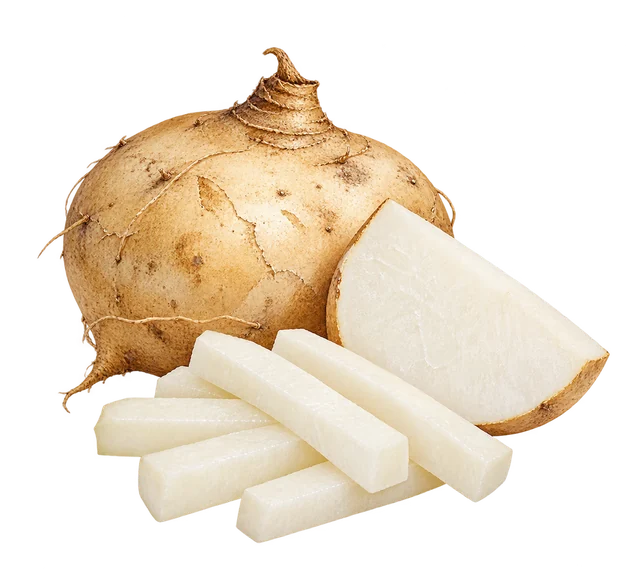
Fresh peeled root, cut sticks, salads and cooked vegetable preparations. Seed, leaf and vine products are excluded.
Vitamins and minerals
A root vegetable whose serving size and additions matter. Chile-salt coatings, sweet dressings and prepared snacks have a different nutrient profile from plain root.
Absorption and preparation
Fiber contributes to the food matrix; no disease-treatment or special mineral-absorption effect is established for a normal serving.
Practical preparation
Wash the exterior before peeling, remove the brown skin completely and cut with clean utensils. Use in a fresh recipe or cook as desired; refrigerate prepared portions.
Traditional and reported uses
- Crisp snack sticks
- Mixed fruit and vegetable dishes
Contraindications and cautions
- Eat only the food-grade root. UF/IFAS warns that other plant parts are poisonous.
- Peel before serving and do not use seeds, pods or vines in food or tea.
- Keep cut root refrigerated and discard spoiled material; raw cut produce requires clean handling.
Botany matters to safety
Jicama is a legume, but that family connection does not make its seeds edible. The root-only warning from UF/IFAS overrides any assumption that a yam bean can be prepared like common beans.
Regional identity
CONABIO’s domestication/diversification inventory helps establish its Mexican/Mesoamerican crop association; it is not clinical evidence for medicinal seed or leaf preparations.
Evidence limits
Regional history and food/material practice do not establish treatment efficacy. Composition depends on the named species, part and preparation; no medicinal dose or universal nutrient ranking is inferred.
Entry sources
- Mexico Agriculture: Jícama, una raíz muy jugosa
- UF/IFAS Gardening Solutions: Jicama
- CONABIO: Especies domesticadas en México
Reference entry 414 · Recorded content review: 2026-10-09 · Review scope and dates