


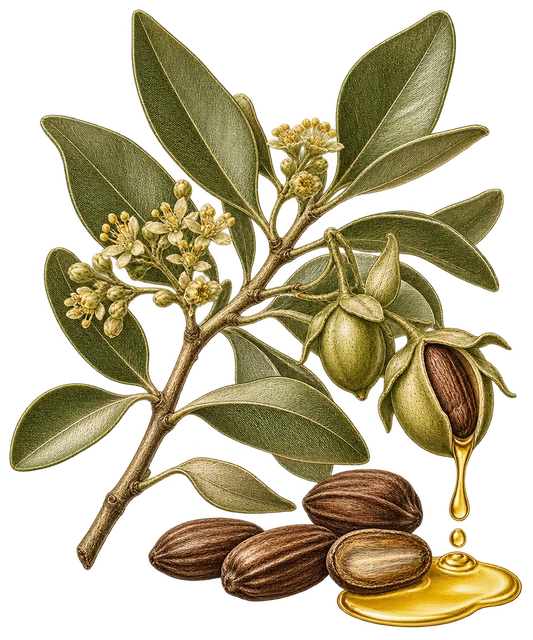
Key cautions
- External use only; jojoba is not a cooking or nutritional oil
- Test a small area and stop for irritation; a carrier does not make every added ingredient safe
What’s inside
Predominantly long-chain wax esters joining monounsaturated fatty acids to fatty alcohols, especially C20/C22 chains. Minor components and color vary with processing. Unlike most edible vegetable oils, triglycerides do not dominate.
Cosmetic Ingredient Review (2008): Safety assessment of jojoba oil, wax and derivatives
Uses in brief

- Cosmetic skin/cuticle softening and hair conditioning
- Traditional Sonoran Desert salves and balms; acne-treatment evidence remains limited
- Hair lengths: jojoba liquid wax offers cosmetic lubrication; detangling depends on the formulation, and regrowth is unproven.
History, folklore and reported uses
Softening dry and chafed skin
Jojoba liquid wax is used in moisturizing skin products; Ranzato and colleagues also record its folk reputation for chafed skin and sunburn. This is the waxy material sold as jojoba oil.
Ranzato et al. (2011): Wound healing properties of jojoba liquid wax, historical background
Hair conditioning and scalp care
The same account identifies jojoba wax in hair conditioners and records an older reputation for hair loss. Conditioning and the traditional hope of promoting growth are separate purposes, neither requiring the seed to be eaten.
Ranzato et al. (2011): Wound healing properties of jojoba liquid wax, historical background
Oily and blemish-prone skin
AromaWeb favors jojoba in natural-care routines for oily or acne-prone skin. This contemporary practitioner choice belongs to the liquid wax and its feel on the skin, rather than to the food history of roasted seeds.
A stable massage carrier
AromaWeb describes jojoba as a stable massage base valued for its skin feel, and attributes soothing and anti-inflammatory purposes to blends containing it. These are practitioner uses, not proof that the wax treats an inflammatory condition.
Burn and wound traditions, with the preparation named
The Desert Botanical Garden records O’odham use of a seed paste for burns; this is a related-material tradition, not evidence for bottled wax. Ranzato’s historical discussion separately records extracted liquid wax used for sores and wounds in the Sonoran region.
Desert Botanical Garden: Jojoba Plants in Arizona · Ranzato et al. (2011): Wound healing properties of jojoba liquid wax, historical background · Cosmetic Ingredient Review (2008): Safety assessment of jojoba oil, wax and derivatives
Industrial lubricant ingredient
USDA’s Agricultural Research Service reported in 2000 that jojoba oil was already an ingredient in industrial lubricants. This concerns the seed-derived liquid wax, a material use separate from skin and massage products.
USDA ARS: ARS Researchers Develop New Markets for Jojoba (2000)
A desert shrub and its seed traditions
The Sonoran Desert’s jojoba shrub has tough, leathery leaves and acorn-like seeds. The Desert Botanical Garden records Cahuilla preparation of roasted seeds as a coffee-like drink. This belongs to the source seed’s history, not to the filtered cosmetic liquid wax sold as jojoba oil.
Whale conservation and a new crop
Restrictions on sperm-whale oil in the early 1970s encouraged interest in jojoba because the two waxes had useful similarities. The Desert Botanical Garden describes Native American communities in Arizona and California collaborating with federal researchers, followed by a cultivation boom and disappointment over unpredictable yields. Cosmetics became jojoba’s lasting commercial home, linking local plant knowledge with conservation and agricultural experimentation.
Regional reading paths
These sourced notes describe cultivation, trade, food traditions or material history. A regional connection does not claim exclusive origin.
North America
Native/cultivated: Sonoran Desert, United States and Mexico.
Liquid wax used in cosmetics and balms; not a cooking oil.
Identity & detailed reference
Identity
Simmondsia chinensis (Link) C.K.Schneid.; a seed-derived liquid wax, commonly sold as a cosmetic carrier oil. It is chemically different from triglyceride-rich food oils.
Ingredient details, preparation and research
Source plant or material
Simmondsia chinensis (Link) C.K.Schneid., a Sonoran Desert shrub; the expressed seed lipid is the material used here.
Plant family / material: Simmondsiaceae (jojoba family).
Forms and route
Expressed unrefined or refined seed liquid wax; an ingredient in skin creams, cleansing oils, cuticle products and hair conditioners. Hydrogenated jojoba, jojoba esters and other processed wax derivatives are separate ingredients.
Food sources
Not applicable to the cosmetic liquid wax: use food-grade edible oils, nuts or seeds for dietary fats.
Vitamins and minerals
Topical use provides no dietary nutrient serving. Wax-ester composition and any vitamin E in a cosmetic formula are not evidence that applying it meets vitamin or essential-fat requirements. Do not invent an edible tablespoon or a dietary percent Daily Value for jojoba.
Absorption and preparation
A six-volunteer study detected the tested jojoba only in the upper stratum corneum. Jojoba was the exception to the similar reduction in transepidermal water loss seen with the other oils; this small experiment does not establish deep delivery or clinical barrier repair.
Practical preparation
Use a finished product intended for the relevant skin or hair area and follow its directions. Keep the container closed and follow its storage/expiry label. Small-area tolerance testing is preferable to trying several new products simultaneously; do not make an oral preparation.
Combination notes
Jojoba can be a vehicle in a formulated cosmetic, but each added fragrance, essential oil or active ingredient needs its own safety assessment. A trial of a clay–jojoba mask or an essential-oil blend does not demonstrate synergy or the effect of jojoba alone.
Traditional and reported uses
- The U.S. National Park Service records local Indigenous use of jojoba wax in soothing salves and balms in the Sonoran Desert.
- Contemporary cosmetic use includes skin and cuticle softening, conditioning hair, and carrying ingredients in finished topical products.
- Acne and wound-healing research is preliminary or indirect; results from clay masks, cultured cells or essential-oil mixtures do not establish pure jojoba as a treatment.
- Hair lengths: jojoba liquid wax offers cosmetic lubrication; detangling depends on the formulation, and regrowth is unproven.
Contraindications and cautions
- Use cosmetic jojoba externally. Do not swallow it or use it as a cooking oil; no dietary serving is assigned.
- Contact dermatitis has been reported. Test a small area first and stop for persistent redness, itching, swelling or rash; a home trial cannot rule out every allergy.
- A carrier does not neutralize an irritating essential oil or perfume. Assess the complete formula and its intended route.
- Do not put ordinary cosmetic oil into eyes or improvise treatment of infected wounds, substantial burns or persistent acne. Cosmetic safety assessments are not evidence of medicinal effectiveness.
Similar items and how they compare
- Grapeseed oil
A cosmetic carrier paired with jojoba in a published alopecia-areata mixture trial.
Grapeseed is a triglyceride oil; both carriers were in the control, so that trial cannot establish either carrier as a hair-regrowth treatment.
- Rosehip oil
Another seed-derived material used in skin oils and conditioning formulas.
Rosehip is rich in polyunsaturated triglycerides; jojoba is predominantly long-chain wax esters.
- Petrolatum
A useful comparison for moisture-retaining topical products.
Petrolatum is a mineral-derived semisolid and produced greater occlusion than the oils in the small penetration study.
Botanical source and the meaning of oil
Kew accepts Simmondsia chinensis in Simmondsiaceae. Seed expression produces a naturally liquid wax. The CIR assessment describes approximately 97% wax esters, mainly involving long monounsaturated acid/alcohol chains. Hydrogenation or other modification changes the material; evidence for a processed ester, butter or hard wax should not be assigned automatically to unmodified seed liquid wax.
Attributed tradition and cosmetic practice
The National Park Service describes Indigenous peoples of the Sonoran Desert using the seed wax in salves and balms, and its later commercial use in shampoos and cosmetics. This is a specifically attributed history, not proof that every preparation treats disease. Modern conditioning means improved skin or hair feel; it is not a promise to normalize sebum production.
Acne evidence: a mask, without a control group
In a six-week open observational study, 194 people returned questionnaires after using a clay–jojoba mask; 133 supplied usable complete lesion counts. Mean total lesions fell 54% from baseline. There was no untreated or placebo comparison, substantial incomplete data, and two principal materials in the mask. The result cannot identify a jojoba effect or establish pure oil as an acne medicine.
Skin penetration and moisture retention
Patzelt and colleagues tested oils in six healthy volunteers using microscopy and transepidermal water-loss measurements. Penetration remained in the outermost stratum-corneum layers. Jojoba was specifically excluded from the similar occlusive effect reported for the other oils; petrolatum gave the greatest occlusion. This supports caution with both “deeply absorbed” marketing and claims of proven barrier repair.
Cell experiments are not wound-care trials
A 2011 experiment exposed cultured HaCaT keratinocytes and human dermal fibroblasts to jojoba liquid wax. Scratch closure accelerated and fibroblast collagen-I synthesis increased, with calcium-dependent signaling implicated. These are cell-culture findings, not evidence that household oil safely heals open, infected or chronic wounds in people.
Hair study: jojoba was also in the control
The 1998 alopecia-areata paper compared an essential-oil mixture in jojoba/grapeseed carriers with the same carriers alone for seven months. It reported improvement in 19/43 versus 6/41 participants. The full methods describe 86 invited and two excluded before 84 were allocated. This product comparison does not isolate jojoba or apply automatically to other causes of hair loss. The authors’ 1999 reply describes alternating allocation, a predictable method that weakens the original claim of randomization.
Topical safety and route boundaries
CIR judged the reviewed ingredients safe under the cosmetic uses/concentrations assessed; that is neither an ingestion assessment nor blanket approval of all blends. A published contact-dermatitis report means allergy remains possible. AAD advises trying new skin products on a small area before wider use and stopping a product that provokes a reaction. Eye-area or wound use needs an appropriately formulated product.
Nutrition, preparation and related materials
No edible serving or dietary vitamin/mineral contribution is assigned to this cosmetic wax. Local conditioning is not nutritional absorption. Keep food uses separate, identify modified jojoba derivatives on labels, and avoid copying medicinal doses from unrelated oils. Rosehip is a fatty-acid-rich triglyceride oil; petrolatum is a more occlusive mineral-derived comparison. No added-food or supplement combination is required for topical jojoba.
Hair care: cosmetic role and evidence limits
Jojoba is a liquid seed wax, commonly called an oil. Its cosmetic role is lubrication and conditioning of existing hair. In one damaged-hair conditioner experiment, the jojoba formulation did not significantly reduce combing resistance; do not promise an ingredient-specific detangling result. Its role as a carrier in an essential-oil blend does not establish jojoba-only regrowth. Cosmetic conditioning can improve the feel or appearance of existing lengths; it is not evidence of new hair growth. Oils do not add water to hair: laboratory moisture studies address changes in water movement, not a universal “hydration” effect. Use a small amount of a tolerated hair product on lengths or ends according to its label, alongside conditioner and gentle detangling. Stop for irritation; persistent scalp itching, redness or loss needs assessment.
Entry sources
- Kew Plants of the World Online: Simmondsia chinensis, accepted name and Simmondsiaceae
- Cosmetic Ingredient Review (2008): Safety assessment of jojoba oil, wax and derivatives
- U.S. National Park Service: Sonoran Desert jojoba and Indigenous salve use
- Meier et al. (2012): Uncontrolled clay–jojoba facial-mask pilot study
- Patzelt et al. (2012): Oil penetration and skin barrier study in six volunteers
- Ranzato et al. (2011): Jojoba liquid wax in cultured keratinocytes and fibroblasts
- Wantke et al. (1996): Contact dermatitis from jojoba oil and myristyl lactate/maleated soybean oil
- Hay et al. (1998): Essential-oil mixture versus jojoba/grapeseed carriers in alopecia areata
- American Academy of Dermatology: How to test skin care products
- Grajzer et al. (2015): Composition and oxidative stability of two cold-pressed rosehip oils
- Hay and Ormerod (1999): Author reply clarifies alternating allocation in the 1998 alopecia trial
- Hay et al. (1998): Full methods, 86 invited and 84 allocated after two exclusions
- USDA ARS: ARS Researchers Develop New Markets for Jojoba (2000)
- Brazilian Journal of Pharmaceutical Sciences: Vegetable-oil conditioner evaluation
- Keis et al. (2007): Effect of oil films on moisture vapor absorption on human hair
- AAD: How to stop damaging your hair
Reference entry 30 · Recorded content review: 2026-10-05 · Review scope and dates