


Key cautions
- Buy from a knowledgeable food supplier or obtain expert identification; this card is not a foraging guide.
- Cook thoroughly and avoid raw consumption
- Do not substitute hen of the woods or assume all Laetiporus species and substrates share the same safety record.
What’s inside
Water, fungal polysaccharides and protein; texture changes strongly with age. These constituents do not establish the effects claimed for concentrated fungal extracts.
Uses in brief

- Cooked casserole ingredient
- Enchilada filling
History, folklore and reported uses
History, folklore and traditional uses
A 2025 Mid-Atlantic study records chicken of the woods among commonly reported harvested mushrooms. Its nonrandom survey documents participating harvesters’ practice, not a continental popularity ranking or confirmation of every specimen.
A closer look at its history
A food name that crosses species boundaries
The chicken-of-the-woods name describes a culinary resemblance, while taxonomy distinguishes multiple fungi adapted to different regions and hosts. Retaining the local species beside the recipe or historical account preserves more information than collapsing every orange shelf into one worldwide L. sulphureus.
Additional history reviewed 2026-10-09
Traditional, historical and reported uses
- Cooked casserole ingredient
Food or household practiceWhy this label?
Label describes the stated practice or evidence, not an efficacy grade. Exact form and cautions remain attached.
Missouri Conservation describes the fungus as a textural substitute in casseroles. This is culinary substitution, not equal protein or micronutrient content.
- Enchilada filling
Food or household practiceWhy this label?
Label describes the stated practice or evidence, not an efficacy grade. Exact form and cautions remain attached.
The same authority records its use in enchiladas and other cooked dishes. Reactions remain possible even after appropriate preparation.
2 supported uses; records describe the named form and are not treatment recommendations.
Historical-use additions reviewed 2026-10-09
Features and lookalikes to study
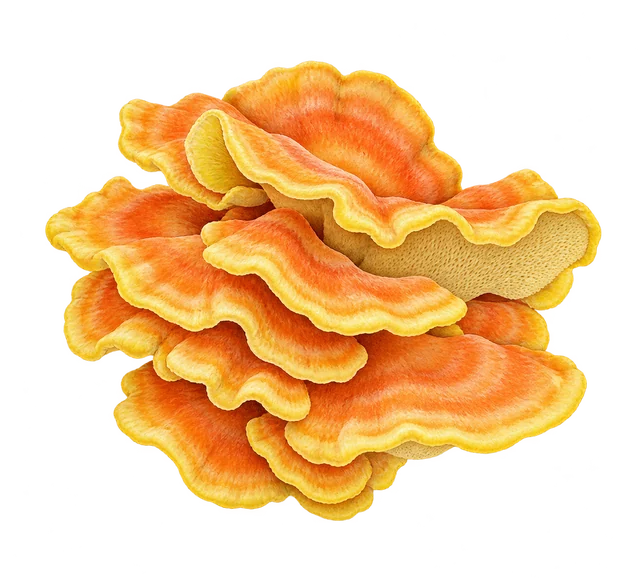
Laetiporus species sold as chicken of the woods, especially L. sulphureus and L. cincinnatus in eastern North American references. Not Grifola frondosa, the hen of the woods.
Common names vary between regions and suppliers; the scientific scope above governs this card.
Morphology described in sources
- Laetiporus forms fleshy shelving or rosette-like polypores. Eastern North American L. sulphureus usually has yellow pores; L. cincinnatus has a white pore surface and often fruits from roots near tree bases.
- Habitat and substrate
- See the source-linked morphology and comparison notes below; a separate habitat summary has not been verified for this card.
- Geographic scope
- A complete regional range is not established here. Broad common names and commercial labels can span different species.
- Season in the cited region
- No region-specific fruiting season has been verified for this card. Do not infer a local season from trade availability.
Other Laetiporus species
Host tree, geography, attachment, pore surface and microscopic or genetic evidence distinguish regional species.
Yellow versus white pores alone does not resolve every Laetiporus worldwide. Older broad L. sulphureus records include several species.
Hapalopilus croceus and other orange brackets
H. croceus has orange angular pores and a fuzzy cap; typical L. sulphureus has yellow pores and shelving clusters.
This comparison does not claim all Hapalopilus are equivalent. Colour fades and other polypores exist; “orange shelf” is not a safe identification.
Limits and regional differences
- Hen of the woods is Grifola, a different fungus. Do not assume all polypores are edible, and do not assume cooking makes an unknown bracket safe. Species identity does not remove the possibility of an adverse reaction.
- Educational comparison only. Neither this card, an illustration, a photograph, a spore-print colour nor a checklist establishes that a wild collection is safe to eat. A qualified local mycologist must assess uncertain material; do not taste an unknown fungus. Cooking does not reliably eliminate mushroom toxins.
Regional reading paths
These sourced notes describe cultivation, trade, food traditions or material history. A regional connection does not claim exclusive origin.
North America
Wild-harvested: United States Mid-Atlantic forests.
Cooked culinary fungus after expert species and substrate identification.
Identity & detailed reference
Identity
Laetiporus species sold as chicken of the woods, especially L. sulphureus and L. cincinnatus in eastern North American references. Not Grifola frondosa, the hen of the woods.
Ingredient details, preparation and research
Also known as: Sulfur shelf; Chicken mushroom
Source plant or material
Laetiporus spp.
Fungal family: Laetiporaceae; older field guides may use Polyporaceae
Forms and route
Fresh identified culinary fruiting bodies and properly preserved food products. Wild specimens identified only by a photo or common name are excluded.
Vitamins and minerals
A mushroom food whose name describes texture, not nutritional equivalence to poultry. Species and preparation prevent assigning one universal nutrient profile.
Absorption and preparation
Cooking changes texture and digestibility but cannot make an incorrectly identified or unsuitable specimen safe.
Practical preparation
Use sound, food-grade material with clear provenance. Follow culinary supplier instructions and refrigerate promptly. Discard deteriorated specimens rather than trying to rescue them.
Traditional and reported uses
- Cooked casserole ingredient
- Enchilada filling
Contraindications and cautions
- Buy from a knowledgeable food supplier or obtain expert identification; this card is not a foraging guide.
- Cook thoroughly and avoid raw consumption. Some people develop stomach upset or swollen lips even from correctly identified material.
- Do not substitute hen of the woods or assume all Laetiporus species and substrates share the same safety record.
Reported harvest is not specimen validation
The Mid-Atlantic study acknowledges that specimens were not voucher-confirmed for every report. The authors do not present the survey as an identification or food-safety guide.
Species distinction
Missouri’s separate accounts distinguish L. cincinnatus and L. sulphureus. Their useful local information should not become a blanket endorsement of every orange shelf fungus worldwide.
Evidence limits
Regional history and food/material practice do not establish treatment efficacy. Composition depends on the named species, part and preparation; no medicinal dose or universal nutrient ranking is inferred.
Entry sources
- Missouri Department of Conservation: Pale Chicken of the Woods
- Missouri Department of Conservation: Ask MDC, November 2021
- Wrobleski and Burkhart (2025): Mushroom harvests in the Mid-Atlantic United States
- Penn State: Wild mushroom harvesters in mid-Atlantic region
Reference entry 397 · Recorded content review: 2026-10-09 · Review scope and dates