


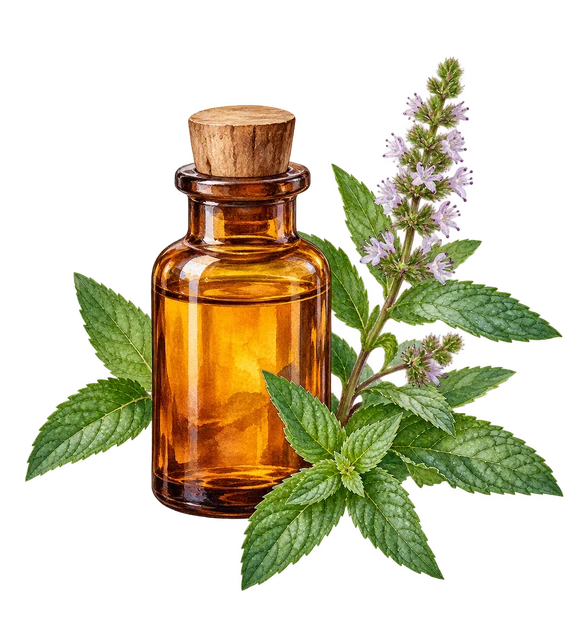
Key cautions
- Do not swallow retail essential oil or add it to drinking water as a home remedy.
- Use only products formulated for the stated route; avoid eyes and damaged skin and stop if irritation occurs.
- Keep concentrated oils away from children and pets.
What’s inside
Carvone is a major characteristic odorant; limonene and other volatile compounds contribute aroma. Oil chemistry differs among commercial mint types.
Uses in brief

- Commercial food flavoring
- Dental-product flavor
History, folklore and reported uses
History, folklore and traditional uses
Oregon State documents the Pacific Northwest as an important mint-growing and distilling region. This is a cultivated industrial connection; the trade term native spearmint does not establish botanical nativity to North America.
Traditional, historical and reported uses
- Commercial food flavoring
Food or household practiceWhy this label?
Label describes the stated practice or evidence, not an efficacy grade. Exact form and cautions remain attached.
Regional mint production supplies flavor for chewing gum and confectionery. Formulation and food-grade specifications determine appropriate use.
- Dental-product flavor
Food or household practiceWhy this label?
Label describes the stated practice or evidence, not an efficacy grade. Exact form and cautions remain attached.
Oregon State also records mint oil use in dental products. A formulated toothpaste or mouth-care product must not be replaced by applying raw oil.
2 supported uses; records describe the named form and are not treatment recommendations.
Historical-use additions reviewed 2026-10-09
Regional reading paths
These sourced notes describe cultivation, trade, food traditions or material history. A regional connection does not claim exclusive origin.
North America
Introduced/cultivated/distilled: United States Pacific Northwest.
Concentrated mint ingredient for formulated flavor/fragrance products.
Identity & detailed reference
Identity
Essential oil associated with Mentha spicata; commercial Scotch spearmint oils have a distinct hybrid identity and should be identified on the specification.
Ingredient details, preparation and research
Also known as: Spearmint oil
Source plant or material
Mentha spicata; commercial Scotch-mint oils require separate identity
Plant family / material: Lamiaceae
Forms and route
Steam-distilled essential oil and formulated products containing it. Culinary leaf, water infusion, fatty carrier oil and spearmint extract are separate forms.
Food sources
Not a whole-food card.
Vitamins and minerals
Not a dietary source of the leaf’s fiber, vitamins or minerals. Its use as a trace flavoring does not turn a retail essential-oil bottle into a food supplement.
Absorption and preparation
Water does not reliably dilute an essential oil into a safe drinking preparation. Clinical results for peppermint capsules or spearmint extracts cannot be copied to this oil.
Practical preparation
Follow the finished product’s label. No home dilution ratio, medicinal dose, diffuser prescription or oil-extraction instructions are supplied.
Traditional and reported uses
- Commercial food flavoring
- Dental-product flavor
Contraindications and cautions
- Do not swallow retail essential oil or add it to drinking water as a home remedy.
- Use only products formulated for the stated route; avoid eyes and damaged skin and stop if irritation occurs.
- Keep concentrated oils away from children and pets.
Odor chemistry is not efficacy
A comparative analytical study found carvone and several other potent odorants in native, Scotch and Macho mint oils. Chemical identification explains aroma; it does not prove treatment of hormonal, digestive or memory problems.
Evidence limits
Regional history and food/material practice do not establish treatment efficacy. Composition depends on the named species, part and preparation; no medicinal dose or universal nutrient ranking is inferred.
Entry sources
- Oregon State Extension: Oregon, Washington and Idaho mint crops
- Study: Identification and Quantitation of Potent Odorants in Spearmint Oils
- National Capital Poison Center: Essential oils, poisonous when misused
Reference entry 395 · Recorded content review: 2026-10-09 · Review scope and dates