


Key cautions
- Follow refrigeration and after-opening directions; a sour smell alone is not a safety test.
- For home production, use a validated food-preservation recipe and do not independently reduce its salt or change critical proportions.
What’s inside
Cabbage fibre and fermentation-derived organic acids, with salt from processing. Live microbial content depends on heat treatment, storage and production; it is not a guaranteed probiotic dose.
Uses in brief

- Fermented vegetable accompaniment
- Cooked regional dishes
History, folklore and reported uses
History, folklore and traditional uses
Traditional processing: Alsace, France, and central-European cabbage fermentation.
Traditional, historical and reported uses
- Fermented vegetable accompaniment
Food or household practiceWhy this label?
The linked sources document this material-specific use; no treatment outcome or universal safety is inferred.
The Alsace specification describes the character and processing of the cabbage product. It can be served as a sour vegetable, separate from the mixed regional meal also called choucroute.
- Cooked regional dishes
Food or household practiceWhy this label?
The linked sources document this material-specific use; no treatment outcome or universal safety is inferred.
Sauerkraut is also used in prepared dishes, and USDA describes heat processing for preservation. Heating changes microbial viability, so cooked and unheated servings should not be presented as identical live-culture foods.
2 supported material-specific uses; practices are not proof of treatment efficacy.
Historical-use additions reviewed 2026-10-09
Regional reading paths
These sourced notes describe cultivation, trade, food traditions or material history. A regional connection does not claim exclusive origin.
Europe
Traditional processing: Alsace, France, and central-European cabbage fermentation.
Soured cabbage eaten as a vegetable; use tested food-safety methods rather than improvising preservation.
Identity & detailed reference
Identity
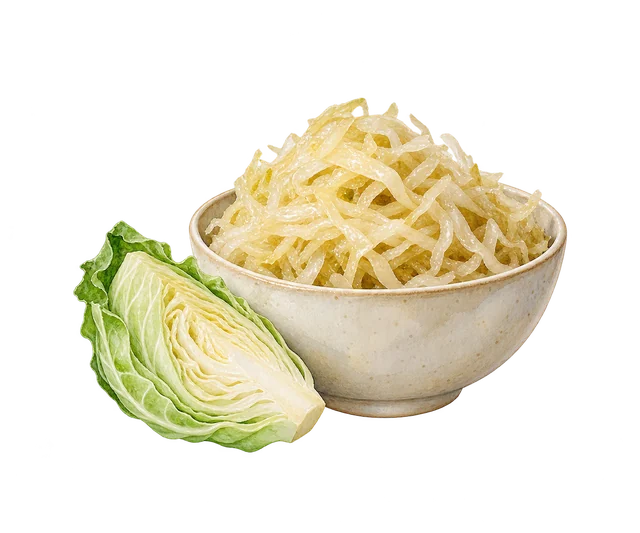
Sauerkraut is cabbage transformed by lactic-acid fermentation under controlled food-production conditions. It is a processed vegetable, not simply raw cabbage with an acidic dressing.
Ingredient details, preparation and research
Also known as: Choucroute; Fermented cabbage
Source plant or material
Brassica oleracea L. (cabbage) + lactic-acid fermentation
Plant family / material: Brassicaceae; fermentation involves microbial communities
Forms and route
Refrigerated unpasteurised sauerkraut and heat-treated canned or jarred products. Seasoned dishes may contain meat or other additions and are not automatically plant-only.
Vitamins and minerals
Salt content can be substantial and varies by brand. Heating, draining and processing affect the food; no universal vitamin or live-culture quantity is assigned.
Absorption and preparation
Fermentation transforms some plant compounds, but this alone does not prove improved nutrient absorption or a treatment effect in the person eating it.
Practical preparation
Choose a reputable product and follow its storage directions. If making sauerkraut, use the complete tested NCHFP/USDA process; this card intentionally omits an abbreviated fermentation recipe.
Combination notes
Check the ingredients of a prepared sauerkraut meal: meats, added fats and salt may change its dietary suitability.
Traditional and reported uses
- Fermented vegetable accompaniment
- Cooked regional dishes
Contraindications and cautions
- Follow refrigeration and after-opening directions; a sour smell alone is not a safety test.
- For home production, use a validated food-preservation recipe and do not independently reduce its salt or change critical proportions.
- People limiting sodium should compare labels and portions rather than assuming fermented vegetables are low-salt.
Similar items and how they compare
- Fresh cabbage
Both begin with cabbage tissue.
Fermentation changes acidity, salt content and storage requirements.
Fermented does not mean probiotic
NIH distinguishes probiotics by identified organisms and demonstrated effects. A naturally fermented cabbage with unspecified microbes does not automatically meet that standard.
Safety relies on the whole process
NCHFP and USDA guidance treats salt, temperature, handling and storage as an integrated process. Historical use or acidity on the tongue is not a replacement for those controls.
Evidence limits
No cure for digestive problems, immune benefit or probiotic guarantee is claimed. This is a food description, not a self-contained preservation protocol.
Entry sources
- EU official product specification: Choucroute d’Alsace (2018)
- National Center for Home Food Preservation: General information on fermenting
- USDA: Preparing and canning fermented foods and pickled vegetables
- NIH ODS: Probiotics, food and supplement distinctions
Reference entry 385 · Recorded content review: 2026-10-09 · Review scope and dates