


Key cautions
- Never eat horse chestnuts or assume a roadside nut is an edible Castanea. Buy identified food-grade chestnuts.
- Score the shell before roasting so steam can escape; handle hot nuts carefully.
What’s inside
More starch and less fat than many commonly eaten nuts, together with fibre and natural sugars. Cooking and drying strongly affect texture and composition by weight.
Uses in brief

- Roasted or cooked kernels
- Piedmont confections
- Baking and dessert ingredient
History, folklore and reported uses
History, folklore and traditional uses
Cultivated and traditional processing: Cuneo and Piedmont, Italy.
Traditional, historical and reported uses
- Roasted or cooked kernels
Food or household practiceWhy this label?
The linked sources document this material-specific use; no treatment outcome or universal safety is inferred.
Michigan State Extension describes roasting and other food preparation. Edible chestnuts become a soft, starchy ingredient, distinct from oily tree-nut kernels.
- Piedmont confections
Food or household practiceWhy this label?
The linked sources document this material-specific use; no treatment outcome or universal safety is inferred.
Italia.it records Cuneo’s marron glacé tradition. Candied chestnuts are a specific sweet preparation whose added sugar is not part of raw-fruit composition.
- Baking and dessert ingredient
Food or household practiceWhy this label?
The linked sources document this material-specific use; no treatment outcome or universal safety is inferred.
Extension food guidance records chestnuts in pastries and other dishes. Chestnut flour and cooked pieces require recipe-specific handling rather than automatic substitution for wheat flour.
3 supported material-specific uses; practices are not proof of treatment efficacy.
Historical-use additions reviewed 2026-10-09
Regional reading paths
These sourced notes describe cultivation, trade, food traditions or material history. A regional connection does not claim exclusive origin.
Europe
Cultivated and traditional processing: Cuneo and Piedmont, Italy.
Edible sweet chestnuts roasted, cooked or made into flour and confections; not horse chestnuts.
Identity & detailed reference
Identity
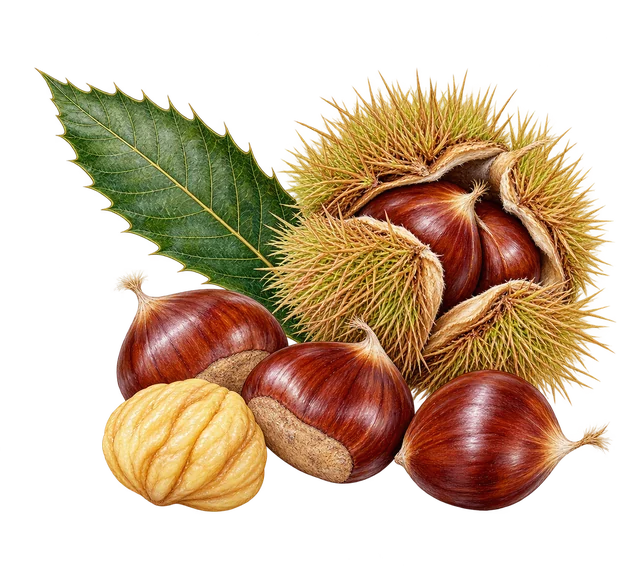
Sweet chestnuts are edible nuts of Castanea sativa in this European profile. Horse chestnuts or conkers come from Aesculus and are not an edible substitute.
Ingredient details, preparation and research
Also known as: European chestnuts; Castanea sativa
Source plant or material
Castanea sativa Mill.
Plant family / material: Fagaceae
Forms and route
Food-grade fresh chestnuts, cooked peeled kernels, dried chestnuts, flour and sweet preserves. Products made from other edible Castanea species need their own identity.
Vitamins and minerals
Chestnuts are not nutritionally interchangeable with walnuts or hazelnuts. Flour is dry and concentrated relative to a moist cooked kernel; candied chestnuts add substantial recipe sugar.
Absorption and preparation
Cooking softens the starch-rich kernel and makes peeling practical. This food-processing role does not show that chestnut remedies improve digestion or mineral uptake.
Practical preparation
Refrigerate fresh chestnuts as directed. For roasting, use a tested culinary method that includes shell scoring; peel when safe to handle. Do not use cooking to rescue mouldy or unidentified nuts.
Combination notes
Use chestnut pieces or flour in a suitable recipe; check the complete dish for gluten, allergens and added sugar.
Traditional and reported uses
- Roasted or cooked kernels
- Piedmont confections
- Baking and dessert ingredient
Contraindications and cautions
- Never eat horse chestnuts or assume a roadside nut is an edible Castanea. Buy identified food-grade chestnuts.
- Score the shell before roasting so steam can escape; handle hot nuts carefully.
- Fresh chestnuts can spoil and should be stored as a perishable food rather than like a dry decorative nut.
Similar items and how they compare
- Horse chestnut
The common names and brown shells can be confused.
Aesculus conkers are not edible sweet chestnuts.
Sweet versus horse chestnut
The botanical distinction is a practical safety boundary. Similar common names and glossy brown shells do not establish edible identity.
A different kind of nut food
USDA named-form data support keeping chestnuts separate from higher-fat nuts. Dry, raw, boiled and roasted entries should not be combined into one universal serving value.
Evidence limits
This is a food profile, not a foraging guide or a claim about horse-chestnut medicinal extracts. No unsupported nutrient numbers are supplied.
Entry sources
- Italia.it: Piedmont hazelnuts and chestnut traditions
- Michigan State University Extension: Horse chestnuts versus sweet chestnuts
- Michigan State University Extension: Chestnut food preparation and composition
- USDA SR28: Nuts and seed products, named edible forms
Reference entry 384 · Recorded content review: 2026-10-09 · Review scope and dates