


Key cautions
- Avoid with fennel/Apiaceae or mugwort-pollen allergy. Medicinal use is not recommended during pregnancy or breastfeeding.
- Child use needs a suitable product and professional advice; estragole exposure matters. Essential oil is not a substitute for fruit tea.
What’s inside
Fruit contains volatile oil rich in trans-anethole, with fenchone, estragole and limonene. Tea, tincture and distilled oil have different compositions; cultivar and processing matter.
EFSA: Sweet fennel essential-oil composition assessment, 2023, amended 2025; animal-feed context · EFSA: Sweet fennel tincture composition assessment, 2023; animal-feed context · EMA: Sweet fennel fruit, final monograph revision 1, 31 January 2024 · EMA: Sweet and bitter fennel fruit assessment, revision 1
Uses in brief

- European traditional use for mild digestive cramps, bloating and gas.
- Also traditionally used for minor menstrual cramps and a mucus-producing cough with a cold.
History, folklore and reported uses
Fruits, fasting and the kitchen
Older fennel traditions included seasoning fish and fasting meals and quieting hunger. The plant supplied roots, leaves and fruits for different uses. A modern Italian ingredient record specifically identifies sweet-fennel fruits in bread, breadsticks and pastries; these are distinct from Florence-fennel bulbs.
The Met: Honoring Fennel · Bauer 1884: Sweet Fennel, Foeniculum dulce, ingredient profile
Three fruit-remedy traditions
European practice used sweet-fennel-fruit preparations for digestive cramps, bloating and wind; minor menstrual cramps; and coughs associated with a cold. The menstrual tradition concerned crushed or powdered fruits taken orally. These particular sweet-fruit preparations belong to one strand of a broader fennel history.
EMA: Sweet and bitter fennel fruit assessment, revision 1 · EMA: Sweet fennel fruit, overview and current document list
A gardener-poet’s fennel
The ninth-century Walahfrid Strabo praised fennel for stomach discomfort, clouded sight and a rasping cough, using the root in his cough account. His poem concerns fennel broadly, rather than securely identifying today’s medicinal sweet-fruit variety.
An herb against unseen harm
In Lacnunga, an Anglo-Saxon collection of remedies and charms, fennel appears among nine powerful herbs in healing charms. Flying venom and elf-shot illness belonged to that period’s explanations of sickness, placing the fragrant plant in a protective as well as a practical role.
Regional reading paths
These sourced notes describe cultivation, trade, food traditions or material history. A regional connection does not claim exclusive origin.
Europe
Traditional processing/use: European fennel-fruit preparations assessed by EMA; Mediterranean cultivation.
Dried aromatic fruits for food flavouring; essential oil is a different preparation.
Identity & detailed reference
Identity
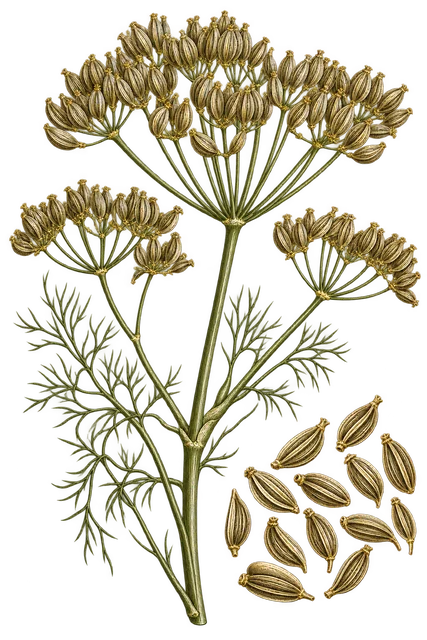
Foeniculum vulgare Mill. subsp. vulgare var. dulce (Mill.) Batt. & Trab., the sweet-fennel medicinal variety; dried fruit, commonly called seed.
Ingredient details, preparation and research
Source plant or material
Foeniculum vulgare Mill. subsp. vulgare var. dulce (Mill.) Batt. & Trab.; dried fruit, commonly called seed.
Plant family / material: Apiaceae (carrot/parsley family).
Forms and route
Whole culinary fruit and oral dried-fruit tea. Tinctures/extracts are different preparations; swallowed essential oil is not a substitute. The sweet-fennel monograph concerns fruit tea, not the vegetable bulb or every fennel product.
Vitamins and minerals
For eaten whole fennel fruits, USDA’s 1 teaspoon (2 g) supplies about 24 mg calcium, 0.37 mg iron and 0.13 mg manganese: approximately 2%, 2% and 6% Daily Value. These modest contributions do not apply to strained tea, and bulb nutrition does not describe seed products.
Absorption and preparation
Hot-water extraction and intestinal absorption are different processes. No clinical food-pairing method is established to improve sweet-fennel tea’s effect. Follow a suitable product’s label rather than making it stronger; tea, tincture and essential oil have different concentrations and estragole exposure.
Traditional and reported uses
- Traditional European use: mild digestive cramps, bloating and gas.
- Traditional European use: minor cramps associated with menstruation.
- Traditional European use: helping loosen mucus during a cold-related cough.
Contraindications and cautions
- Avoid with fennel, anethole, Apiaceae-family or mugwort-pollen allergy; skin and respiratory reactions are possible.
- Medicinal use during pregnancy and breastfeeding is not recommended because safety is unestablished; trans-anethole can enter breast milk.
- Estragole exposure should be kept as low as practicable. Culinary seasoning, repeated medicinal tea and concentrated oil are different exposures; avoid unnecessarily prolonged or concentrated use.
- EMA does not recommend medicinal use under age 4. For ages 4–12, digestive/cough use depends on product-specific estragole exposure and safety assessment; generic tea is not automatically suitable. Menstrual use below 12 is not established.
- No medicine interactions are reported in the monograph, which does not establish safety of all extracts or blends. Do not swallow essential oil as a tea substitute.
- Seek assessment for persistent or worsening digestive pain, menstrual symptoms or cough.
Similar items and how they compare
- Peppermint leaf
Both are aromatic tea ingredients traditionally used for bloating and digestive cramps, with separate concentrated volatile-oil preparations available.
Fennel uses anethole-containing fruit; peppermint uses menthol-containing leaves and may aggravate reflux.
- Licorice root
Both contribute a sweet or licorice-like character to traditional digestive and cough preparations, despite their very different chemistry.
Fennel aroma involves anethole; licorice root contains glycyrrhizin with electrolyte-related risks.
Species, variety and plant part
The card concerns sweet fennel, Foeniculum vulgare subsp. vulgare var. dulce, in Apiaceae. Kew recognizes the species Foeniculum vulgare; EMA specifies the medicinal sweet-fennel variety. Its dry fruits are sold as “seeds.” Bitter fennel, the vegetable bulb and distilled oil should be identified separately.
Constituents, forms and routes
The fruits contain aromatic oil rich in trans-anethole, with fenchone, estragole and limonene. Proportions vary. Tea, solvent tincture and distilled oil are compositionally different; EFSA’s oil/tincture assessments help characterize those materials but concern animal-feed products and are not evidence of human treatment benefit or human dosing safety.
Traditional use versus experimental findings
EMA’s recognized uses are European traditional ones: mild digestive spasm with bloating or flatulence, minor menstrual spasm, and an expectorant role in cold-related cough. This status rests on long-standing use, not proof from large clinical trials. Laboratory and animal observations of smooth-muscle relaxation or secretion do not establish the effect of a home infusion in people.
Estragole: hazard and exposure
Estragole has genotoxic and carcinogenic findings in rodents, prompting EMA to recommend minimizing exposure. That is not proof that an occasional culinary serving causes cancer in people. Amounts vary between plants and preparations; a cup count cannot reliably determine exposure. Avoid treating a more concentrated or prolonged preparation as necessarily better.
Children, pregnancy and breastfeeding
EMA does not recommend medicinal use under 4. For digestive/cough use at ages 4–12, its monograph discourages products exceeding 1.0 microgram estragole/kg body weight/day unless an adequate product-specific risk assessment justifies use; the 2026 EU list retains this condition. This is a regulatory exposure criterion, not a home recipe. Menstrual use below 12 is unestablished. Medicinal use in pregnancy or breastfeeding is not recommended.
Allergy, interactions and duration
Avoid with fennel/anethole, related Apiaceae or mugwort-pollen allergy. Skin or respiratory reactions can occur. EMA reports no interactions, but that does not validate every concentrated or multi-herb product. Its traditional-use framework is short-term, not indefinite daily self-treatment. Persistent or worsening symptoms need assessment.
Absorption and nutrient-sized servings
No validated food pairing is established to enhance tea absorption. USDA whole-fruit data give 1 teaspoon as 2 g: about 24 mg calcium, 0.37 mg iron and 0.13 mg manganese, roughly 2%, 2% and 6% Daily Value. These estimates concern fruit actually eaten, not minerals extracted into strained tea; they do not describe bulb or oil.
Similar items
Peppermint leaf is another aromatic digestive-tea herb; its menthol-rich leaves differ from fennel’s anethole-rich fruits. Licorice root shares a sweet sensory character but contains glycyrrhizin, with distinct blood-pressure and potassium risks. Neither similarity establishes a safe or effective combined preparation.
Entry sources
- EMA: Sweet fennel fruit, final monograph revision 1, 31 January 2024
- European Commission: Implementing Decision (EU) 2026/334, revised sweet-fennel traditional-use list entry
- Kew Plants of the World Online: Foeniculum vulgare Mill.
- EFSA: Sweet fennel essential-oil composition assessment, 2023, amended 2025; animal-feed context
- EFSA: Sweet fennel tincture composition assessment, 2023; animal-feed context
- EMA: Sweet fennel fruit, overview and current document list
- EMA: Public statement on estragole-containing herbal medicines, revision 1, corrected 2023
- USDA FoodData Central, SR Legacy: whole fennel seed, FDC 171323; downloadable dataset
- FDA: Daily Values on Nutrition and Supplement Facts labels
- EMA: Peppermint leaf, traditional digestive use and reflux precautions
- NCCIH: Licorice Root, updated April 2025
- Bauer 1884: Sweet Fennel, Foeniculum dulce, ingredient profile
Reference entry 22 · Recorded content review: 2026-10-05 · Review scope and dates