


Key cautions
- Do not ingest building, craft or agricultural gypsum. Keep it separate from food and medications.
- Gypsum dust can irritate eyes and airways. Follow the product safety data sheet; mixtures may add hazards not covered by pure gypsum information.
What’s inside
Calcium sulfate with water of crystallisation; associated impurities vary by deposit and process. Commercial construction mixtures should not be represented as pure mineral specimens.
Uses in brief

- Plaster and construction materials
- Conditional sodic-soil amendment
History, folklore and reported uses
History, folklore and traditional uses
Geological and processed: English Pennines and adjacent basins.
Traditional, historical and reported uses
- Plaster and construction materials
Food or household practiceWhy this label?
The linked sources document this material-specific use; no treatment outcome or universal safety is inferred.
USGS and BGS identify construction uses, including plaster and plasterboard. Processing changes water content and product behaviour, so raw mineral and setting plaster are not identical.
- Conditional sodic-soil amendment
Food or household practiceWhy this label?
The linked sources document this material-specific use; no treatment outcome or universal safety is inferred.
Extension guidance describes gypsum as a possible amendment when excess exchangeable sodium is demonstrated. It is not a universal cure for clay soil, compaction or poor drainage.
2 supported material-specific uses; practices are not proof of treatment efficacy.
Historical-use additions reviewed 2026-10-09
Regional reading paths
These sourced notes describe cultivation, trade, food traditions or material history. A regional connection does not claim exclusive origin.
Europe
Geological and processed: English Pennines and adjacent basins.
Plaster and building-material history; not a dietary calcium recommendation.
North America
Geological/mined: United States.
Construction and soil-conditioning mineral; no ingestion recommendation.
Identity & detailed reference
Identity
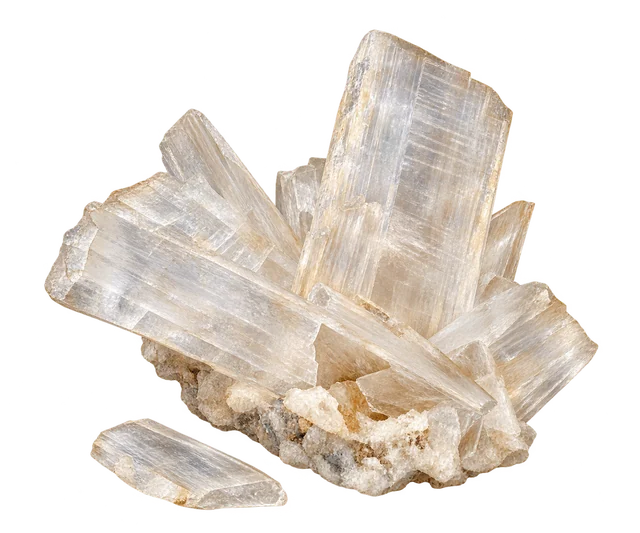
Gypsum is calcium sulfate dihydrate, CaSO4·2H2O. Plaster of Paris is a partly dehydrated calcium sulfate material and is not identical to the unheated mineral.
Ingredient details, preparation and research
Also known as: Calcium sulfate dihydrate; Gypsum stone
Source plant or material
Not botanical
Plant family / material: Not applicable: mineral material
Forms and route
Natural geological gypsum, processed construction products and specified agricultural amendments. Building boards, joint compounds and soil products may contain additional ingredients.
Vitamins and minerals
No human nutrient value is assigned. Calcium in a construction or soil material does not make the product edible or equivalent to a calcium supplement.
Absorption and preparation
The relevant chemistry here concerns mineral processing and soil exchange, not human absorption. Agricultural response depends on soil conditions, water movement and laboratory testing.
Practical preparation
For construction, use the specified finished product and its instructions. For soil, obtain a soil test and qualified local advice rather than spreading gypsum because soil feels heavy.
Combination notes
Use only in a specified construction system or professionally assessed soil programme; avoid improvised food or skin mixtures.
Traditional and reported uses
- Plaster and construction materials
- Conditional sodic-soil amendment
Contraindications and cautions
- Do not ingest building, craft or agricultural gypsum. Keep it separate from food and medications.
- Gypsum dust can irritate eyes and airways. Follow the product safety data sheet; mixtures may add hazards not covered by pure gypsum information.
Similar items and how they compare
- Calcium supplement
Both may contain the element calcium.
Construction gypsum is not a dietary supplement or an ingestible substitute.
A precise mineral identity
NIOSH explicitly distinguishes the dihydrate from plaster’s hemihydrate form and documents dust irritation. Chemical identity and product formulation must both be checked.
Soil testing governs usefulness
The soil guidance connects amendment need with sodium-related measurements and drainage. Adding material without identifying the problem can waste resources and fail to improve the growing site.
Evidence limits
No dietary calcium, supplement, edible coagulant, skin remedy or medicinal use is claimed. This deliberately restricted card is not interchangeable with a food-additive specification.
Entry sources
- British Geological Survey: The Pennines and adjacent areas, salt and gypsum
- US Geological Survey: Gypsum statistics and material uses
- CDC/NIOSH: Gypsum, identity and dust hazards
- University of Minnesota Extension: Identifying and remediating saline and sodic soils
Reference entry 377 · Recorded content review: 2026-10-09 · Review scope and dates