


Key cautions
- If taking warfarin or a similar vitamin-K antagonist, do not add natto regularly without advice from the anticoagulation team; its vitamin K can materially change intake.
- Contains soy. Normal stringiness does not guarantee that a damaged or badly stored pack is safe.
What’s inside
Soy protein, fiber and fermentation products; natto can provide substantial vitamin K, especially menaquinones. Seasoning packets may add salt, sugar, wheat or fish ingredients.
Uses in brief

- Natto with rice
- Natto with cooked vegetables
History, folklore and reported uses
History, folklore and traditional uses
MAFF describes Mito in Ibaraki as a centre of small-bean natto production. Its household and railway-market history is a regional account, while modern products are made under controlled fermentation conditions.
Traditional, historical and reported uses
- Natto with rice
Food or household practiceWhy this label?
The cited source documents this material, preparation or cultural practice; it does not establish treatment efficacy.
Small-bean natto is mixed with rice in the documented Mito tradition. Check optional seasoning packets if avoiding wheat, fish or additional sodium.
- Natto with cooked vegetables
Food or household practiceWhy this label?
The cited source documents this material, preparation or cultural practice; it does not establish treatment efficacy.
MAFF records natto combined with cooked okra. Its example includes optional animal-derived seasoning; use suitable ingredients if the finished dish must remain plant-only.
2 supported featured food or cultural uses; no treatment claim.
Historical-use additions reviewed 2026-10-09
Regional reading paths
These sourced notes describe cultivation, trade, food traditions or material history. A regional connection does not claim exclusive origin.
Asia
Traditional processing: Japan, including regional natto traditions.
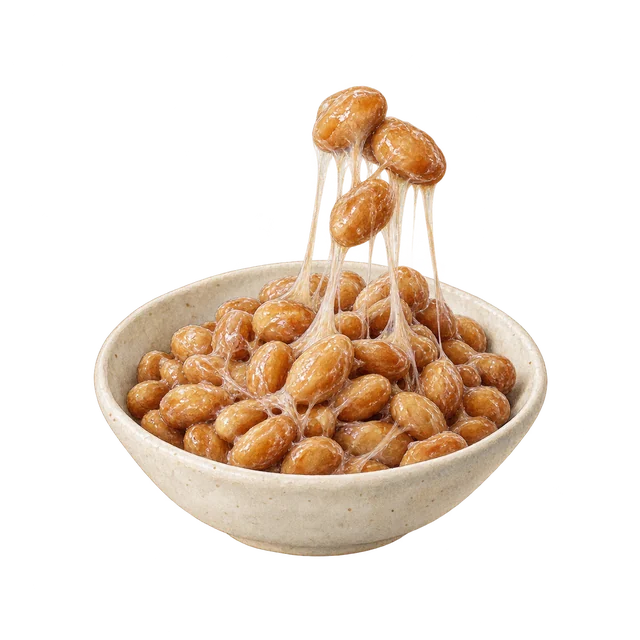
Fermented whole soybeans, commonly eaten with rice.
Identity & detailed reference
Identity
Cooked Glycine max soybeans fermented with Bacillus subtilis var. natto to produce stringy itohiki natto. Salt-fermented foods also called natto and nattokinase supplements are different preparations.
Ingredient details, preparation and research
Also known as: Itohiki natto; Stringy natto; Bacillus-fermented soybeans
Source plant or material
Glycine max; Bacillus subtilis var. natto fermentation
Plant family / material: Fabaceae
Forms and route
Commercial chilled or frozen whole-bean packs, often with separate sauce and mustard sachets. Dried natto and composite dishes require their own labels and preparation directions.
Vitamins and minerals
Natto’s vitamin K is relevant, but no universal amount is assigned to all brands or forms. Sauces and dried products differ from the plain chilled beans.
Absorption and preparation
Vitamin K is fat-soluble and has medication implications; this is not advice to manipulate absorption. Fermented beans are not equivalent to a measured MK-7 or nattokinase supplement.
Practical preparation
Follow the pack’s cold-storage and thawing instructions, use clean utensils and consume within the stated period after opening. Do not improvise warm household fermentation from cooked beans or assume a starter excludes contamination.
Combination notes
Consider the whole meal and packet ingredients, particularly when maintaining a medically managed vitamin-K intake.
Traditional and reported uses
- Natto with rice
- Natto with cooked vegetables
Contraindications and cautions
- If taking warfarin or a similar vitamin-K antagonist, do not add natto regularly without advice from the anticoagulation team; its vitamin K can materially change intake.
- Contains soy. Normal stringiness does not guarantee that a damaged or badly stored pack is safe.
Nutrient interaction is not a blood-thinning claim
NIH ODS emphasizes consistent vitamin-K intake with warfarin-type medicines. That established interaction does not mean eating natto replaces anticoagulant treatment or that food quantities reproduce supplement trials.
Evidence limits
Finished-food profile; no clot treatment, enzyme dosing or household fermentation protocol.
Entry sources
- Japan MAFF: Processed bean products
- Japan MAFF: Ibaraki natto
- NIH ODS: Vitamin K professional fact sheet
- FDA: Food allergies
Reference entry 363 · Recorded content review: 2026-10-09 · Review scope and dates