


Key cautions
- Do not swallow; severe poisoning is documented in children and adults
- Contact allergy is possible; never substitute garden pesticide or veterinary products
- Do not swallow neem oil, repurpose garden pesticides for skin, or treat these older results as proof that raw neem oil reliably protects against mosquito-borne illness.
What’s inside
Triglycerides/fatty acids including oleic, linoleic, palmitic and stearic acids, plus variable limonoids such as azadirachtin, nimbin and salannin. Processing can markedly change the limonoid fraction, so crude seed oil and clarified extracts cannot be assumed equivalent.
National Research Council (1992): Neem, Industrial Products · Kumar and Parmar (1996): Chemical variation among oils from 42 neem ecotypes · U.S. EPA: Azadirachtin and clarified hydrophobic neem-oil extract are distinct pesticide ingredients
Chemistry depends on the material
A primary study of 42 neem ecotypes found substantial variation in fatty-acid and azadirachtin/nimbin/salannin content. EPA explains that alcohol processing separates much of the azadirachtin-related fraction from natural oil; the remaining clarified hydrophobic extract is a different pesticide ingredient. Neither an azadirachtin percentage nor a crude-oil description can be copied to every neem product.
Kumar and Parmar (1996): Chemical variation among oils from 42 neem ecotypes · U.S. EPA: Azadirachtin and clarified hydrophobic neem-oil extract are distinct pesticide ingredients
Uses in brief

- Traditional external skin use and modern formulated scalp/cleansing products
- Limited head-lice evidence concerns particular seed-extract shampoos
- Mosquito-repellent research: older Indian field studies reported fewer bites on human volunteers using particular neem-oil formulations. This external repellent research is separate from agricultural insecticide and larvicidal uses.
History, folklore and reported uses
Source plant and fixed-oil classification
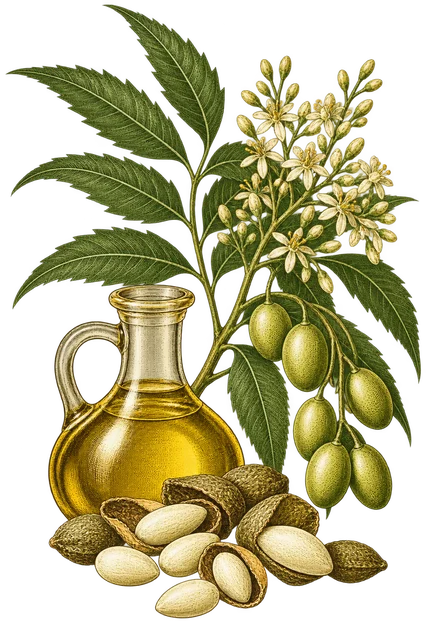
Neem is Azadirachta indica in Meliaceae, the mahogany family. The oil comes from seed kernels. Its strong odor and bitter character distinguish it from ordinary flavor oils, but the decisive issue is route-specific safety. Fixed oil describes a lipid-rich, nonvolatile material; the category does not mean edible.
Kew Plants of the World Online: Azadirachta indica A.Juss., accepted name and family · NIDDK LiverTox (2020): Margosa/neem oil, severe ingestion toxicity
Tradition and contemporary skin/scalp products
MSK describes external Ayurvedic use for skin conditions. This is historical practice, not proof that neem seed oil treats eczema, fungal infection or alopecia. Modern soaps, shampoos and skin products may contain different plant parts or extracts. Check the actual preparation; dental leaf-gel and oral bark-extract studies are not seed-oil safety studies.
Memorial Sloan Kettering: Neem, route-specific toxicity and interaction uncertainty
From wooden presses to household materials
Neem seed oil’s strong smell belongs to an exceptionally practical household material. A 1992 National Research Council account describes kernels worked in hand- or bullock-powered wooden presses called ghanis, as well as industrial expellers. The resulting oil supplied lamps, soap and lubricants; the remaining seed cake had a separate life as a soil amendment. In this history, a tree furnished a chain of useful products, and the oil’s bitter, garlic-like character was familiar long before deodorised cosmetic ingredients were developed.
Ayurvedic and Unani traditions
Neem also holds an established place in Indian Ayurvedic and Unani medicine, but leaves, bark, twigs and seed oil have different traditional roles. The same historical survey records seed oil used for skin complaints and, in India and Bangladesh, for head lice. These are reports of practice rather than an invitation to substitute any garden neem product for a medicinal preparation. Oral neem-oil traditions require particular care in the telling: serious poisonings, including deaths in children, make ingestion unsuitable as a household remedy.
National Research Council (1992), Neem: Medicinals, reported uses and ingestion warning · NIDDK LiverTox (2020): Margosa/neem oil, severe ingestion toxicity
Ringworm and persistent skin complaints
The National Research Council’s 1992 account records neem seed oil used in South Asian medicine for ringworm and other skin diseases. Leaf poultices and bark preparations have separate histories.
National Research Council (1992), Neem: Medicinals, reported uses and ingestion warning
Older ulcer and sore-care remedies
The same account specifically records oil used on indolent ulcers. This is a historical external use; a persistent, infected or poorly healing sore needs proper assessment rather than a garden-oil application.
National Research Council (1992), Neem: Medicinals, reported uses and ingestion warning
Head-lice care in India and Bangladesh
The Council describes villagers applying neem oil to the hair to combat head lice. This oil-specific practice was recorded separately from neem-leaf wound treatments.
National Research Council (1992), Neem: Medicinals, reported uses and ingestion warning
Repelling biting mosquitoes
Neem oil has been used in topical repellent mixtures, including an Indian study of an oil-in-coconut-oil preparation. This documents a separate insect-deterrent purpose, without treating a homemade mixture as reliable malaria protection. Mosquito-repellent research: older Indian field studies reported fewer bites on human volunteers using particular neem-oil formulations. This external repellent research is separate from agricultural insecticide and larvicidal uses. Studies involved specific carrier formulations, sites and mosquitoes. They do not validate any seed-oil bottle, population, duration or malaria-prevention claim.
Sharma et al. (1993): Mosquito repellent action of neem oil · Mishra et al. (1995): Neem-oil repellent field study in Mandla villages
Laundry and toilet soaps
The National Research Council’s 1992 account records Indian use of neem seed oil in soap manufacture: crude oil supplied laundry soaps, while processed fatty acids supplied finer toilet soaps. The record concerns manufactured products, not applying garden neem oil to skin.
Greasing village cart wheels
The same National Research Council account records neem oil used to grease cart wheels in rural India. Its nondrying character gave the seed oil a practical mechanical role.
Interactions and absorption remain uncertain
An in-vitro extract study found inhibition of CYP3A4/5, CYP2C8 and CYP2C9; MSK says the clinical relevance is unknown. It does not prove that a rinse-off neem cosmetic meaningfully changes drug levels. Conversely, lack of interaction data does not demonstrate no exposure. The preparation, contact time, skin condition and complete formulation matter; no universal absorption percentage is assigned.
Amaeze et al. (2021): In-vitro CYP inhibition by medicinal plant extracts · Memorial Sloan Kettering: Neem, route-specific toxicity and interaction uncertainty · Amaeze et al. (2021): Full manuscript, leaf extraction and human liver microsome methods
Regional reading paths
These sourced notes describe cultivation, trade, food traditions or material history. A regional connection does not claim exclusive origin.
Asia
Native source plant and practical tradition: Assam to Indo-China; National Research Council documentation describes neem-oil soap-making and lubrication in India.
Non-culinary fixed oil with soap, cosmetic and technical uses. Do not ingest neem oil or substitute a pesticide product for a skin preparation.
Identity & detailed reference
Identity
Azadirachta indica A.Juss. seed-kernel fixed oil, also called neem or margosa oil. Its place under fixed oils is a chemical classification, not permission for culinary use.
Ingredient details, preparation and research
Source plant or material
Azadirachta indica A.Juss.; fixed oil from seed kernels, also called margosa oil.
Plant family / material: Meliaceae (mahogany family).
Forms and route
Appropriately labeled human external skin/scalp products containing neem seed oil; separately, seed-extract shampoos. Garden pesticides, clarified hydrophobic extracts, veterinary products, leaf/bark preparations and chemically ozonated oils are different materials.
Food sources
None for neem seed oil. Do not assign a food serving, nutritional tablespoon, vitamin target or edible pairing. Food uses of other neem parts do not establish that the seed oil is edible.
Vitamins and minerals
No dietary nutrient contribution or serving is assigned. Fatty-acid content does not make neem seed oil suitable for nutrition, and topical use does not meet vitamin, mineral or essential-fat requirements.
Absorption and preparation
Systemic exposure after swallowing can be dangerous. There is no validated universal human skin-absorption percentage for neem oil, and local cosmetic intent is not proof of zero absorption. Increasing penetration with improvised solvents, occlusion or mixtures is not supported by the clinical evidence reviewed.
Practical preparation
Choose a human-use finished product with a clear ingredient list, intended site, age guidance and directions. Avoid eyes, mouth and improvised intranasal, genital or oral uses. Keep in its labeled container away from food and children; do not make a homemade pesticide-shampoo dilution.
Combination notes
Dilution into another carrier does not establish safety or efficacy, remove an allergy, or justify ingestion. A seed-extract shampoo’s surfactants and other ingredients matter. No food, supplement or penetration-enhancing mixture is recommended.
Traditional and reported uses
- Attributed traditional use: external neem preparations for skin complaints in Ayurveda and South Asian practice.
- Modern use: an ingredient in some skin/scalp cleansing products; specific seed-extract shampoos have been studied for head lice.
- Laboratory antimicrobial or insecticidal activity does not establish raw neem oil as a safe treatment for infection, hair loss or disease-carrying insect bites.
- Mosquito-repellent research: older Indian field studies reported fewer bites on human volunteers using particular neem-oil formulations. This external repellent research is separate from agricultural insecticide and larvicidal uses.
Contraindications and cautions
- Do not swallow neem oil or use it in food. Ingestion has caused seizures, metabolic acidosis, encephalopathy, liver injury and deaths; keep it securely away from children.
- Use only human external products for their labeled site and age. Garden or veterinary formulations must not be repurposed for people.
- Neem oil can cause allergic contact dermatitis. Avoid medicinal self-use in pregnancy/breastfeeding because adequate safety is not established; do not apply where a nursing infant could ingest it.
- Extract-related CYP inhibition is a laboratory finding, not a proven interaction from ordinary cosmetic use. Seek professional advice for persistent scalp/skin disease rather than escalating concentration.
- Do not swallow neem oil, repurpose garden pesticides for skin, or treat these older results as proof that raw neem oil reliably protects against mosquito-borne illness.
Similar items and how they compare
- Black seed oil
Both have distinctive odours and appear in traditional skin-care preparations, but this resemblance describes practice rather than equivalent efficacy.
Black seed’s thymoquinone differs from neem’s limonoids; neem oil must not be swallowed.
- Sesame oil
Both are fixed seed oils used in traditional external body or scalp care, providing an oily vehicle within the preparation.
Sesame lacks neem’s characteristic limonoids; their ingestion safety and allergy profiles differ.
Human lice evidence concerns a shampoo
A 2007 study treated 60 lice-infested children aged 4–15 with a particular neem-seed-extract shampoo and reported activity against lice with no observed irritation during the studied use. The abstract does not describe a randomized comparator group. This supports further product-specific research, not use of raw oil on children, an all-night application, or a universal home dilution.
Laboratory antimicrobial activity is not infection treatment
A 2017 experiment chemically ozonated neem oil, producing peroxide-containing materials and testing them against bacteria and cultured cells. Those modified products are not the original oil, and laboratory inhibition of resistant bacteria is not evidence that a household bottle treats infected wounds or is safe to apply to damaged skin.
Ingestion toxicity: adults as well as children
LiverTox records severe poisoning syndromes including acidosis and liver/multiorgan failure after ingestion. A published adult case developed vomiting, seizures and toxic encephalopathy after accidental neem-oil ingestion and required intensive supportive care. Case reports do not define a safe lower dose. If swallowed, obtain poison-center or emergency advice promptly rather than waiting for symptoms or trying a home remedy.
External use can cause allergy
A 2017 report documented allergic contact dermatitis from neem oil and reviewed earlier cases. The responsible allergen was not established. Stop a product causing itching, rash, swelling or worsening skin/scalp symptoms. A small-area tolerance check of an appropriate product is different from dermatologist patch testing and cannot guarantee safety. Do not test again after a suspected allergic reaction.
Pregnancy, breastfeeding and children
The evidence reviewed does not establish medicinal neem-oil safety in pregnancy or breastfeeding, so avoid self-treatment in these settings and check any proposed external product with a clinician. Keep it away from the breast/nipple and places an infant could lick. Pediatric shampoo observations cannot cancel the serious ingestion hazard or be extrapolated to babies, raw oil or repeated unsupervised treatment.
Pesticides and personal repellents are separate uses
EPA’s assessments concern labeled pesticide applications, including specified crop uses; they do not authorize a garden product as a human medicine. NCCIH cautions that neem oil is not established as safe, effective personal bite protection. For travel or disease-carrying insects, use an appropriate registered repellent rather than relying on neem’s agricultural reputation.
Nutrition and similar oils
Neem receives no edible serving or vitamin/mineral calculation. Sesame is another fixed seed oil but has a different ingestion and allergy profile; black seed oil contains different characteristic compounds. Such comparisons can explain texture or traditional external practice, not equivalence. Carrier mixing is not a detoxification method, and no nutritional combination is appropriate.
Mosquito repellency in research
Topical human field observation. Mandla village testing reported partial protection against anopheline bites; another small older study reported complete protection under its conditions. Studies involved specific carrier formulations, sites and mosquitoes. They do not validate any seed-oil bottle, population, duration or malaria-prevention claim.
Entry sources
- Kew Plants of the World Online: Azadirachta indica A.Juss., accepted name and family
- NIDDK LiverTox (2020): Margosa/neem oil, severe ingestion toxicity
- Kumar and Parmar (1996): Chemical variation among oils from 42 neem ecotypes
- U.S. EPA: Azadirachtin and clarified hydrophobic neem-oil extract are distinct pesticide ingredients
- Memorial Sloan Kettering: Neem, route-specific toxicity and interaction uncertainty
- Abdel-Ghaffar and Semmler (2007): Neem-seed-extract shampoo in 60 children with head lice
- de Oliveira et al. (2017): Chemically ozonated neem oil, laboratory antibacterial experiments
- Mishra and Dave (2013): Adult neem-oil poisoning with seizures, acidosis and encephalopathy
- National Capital Poison Center: Insecticide exposure and getting poison-center advice
- de Groot et al. (2017): Contact allergy to neem oil
- American Academy of Dermatology: How to test skin care products
- Amaeze et al. (2021): In-vitro CYP inhibition by medicinal plant extracts
- NCCIH: Complementary health approaches for travelers, neem is not established personal bite protection
- National Research Council (1992): Neem, Industrial Products
- Mishra et al. (1995): Neem-oil repellent field study in Mandla villages
- Sharma et al. (1993): Mosquito repellent action of neem oil
Reference entry 74 · Recorded content review: 2026-10-05 · Review scope and dates