


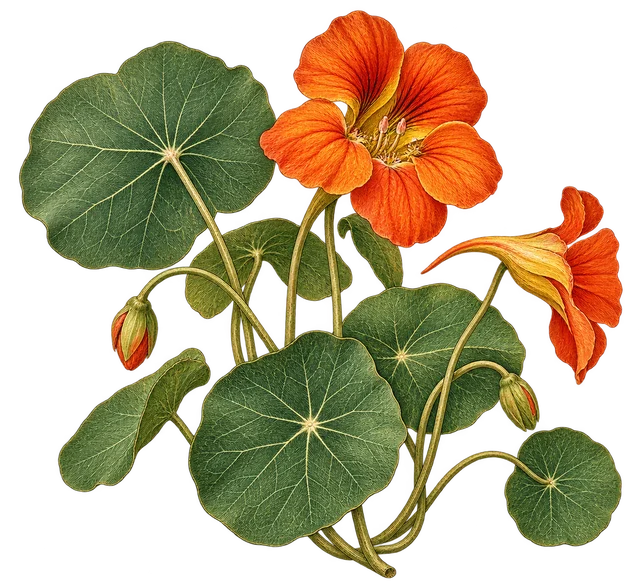
Key cautions
- Confirm T. majus and food-growing history; the name nasturtium alone is insufficient.
- Do not treat nursery ornamentals or seed intended for planting as ready-to-eat food. Stop if a new food causes a reaction.
What’s inside
Glucotropaeolin, a glucosinolate, has been measured in T. majus. Buds contain mustard-oil constituents contributing pungency.
Uses in brief

- Peppery flowers or leaves added to food in modest seasoning amounts.
History, folklore and reported uses
History, folklore and traditional uses
NC State’s garden profile and the RHS both describe nasturtium as more than a colorful ornament: different above-ground parts bring a peppery flavor to a plate. NC State also records seeds used as a caper substitute. That is a culinary analogy, not botanical identity; true capers come from another plant. Here the kitchen story remains about flavor rather than making the flower into a natural antibiotic.
Traditional, historical and reported uses
- Flower and leaf seasoning
Food or household practiceWhy this label?
The claim documents flower and leaf seasoning as a culinary, craft, gardening, or practical material use; it reports neither a treatment outcome nor measured nutrient content.
The RHS records flowers, leaves and buds in salad and pasta dishes.
- Caper-style substitution
Food or household practiceWhy this label?
The claim documents caper-style substitution as a culinary, craft, gardening, or practical material use; it reports neither a treatment outcome nor measured nutrient content.
NC State records seed use as a caper substitute. No unvalidated preservation method is supplied.
Only specifically supported uses are included; historical or culinary use is not clinical proof.
Regional reading paths
These sourced notes describe cultivation, trade, food traditions or material history. A regional connection does not claim exclusive origin.
South America
South American botanical connection; Embrapa documents capuchinha among Brazil’s traditional, less-common vegetables.
Food-grown flowers, leaves and buds provide a peppery culinary accent.
Identity & detailed reference
Identity
Garden nasturtium, Tropaeolum majus; food-grown flowers, leaves and buds are culinary materials. It is distinct from watercress.
Ingredient details, preparation and research
Source plant or material
Tropaeolum majus L.; Garden nasturtium, Tropaeolum majus; food-grown flowers, leaves and buds are culinary materials. It is distinct from watercress.
Plant family / material: Tropaeolaceae
Forms and route
Fresh flowers, petals, leaves or buds in food; immature seed preparations only with an appropriate food-safe recipe.
Vitamins and minerals
Flower garnishes are not a dependable vitamin serving. No fixed nutrient percentage is assigned to a few petals or a mixed leaf-and-flower portion.
Absorption and preparation
No special pairing has demonstrated a health benefit for ordinary flower portions. Glucosinolate chemistry does not establish antibiotic or urinary-infection treatment.
Practical preparation
Use washed culinary-grown material. Petals alone give a milder effect than a whole flower. Any pickled preparation needs a food-safe recipe and storage method.
Traditional and reported uses
- Peppery flowers or leaves added to food in modest seasoning amounts.
Contraindications and cautions
- Confirm T. majus and food-growing history; the name nasturtium alone is insufficient.
- Do not treat nursery ornamentals or seed intended for planting as ready-to-eat food. Stop if a new food causes a reaction.
Similar items and how they compare
- Watercress
Both may be described as peppery cress.
Nasturtium officinale is watercress; Tropaeolum majus is a different plant.
- Pansies
Both provide flower color in food.
Pansies have a milder taste and different chemistry.
Species and chemistry
NC State identifies the edible garden plant as T. majus. Glucotropaeolin research concerns composition and cultivation conditions, not proof of a therapeutic serving.
Entry sources
- NC State Extension: Tropaeolum majus
- Bloem et al. (2007): Glucotropaeolin content of Tropaeolum majus
- Royal Horticultural Society: Edible flowers
Reference entry 183 · Recorded content review: 2026-10-07 · Review scope and dates