


Key cautions
- Confirm Amomum subulatum when the species matters; black cardamom is an ambiguous market name.
- Do not substitute a volume of concentrated oil for whole pods. Remove hard capsule pieces for diners who may have difficulty chewing.
What’s inside
Seed volatile oils supply the aroma. Curing and storage influence the smoky and camphoraceous character; whole-fruit composition is not the same as distilled oil.
Uses in brief

- Whole-pod savoury seasoning
- Ground spice preparations
History, folklore and reported uses
History, folklore and traditional uses
Sikkim and the Darjeeling hills are longstanding cultivation centres. The Sikkim Agriculture Department documents large cardamom as a regional cash crop grown under Himalayan conditions.
Traditional, historical and reported uses
- Whole-pod savoury seasoning
Food or household practiceWhy this label?
The cited source documents this material, preparation or cultural practice; it does not establish treatment efficacy.
Dried capsules contribute aroma to savoury preparations. They can be used during cooking and removed before serving when their firm texture is unwelcome.
- Ground spice preparations
Food or household practiceWhy this label?
The cited source documents this material, preparation or cultural practice; it does not establish treatment efficacy.
The aromatic seeds may enter ground seasonings. A mixture is a separate recipe, so its salt, heat and ingredients need to be checked rather than attributed to cardamom alone.
2 supported featured food or cultural uses; no treatment claim.
Historical-use additions reviewed 2026-10-09
Regional reading paths
These sourced notes describe cultivation, trade, food traditions or material history. A regional connection does not claim exclusive origin.
Asia
Cultivated: Himalayan Sikkim and Darjeeling, India.
Dried aromatic capsules in savoury spice preparations.
Identity & detailed reference
Identity
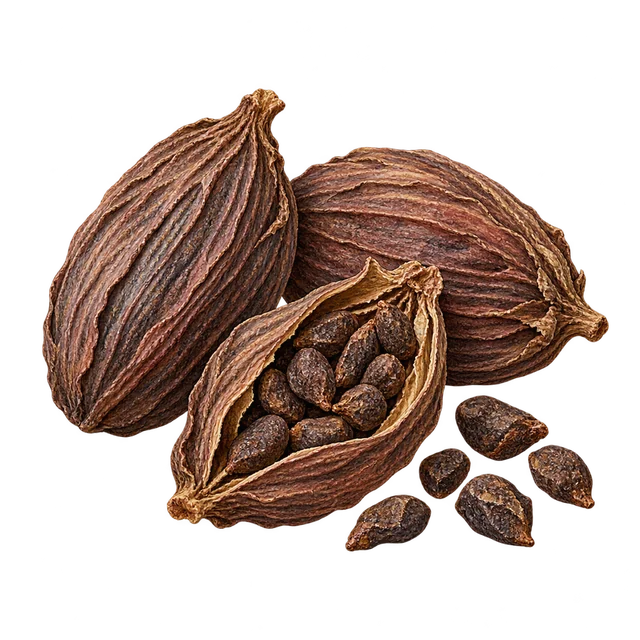
Amomum subulatum; dried capsules and seeds of Himalayan large cardamom. This is distinct from Elettaria green cardamom and from other Asian species marketed as black cardamom.
Ingredient details, preparation and research
Also known as: Large cardamom; Badi elaichi; Amomum subulatum
Source plant or material
Amomum subulatum
Plant family / material: Zingiberaceae
Forms and route
Whole dried brown capsules or separated seeds, often with a smoky character from curing. Ground blends may contain multiple spices.
Vitamins and minerals
Culinary quantities are small. No reliable serving-specific mineral contribution is assigned, and the weight of woody capsule material is not equivalent to edible seed weight.
Absorption and preparation
Heat and crushing change aroma release. Neither establishes improved nutrient absorption or a medicinal effect.
Practical preparation
Keep whole pods dry and covered. Follow a tested culinary recipe for crushing, simmering or grinding; discard musty products rather than masking their flavour with other spices.
Combination notes
Its stronger character suits savoury spice mixtures; green cardamom is not a neutral one-for-one flavour replacement.
Traditional and reported uses
- Whole-pod savoury seasoning
- Ground spice preparations
Contraindications and cautions
- Confirm Amomum subulatum when the species matters; black cardamom is an ambiguous market name.
- Do not substitute a volume of concentrated oil for whole pods. Remove hard capsule pieces for diners who may have difficulty chewing.
A separate Himalayan species
Kew accepts A. subulatum as a distinct species. Regional crop documentation supports its cultivation history; it does not establish that every black-cardamom product has the same botanical identity or chemical profile.
Evidence limits
Food and crop-history evidence only; no supplement dose or treatment benefit is inferred.
Entry sources
- Sikkim Agriculture Department: Large cardamom
- Spices Board India: Spices of India
- Spices Board India: Cardamom (large)
- Kew POWO: Amomum subulatum
Reference entry 340 · Recorded content review: 2026-10-09 · Review scope and dates