


Key cautions
- Avoid ingestion, neat application and damaged skin. Oxidation can increase allergy risk.
- Pregnancy, breastfeeding, children, asthma/epilepsy and sedating medicines need product-specific advice.
- If aromatherapy oil is swallowed, contact a poison-control service or get medical help right away. Aromatherapy oil is for external use, not a substitute for a manufactured oral medicine.
- Health Canada’s 2025 monograph covers external aromatherapy products used on the skin or by inhalation. Products licensed under it must not be used during pregnancy or breastfeeding. This is not a monograph for manufactured oral Silexan.
What’s inside
Steam distillation concentrates lavender’s volatile aromatic compounds. The oil differs from whole flowers, flower tea and the watery distillation product called hydrosol.
EMA: Final assessment of lavender flowers and oil, 2012
The main aromatic compounds
Linalool and linalyl acetate commonly predominate. Smaller constituents include lavandulyl acetate, terpinen-4-ol and other terpenes; cultivar, harvest and distillation alter their proportions.
Oil is not the whole flower
Whole flowers also contain flavonoids, tannins and phenolic acids, including rosmarinic acid. Their presence in flowers does not mean a steam-distilled oil delivers the same mixture. Lavandin and spike lavender have different profiles from L. angustifolia.
A volatile oil, not a food oil
Distilled lavender oil is not a dietary source of vitamins, minerals, protein or essential fatty acids. Its aromatic molecules differ from the fats in carrier oils. Skin and scent use do not feed hair follicles with dietary nutrients. Manufactured oral lavender medicines are not vitamin supplements.
NCCIH: Lavender, updated February 2025 · EMA: Final assessment of lavender flowers and oil, 2012
Uses in brief

- Traditional calming/sleep-support preparations; fragrance in properly formulated massage, bath and hair products.
- Historical skin-care use; scalp regrowth evidence is limited to mixtures and animal research.
- Hair cosmetics: lavender adds fragrance; animal and human-blend research does not establish lavender-only human regrowth.
History, folklore and reported uses
Settling mild stress and exhaustion
The European Medicines Agency records a long-standing medicinal tradition of specified lavender-oil preparations for mild mental stress and exhaustion. AromaWeb likewise describes its fragrance in care for nervous tension.
European Medicines Agency: Lavandulae aetheroleum · AromaWeb: Lavender essential oil, contemporary practitioner uses
A bedtime scent and sleep aid
Specified lavender-oil medicines have a traditional-use designation as sleep aids. Modern evening scent rituals extend that association through lavender-containing aromatic products.
Headache and migraine aromatherapy
AromaWeb, drawing on aromatherapy author Julia Lawless, lists headache and migraine among lavender oil’s practitioner applications. This record concerns the distilled oil, not lavender-leaf tea.
AromaWeb: Lavender essential oil, contemporary practitioner uses · National Capital Poison Center: Essential oils, poisonous when misused
Minor skin complaints and insect bites
AromaWeb’s practitioner record includes itching, insect bites, cuts and minor skin complaints among lavender oil’s applications. These uses help explain its household first-aid reputation.
AromaWeb: Lavender essential oil, contemporary practitioner uses · National Capital Poison Center: Essential oils, poisonous when misused
Muscle, sprain and menstrual comfort
AromaWeb records lavender oil in care for rheumatic discomfort, meaning painful muscles or joints, as well as sprains, strains and menstrual pain. These are reported body-comfort purposes in aromatherapy and massage practice.
AromaWeb: Lavender essential oil, contemporary practitioner uses
Flowers in the linen cupboard
Kew describes lavender flowers used among linens, in fragrant washing and in perfume, and links the plant’s name to the Latin word for washing. These flower and infusion traditions are distinct from steam-distilled oil. The familiar name English lavender refers to a plant native to parts of Mediterranean Europe.
Royal Botanic Gardens, Kew: Bring lavender into your home · Royal Botanic Gardens, Kew: English lavender
The burn story behind modern aromatherapy
French chemist René-Maurice Gattefossé worked with lavender growers in Haute-Provence, France. His company’s historical account describes a laboratory explosion followed by his use of lavender essential oil on his burns. His reported experience became an influential story in aromatherapy, but an individual account does not establish a burn treatment. The same company account dates his professional journal La Parfumerie Moderne to 1908 and his book Aromathérapie to 1937, placing the story within a wider exchange between perfume makers, growers and medicine.
Gattefossé: Histoire, company account of René-Maurice Gattefossé and lavender · National Capital Poison Center: Essential oils, poisonous when misused
Identity and chemistry
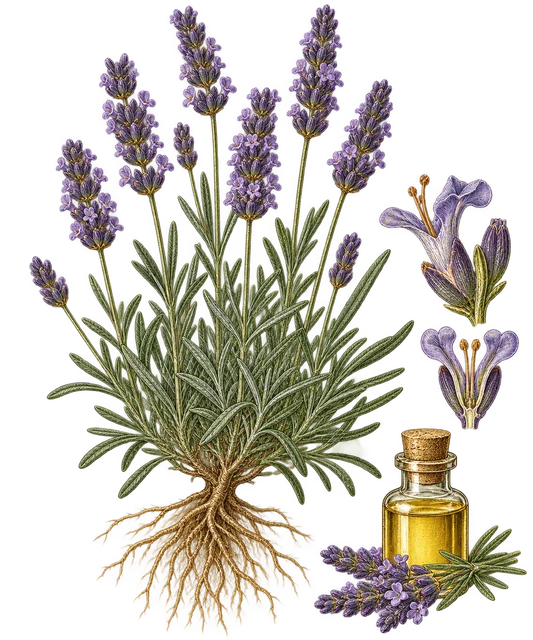
L. angustifolia is a Lamiaceae plant; steam distillation of flowering tops yields a volatile oil, typically rich in linalool and linalyl acetate. The botanical name matters because lavandin and spike-lavender oils have different constituent profiles. Flowers, hydrosol and oil are not interchangeable.
Royal Botanic Gardens, Kew: English lavender · EMA: Final assessment of lavender flowers and oil, 2012
Traditional body and skin uses
EMA recognizes specified oil medicines for mild stress and sleep support, and records a German anthroposophic medical tradition of diluted skin applications for tension. Herbal practice also describes skin and wound-care uses. These are attributed traditions; this card recommends finished intact-skin products rather than reproducing historical wound or child-use recipes.
European Medicines Agency: Lavandulae aetheroleum · EMA: Final assessment of lavender flowers and oil, 2012 · University of Cape Coast, Pharmacognosy and Herbal Medicine: Lavandula angustifolia ethnobotanical uses
Healing after an episiotomy
A trial in 120 first-time mothers after episiotomy, a surgical cut made during childbirth, found less redness with a lavender preparation than with the antiseptic povidone-iodine. There was no statistically clear difference in wound complications or in the number of women reporting no pain. The tested oil’s botanical identity was not verified as L. angustifolia: the publisher-indexed introduction names L. stoechas. This study cannot establish true-lavender oil as a treatment for open wounds.
Vakilian et al., 2011: Lavender oil versus povidone-iodine after episiotomy · Vakilian et al.: publisher introduction to episiotomy trial
Hair research: mixture versus individual oil
A 1998 seven-month trial for alopecia areata, an immune-related form of patchy hair loss, invited 86 people and allocated 84 after two exclusions. A blend of lavender, rosemary, thyme and cedarwood in carriers improved photographic outcomes in 44% versus 15% with carriers alone. It did not isolate lavender, and alopecia areata is different from pattern hair loss. A 2016 lavender hair-growth study was in mice. The 1998 scalp trial’s authors, in their 1999 reply, describe alternating allocation, a predictable method that weakens the original claim of randomization. This research does not establish a home-mixing recipe or show that lavender alone regrows human hair. Lavender can also simply fragrance a hair product.
Hay et al., 1998: Mixed essential oils for alopecia areata, trial reported as randomized; see 1999 allocation clarification · Lee et al., 2016: Lavender oil hair-growth experiment in mice · Hay and Ormerod (1999): Author reply clarifies alternating allocation in the 1998 alopecia trial · Hay et al. (1998): Full methods, 86 invited and 84 allocated after two exclusions
Newer mixed-product evidence
A manufacturer-funded 2025 trial randomized 90 adults to rosemary-lavender, rosemary-castor or coconut-oil products for 90 days. Reported improvements were product-specific; 82 completed, and analysis emphasized within-group changes. Mixed ingredients, short follow-up and sponsor involvement limit what can be inferred about lavender alone or durable hair regrowth.
Patel et al., 2025: Rosmagain and rosemary-castor products, 90-day randomized trial
Skin allergy, oxidation and laboratory limits
Air exposure can oxidize linalool/linalyl acetate into sensitizing products. Chemical testing, a mouse sensitization assay and patch tests in selected allergic patients support this risk; they do not give an allergy rate for all users. Cultured skin-cell toxicity experiments also do not define a universally safe human dilution.
Hagvall et al., 2008: Air oxidation of lavender oil and contact allergens · Prashar et al., 2004: Lavender oil cytotoxicity in cultured human skin cells
Practical skin/scalp and bath use
Choose a product labeled for its intended skin/scalp or bath use, with an identified species and dilution. Carrier oil supports spreading; it does not guarantee safety. Neat oil added to water does not make an evenly diluted wash. Avoid eyes and damaged skin, and stop for rash or respiratory irritation. Store tightly closed and light-protected.
National Capital Poison Center: Essential oils, poisonous when misused · Health Canada: Aromatherapy essential oils monograph, July 25, 2025
Pregnancy, children and medicines
NCCIH describes pregnancy and breastfeeding safety data as inadequate. EMA’s assessed lavender medicines are for ages 12 and over, whereas Health Canada’s external aromatherapy monograph is for adults 18 and older; follow the exact product’s restrictions. Reported breast-tissue changes in children do not establish causation. Sedative interaction concerns are theoretical. Asthma or epilepsy warrants professional advice before aromatherapy.
NCCIH: Lavender, updated February 2025 · European Medicines Agency: Lavandulae aetheroleum · Health Canada: Aromatherapy essential oils monograph, July 25, 2025
Absorption, nutrition and related forms
Some volatile exposure can occur through inhalation or skin contact; this does not establish an absorption target to maximize. Silexan trials concern a manufactured oral formulation, not flower tea or a bottle of fragrance oil. Distilled oil has no meaningful dietary nutrient role. Compare lavender flowers and rosemary oil as separate preparations. Scent intensity, dilution and massage do not establish a predictable absorbed dose or clinical benefit. Use the labeled route; do not try to increase absorption with heat, covered dressings or damaged skin.
NCI: Aromatherapy with essential oils, routes and safety · NCCIH: Lavender, updated February 2025
An oral preparation studied for anxiety
A 10-week trial randomized 539 adults with generalized anxiety disorder to two strengths of the manufactured lavender-oil product Silexan, paroxetine or placebo. Anxiety scores improved more with Silexan than placebo. This result belongs to that oral formulation; it does not justify swallowing aromatherapy oil or assigning the same effect to flower tea. NCCIH notes limitations across the evidence, including limited independent testing and participant diversity.
Kasper et al. (2014): Silexan, placebo and paroxetine in generalized anxiety disorder · NCCIH: Lavender, updated February 2025
What scent studies can and cannot show
NCCIH finds the benefits of lavender aromatherapy for anxiety, pain, sleep or depression uncertain. Enjoying a bedtime scent and demonstrating a treatment effect are different outcomes. Oral lavender products can cause burping, nausea, diarrhea or headache, while inhalation may cause coughing or headache.
Regional reading paths
These sourced notes describe cultivation, trade, food traditions or material history. A regional connection does not claim exclusive origin.
Europe
Cultivated/distilled: Haute-Provence, France, with a protected regional oil tradition.
Concentrated aromatic ingredient in formulated products; not interchangeable with flowers.
Identity & detailed reference
Identity
Lavandula angustifolia Mill.; steam-distilled essential oil from flowering tops. Lavandin (L. × intermedia), spike lavender (L. latifolia) and Spanish lavender (L. stoechas) are different oils.
Ingredient details, preparation and research
Source plant or material
Lavandula angustifolia Mill.; essential oil distilled from flowering tops.
Plant family / material: Lamiaceae (mint family).
Forms and route
Aroma products, appropriately diluted skin/scalp products and formulated bath additives. Standardized oral lavender-oil capsules such as Silexan are separate manufactured medicines/supplements; this card is not an instruction to swallow aromatherapy oil.
Traditional and reported uses
European traditional use: mild stress/exhaustion and sleep support with specified lavender-oil medicines. Aromatherapy practice: a calming scent and diluted massage/body products; cosmetic use in soaps, perfumes and hair products. Herbal practice has also used the oil for minor skin complaints and wound care, but these traditions do not validate neat oil on burns or open wounds. Human scalp findings concern mixed formulations rather than isolated lavender oil. Hair cosmetics: lavender adds fragrance; animal and human-blend research does not establish lavender-only human regrowth.
Contraindications and cautions
- Do not swallow aromatherapy oil or apply it neat to skin, wounds, burns or an inflamed scalp. Allergy and irritation are possible, especially with oxidized oil; stop and wash off if a rash occurs. Inhalation can cause headache or coughing. Pregnancy/breastfeeding and child-use advice depends on the product and route; this is adult guidance. Ask about medicinal use with sedatives or before surgery. Keep tightly closed, protected from light and inaccessible to children; follow the labeled storage and expiry instructions.
- If aromatherapy oil is swallowed, contact a poison-control service or get medical help right away. Aromatherapy oil is for external use, not a substitute for a manufactured oral medicine.
- Health Canada’s 2025 monograph covers external aromatherapy products used on the skin or by inhalation. Products licensed under it must not be used during pregnancy or breastfeeding. This is not a monograph for manufactured oral Silexan.
Similar items and how they compare
- Lavender flowers
Same plant and overlapping floral volatiles.
Tea and flowers contain a different, much less concentrated mixture; oral oil-capsule findings cannot be assigned to them.
- Rosemary essential oil
Both are aromatic mint-family distillates found in massage and scalp products, including studied mixtures.
Rosemary commonly emphasizes cineole, camphor and pinene; a blend does not prove either component grows hair.
Entry sources
- EMA: Lavender oil, current published traditional-use assessment
- NCCIH: Lavender, updated February 2025
- Hay et al., 1998: Mixed essential oils for alopecia areata, trial reported as randomized; see 1999 allocation clarification
- Hagvall et al., 2008: Air oxidation of lavender oil and contact allergens
- National Capital Poison Center: Essential oils, poisonous when misused
- Kew: English lavender, Lavandula angustifolia, family and uses
- EMA: Final assessment of lavender flowers and oil, 2012
- Health Canada: Aromatherapy essential oils monograph, July 25, 2025
- Lee et al., 2016: Lavender oil hair-growth experiment in mice
- Patel et al., 2025: Rosmagain and rosemary-castor products, 90-day randomized trial
- Prashar et al., 2004: Lavender oil cytotoxicity in cultured human skin cells
- Vakilian et al., 2011: Lavender oil versus povidone-iodine after episiotomy
- University of Cape Coast, Pharmacognosy and Herbal Medicine: Lavandula angustifolia ethnobotanical uses
- NCI: Aromatherapy with essential oils, routes and safety
- Hay and Ormerod (1999): Author reply clarifies alternating allocation in the 1998 alopecia trial
- Hay et al. (1998): Full methods, 86 invited and 84 allocated after two exclusions
Reference entry 32 · Recorded content review: 2026-10-05 · Review scope and dates