


Key cautions
- Buy edible fruit varieties and use a cooking method appropriate to ripeness. This card does not cover Plantago herbs or identify wild Musa plants.
- If following a potassium-restricted diet, use individualized dietary guidance. Chips and heavily salted or fried foods are not nutritionally interchangeable with plain cooked fruit.
What’s inside
Carbohydrate shifts from starch toward sugars as fruit ripens, with fiber and potassium among other constituents. A fried chip has different water and fat content from boiled green fruit.
Uses in brief

- Boiled or mashed staple
- Roasted and fried foods
History, folklore and reported uses
History, folklore and traditional uses
Introduced plantains became important cultivated foods in humid West and Central Africa, including Cameroon and Nigeria, and in Belize and the Caribbean. The food traditions span boiling, mashing, roasting and frying; cultivar and maturity influence the appropriate preparation.
A closer look at its history
More than one Atlantic entry route
A study of sixteenth- and early-seventeenth-century documents finds at least two important banana entry routes into the Americas: the West Indies through the Canary Islands and the Atlantic South American coast directly from Africa. Historical banana names do not always resolve modern cultivar groups, so this is a shared Musa history rather than proof of one plantain variety’s arrival date.
Plantain became a material for Caribbean self-representation
Miguel Luciano’s 2006 Pure Plantainum plates a green plantain in platinum. The Smithsonian interprets the work through Caribbean associations with African ancestry, masculinity and national sovereignty. A food can therefore carry social and political meaning far beyond its cooking qualities; this is a documented artwork, not a claim about every Caribbean person’s symbolism.
Additional history reviewed 2026-10-10
Traditional, historical and reported uses
- Boiled or mashed staple
Food or household practiceWhy this label?
The source supports the named food, cosmetic or material practice; no treatment effect is inferred and the card’s form and safety limits remain attached.
IITA and FAO document plantain as a starchy staple. The cooked fruit can accompany legumes, vegetables or other foods, with consistency depending on maturity.
- Roasted and fried foods
Food or household practiceWhy this label?
The source supports the named food, cosmetic or material practice; no treatment effect is inferred and the card’s form and safety limits remain attached.
FAO describes cooking methods including roasting and frying. Added oil and salt materially change the food; crispness is not evidence of superior digestion or low carbohydrate.
2 sourced featured uses; cultural or material records are not clinical efficacy evidence.
Historical-use additions reviewed 2026-10-09
Growing notes
Edible Musa acuminata / M. balbisiana-derived cultivars; not ornamental cold-hardy Musa basjoo.
- Climate and habit
- Large perennial herbs form clumps of pseudostems. Sustained warmth is needed; frost-free survival alone does not guarantee fruit. Plant in the warm growing season and protect from damaging wind. [1]
- Sun, soil and water
- Provide full or near-full sun, deep well-drained soil and dependable moisture. Bananas suffer in drought and stagnant water alike. [1]
- Pollination and harvest
- Edible cultivars generally form fruit without pollination. Harvest timing can range roughly 9–20 months from planting, depending on cultivar and climate. Do not apply a dessert-banana calendar to every plantain. [1]
- Clump care and pests
- Thin excess suckers to avoid crowding. Remove the harvested pseudostem while retaining replacement growth. Start with clean planting material; Fusarium wilt, nematodes and borers are serious risks. [1]
Growing sources and regional guidance
Growing notes reviewed 2026-10-10
Regional reading paths
These sourced notes describe cultivation, trade, food traditions or material history. A regional connection does not claim exclusive origin.
Africa
Introduced/cultivated: humid West/Central Africa, including Cameroon and Nigeria.
Starchy cooking banana used in boiled, roasted and fried foods.
North America
Introduced/cultivated: Belize and Caribbean.
Starchy cooking banana used cooked at green or ripe stages.
Identity & detailed reference
Identity
Plantain cooking-banana fruit, commonly the Musa AAB Plantain subgroup. It differs from Burro/Bluggoe ABB bananas and from Plantago leaf herbs; the broader word cooking banana can include other cultivar groups.
Ingredient details, preparation and research
Source plant or material
Musa AAB Plantain subgroup
Plant family / material: Musaceae
Forms and route
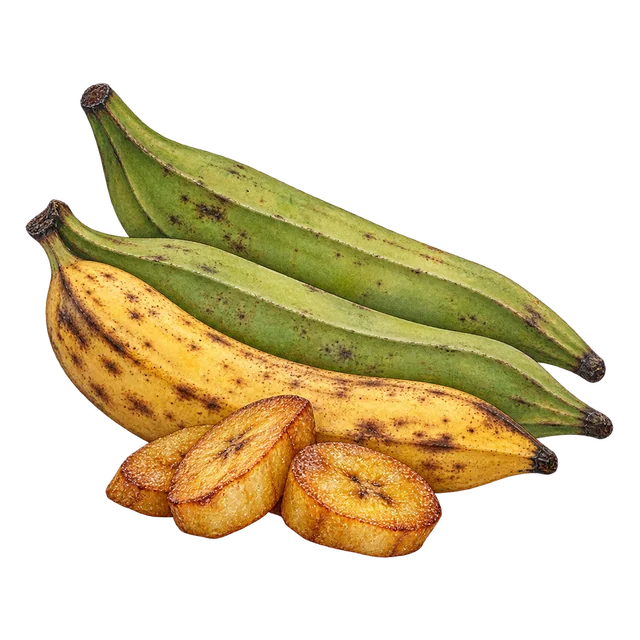
Green starchy fruit, ripe sweeter fruit, cooked pieces, mashed dishes and chips. Ripeness, cooking method and added oil distinguish these foods.
Vitamins and minerals
Plantain contributes carbohydrate and some fiber and minerals. Ripening and processing prevent a single nutrient or glycemic claim from describing all green, ripe, boiled and fried forms.
Absorption and preparation
Cooking, cooling and ripeness influence starch structure and digestion, but no universal blood-glucose response or resistant-starch dose is assigned.
Practical preparation
Wash the exterior before peeling and prepare the edible flesh in a familiar cooked recipe. Refrigerate prepared dishes promptly and follow packaging guidance for commercial chips or flour.
Traditional and reported uses
- Boiled or mashed staple
- Roasted and fried foods
Contraindications and cautions
- Buy edible fruit varieties and use a cooking method appropriate to ripeness. This card does not cover Plantago herbs or identify wild Musa plants.
- If following a potassium-restricted diet, use individualized dietary guidance. Chips and heavily salted or fried foods are not nutritionally interchangeable with plain cooked fruit.
Food form is more informative than a trade name
FAO distinguishes roots, plantains and bananas by preparation, and IITA documents regional staple use. These records do not verify the genome group of an unlabelled market fruit or establish clinical benefits.
Evidence limits
Culinary cultivar-group profile, without exact cultivar authentication, low-glycemic claim or equivalence to the existing Burro-banana card.
Entry sources
- IITA: Research to nourish Africa, yam and plantain systems
- Belize Agriculture: Agricultural market prices, February 2020
- UWI: Faculty of Food and Agriculture Handbook 2022–2023
- FAO: Roots, tubers, plantains and bananas in human nutrition; cooking and processing
Reference entry 336 · Recorded content review: 2026-10-09 · Review scope and dates