


Key cautions
- Identify the species and use clean material. Fresh leaves are not sterile; keep homemade mash off broken or infected skin.
- Stop for irritation or allergy. Do not replace care for serious bites, spreading redness, fever or poorly healing wounds.
What’s inside
Fresh leaves, strained infusions and extracted leaf fractions have different compositions. Food measurements describe eaten leaves, while laboratory studies examine selected constituents.
Guil-Guerrero (2001): Nutritional composition of three Plantago species, primary-study abstract in FAO AGRIS · Primary research: Prebiotic Activity of Poly- and Oligosaccharides Obtained from Plantago major Leaves
Fresh-leaf nutrition
A 2001 analysis of wild Plantago leaves from southeastern Spain reported 45.1 mg vitamin C and 108 mg calcium per 100 g fresh P. major leaf. These are study-specific fresh-weight measurements, not values for dried powder, cooked greens, tea or tincture.
Constituents and extraction
Leaf studies identify plantamajoside, variable verbascoside, aucubin, triterpenes and water-extractable polysaccharides. Organ, drying and solvent affect the mixture. Cell assays of cytokines or enzymes are mechanistic research; they do not establish that fresh mash is an antihistamine, disinfectant or antibiotic.
Zubair et al. (2011): Primary analysis of Plantago major leaf polyphenols and drying effects · Kartini et al. (2017): Plantago major constituents and laboratory cell experiments
Water-extractable leaf polysaccharides
Polysaccharides are long chains of sugars. A 2020 study extracted them from mature Bulgarian P. major leaves and found galacturonic acid, a building block of pectin, as the main sugar component. The researchers also made smaller fragments with enzymes and tested fermentation by selected Lactobacillus strains in laboratory cultures. This does not demonstrate a digestive benefit from ordinary leaf tea.
Why drying changes the material
A 2011 comparison found different phenolic profiles in leaves, flower stalks and seeds. Leaf phenolics declined more at higher drying temperatures, with freeze-drying preserving the most in that experiment. The unidentified compound reported in the study remains unidentified; these processing results do not establish a preferred medicinal home preparation.
Zubair et al. (2011): Author-institution abstract on Plantago major polyphenols and drying
Uses in brief

- Traditional: fresh-leaf applications for bites, stings and minor skin discomfort.
- Human findings concern manufactured topical wound products used with clinical care, not a proven household bite remedy.
History, folklore and reported uses
Plant, family and parts
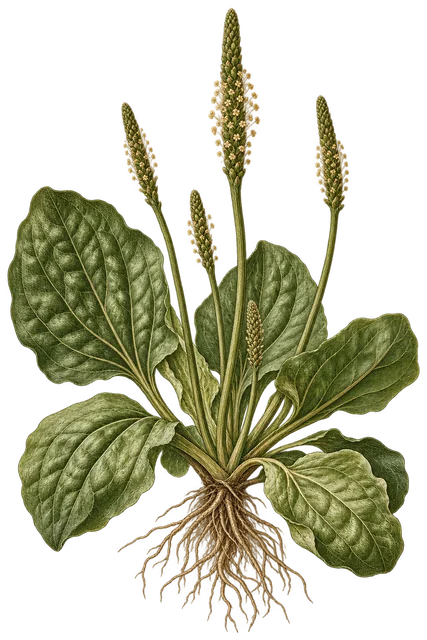
This entry concerns Plantago major L. leaves in Plantaginaceae. Broadleaf plantain is unrelated to the banana-like cooking plantain. P. lanceolata, P. rugelii and psyllium seed/husk products are different materials; a monograph for one does not authorize claims for another.
NC State Extension: Plantago major identity, family and traditional leaf uses · EMA: Ribwort plantain leaf, Plantago lanceolata, is a distinct species-specific monograph
Food and preparation
NC State Extension describes young leaves as a spinach-like vegetable and older leaves as stringier material used boiled in stews. This is a leafy food rather than a banana substitute. A known food source and correct identification are essential; its presence on a path or lawn does not make it suitable for eating.
NC State Extension: Plantago major identity, family and traditional leaf uses
Waybread and the Nine Herbs Charm
Broadleaf plantain’s low rosette survives along paths and on trampled ground. Its old English name, waybread, belongs to that close relationship with everyday footsteps. The Botanical Society of Scotland identifies Plantago major with the waybread addressed in the Old English Nine Herbs Charm, from around the tenth or eleventh century. The poem imagines a herb that withstands passing traffic and calls on it to resist poison and contagion. It is a vivid glimpse of a healing tradition in which observation, poetry and protective belief worked together.
Botanical Society of Scotland: Three plantains and the waybread tradition · Rutgers Old English Poetry Project: The Metrical Charms, including the Nine Herbs Charm
Household practice and local records
That familiar wayside leaf also entered ordinary household care. NC State Extension records uses for bites, stings, cuts and sore feet. In a 2024 study of Italy’s Bologna district, researchers documented Plantago major separately: informants described leaves used on sores and irritated skin, and leaf infusions for coughs and sore throats. The modern survey preserves local voices alongside the much older written record, without assuming an unbroken or identical practice between them. Fresh roadside leaves are not sterile wound dressings, despite the plant’s long reputation for tending skin.
NC State Extension: Plantago major identity, family and traditional leaf uses · Chiocchio et al. (2024): Original ethnobotanical survey in Bologna district, Italy
Traditional skin use
NC State Extension records leaf use for bites, stings and other minor complaints. The Bologna field survey records fresh Plantago leaves used on bites and irritated skin, but some records are only identified to genus. That tradition can be included without relabeling every Plantago report as P. major.
NC State Extension: Plantago major identity, family and traditional leaf uses · Chiocchio et al. (2024): Original ethnobotanical survey in Bologna district, Italy
Reading the medicinal traditions
The accounts below record practices rather than established treatments. Astringent describes a drying or tightening action traditionally attributed to a preparation. American Eclectic medicine was a nineteenth- and early-twentieth-century medical movement that made extensive use of botanical preparations; its dental and urinary accounts sometimes concern whole plants, tops and roots rather than the leaf alone.
Felter and Lloyd, King's American Dispensatory (1898): Plantago major · Harvey Wickes Felter (1922): Plantago major
Leaf applications for skin and stings
Bologna informants described fresh broadleaf-plantain leaves on sores, wounds and rashes; Felter’s 1922 American account emphasized crushed leaves for insect stings and caterpillar irritation. Both accounts preserve the use of the leaf as a local skin remedy.
Chiocchio et al. (2024): Original ethnobotanical survey in Bologna district, Italy · Harvey Wickes Felter (1922): Plantago major
Cough and sore-throat infusions
The Bologna study, published in 2024 from interviews collected in 2010–2016, records Plantago major leaf infusion for cough and sore throat. It lists broadleaf plantain separately from ribwort plantain.
Chiocchio et al. (2024): Original ethnobotanical survey in Bologna district, Italy
Astringent bowel remedies
Bologna informants described astringent leaf infusions and intestinal uses. King’s 1898 Dispensatory also recorded plantain preparations for diarrhoea and dysentery, identifying fresh tops and roots rather than psyllium husk.
Chiocchio et al. (2024): Original ethnobotanical survey in Bologna district, Italy · Felter and Lloyd, King's American Dispensatory (1898): Plantago major · NHS: Dysentery, bloody diarrhoea and urgent assessment
Toothache applications
American Eclectic herbalists used an alcoholic Plantago major preparation locally for toothache associated with a sensitive tooth pulp. Felter records this in 1922, showing an oral-pain tradition distinct from leaf poultices.
Harvey Wickes Felter (1922): Plantago major · NHS: Toothache and when dental assessment is needed
Urinary complaints
King’s Dispensatory records fresh Plantago major tops and root preparations for difficult urination and urinary complaints. These historical medicines used more than the leaf alone.
Felter and Lloyd, King's American Dispensatory (1898): Plantago major · NIDDK: Symptoms and causes of urinary retention
Identity & detailed reference
Identity
Plantago major L., broadleaf or greater plantain; the leaf is the ingredient described here. It is an herb in the Plantaginaceae family, unrelated to the banana-like cooking plantain. Ribwort plantain (Plantago lanceolata L.) and blackseed plantain (Plantago rugelii) are distinct species, not synonyms.
Ingredient details, preparation and research
Source plant or material
Plantago major L.; fresh or dried leaves from a correctly identified plant. This entry does not cover seeds, seed husks or Plantago lanceolata preparations.
Plant family / material: Plantaginaceae (plantain family).
Forms and route
Fresh or dried leaves; leaf infusions, tinctures and prepared external products. Fresh-leaf poultices belong to traditional household practice. Extract strengths and formulation quality vary; none is interchangeable with a sterile wound-care product.
Vitamins and minerals
Young correctly identified leaves have a food history. One Spanish analysis reported 45.1 mg vitamin C and 108 mg calcium per 100 g fresh Plantago major leaf. Scaling those study values to a small, weighed 10 g food portion gives about 4.5 mg vitamin C and 11 mg calcium; these are composition estimates, not a guaranteed serving label or a recommended medicinal dose. A topical poultice supplies no dietary nutrients, and strained tea does not reproduce eaten-leaf nutrition.
Absorption and preparation
A poultice is intended for brief local contact, not systemic nutrient delivery. There is no established household method for boosting useful absorption through skin. Oil, alcohol, heat and airtight covering should not be added to force absorption. Infusions and tinctures extract different fractions, and the nutrients in eaten leaves cannot be assumed to remain at the same levels in strained tea or other preparations.
Traditional and reported uses
- Traditional external use: NC State Extension records Plantago major leaves used for bites, stings and minor skin complaints. This establishes a history of use, not reliable clinical effectiveness for mosquito-bite itching.
- Regional tradition: a 2024 ethnobotanical field study in Bologna district, Italy, records fresh Plantago spp. leaves applied to insect bites and irritated skin. The study lists those bite uses at genus level; they must not all be assigned to P. major or to another specific species.
- Food use: young, correctly identified leaves have been eaten as greens. An edible history does not make unidentified wild plants, contaminated leaves or concentrated extracts safe.
- Human research: small trials of standardized or manufactured Plantago major creams/gels reported improved pressure-injury or ulcer outcomes alongside clinical care. These products and conditions differ from a freshly crushed leaf on a bite; there is no established fresh-leaf dose or proven mosquito-bite benefit.
- Research context: plant constituents and extracts have been studied in laboratory assays, including inflammatory pathways. Such findings do not establish a fresh-leaf poultice as a proven antihistamine, antibiotic or treatment for wounds or mosquito-borne disease.
Contraindications and cautions
- Correct identification and clean sourcing matter. Prefer a labeled cultivated plant from a reputable grower. Do not gather from sprayed lawns, roadsides or animal-fouled ground, or identify a plant solely by a common name or an uncertain photo match.
- Fresh leaves are not sterile even after washing. A household poultice should be limited to a small patch of intact skin; avoid broken, infected, weeping or extensively inflamed skin, eyes and mucous membranes. Use clean utensils rather than chewing leaves.
- Plant preparations can irritate skin or cause allergic reactions. Avoid if previously allergic to plantain; stop, remove and rinse if burning, worsening itch, redness or rash develops. A small test spot cannot rule out delayed allergy.
- Prepare wet leaf mash for one immediate use and discard leftovers. Do not store an unpreserved watery paste or wet fresh-leaf oil mixture, or cover the area tightly overnight.
- No medicinal oral dose or safety recommendation for pregnancy, breastfeeding or children is established by these sources. Obtain qualified advice before medicinal use in these groups; household topical tradition is not evidence of general safety.
- Seek medical advice for spreading warmth or redness, worsening pain, pus or fever. Trouble breathing or sudden swelling of the mouth, tongue or throat requires emergency help. Do not use plantain instead of care for a tick bite, venomous bite or serious reaction.
Similar items and how they compare
- Ribwort plantain leaf (Plantago lanceolata)
A related Plantago species with overlapping traditional uses and some shared phytochemicals.
It is a separate narrow-leaved species with its own EMA cough-and-cold monograph. That monograph cannot be used as proof that a P. major bite poultice is clinically effective or approved.
- Lemon balm
Fresh leaves also have a documented tradition of external use for insect bites.
Lemon balm is Melissa officinalis in the mint family and has a different aromatic chemistry. Adding it to plantain has no established benefit for mosquito-bite itch.
- Calendula
Another plant used traditionally in preparations for minor inflamed skin.
Calendula preparations use flowers of Calendula officinalis and have Asteraceae-family allergy cautions. Its traditional-use monograph does not validate fresh plantain mash.
What human studies actually tested
A 130-patient trial tested a standardized topical formulation for stage-1 pressure injury over 14 days. Another study, with 94 completers, tested a 10% hydroalcoholic-extract gel alongside dressings and routine care for diabetic-foot or pressure ulcers. Its open-label design, different dressings and predictable even/odd record-number allocation limit confidence despite a reported benefit. Neither study tested mosquito-bite poultices.
- Ghiasian et al. (2021): Standardized Plantago major topical formulation in 130 patients with stage-1 pressure injury
- Ghanadian et al. (online 2022; print 2024): Plantago major extract gel, open-label diabetic-foot and pressure-ulcer study
- Ghanadian et al.: Full primary report showing allocation and dressing protocols
Fresh-leaf practice and contamination
For someone choosing the household tradition, limit it to a small area of intact skin: use correctly identified, unsprayed, cleanly grown leaves, wash them, and crush with clean utensils rather than chewing. Make one immediate-use portion and discard it after use. Washing does not sterilize leaves. Avoid eyes, mucosa, wounds, weeping dermatitis and tight overnight covering; remove and rinse if it irritates. This is a harm-reduction approach, not a validated dose or preservation method.
Scalp and realistic nutrition
No scalp-specific human result was identified in the reviewed sources. A nutrient-rich leaf analysis does not show nutrient delivery through skin or hair. The study-specific 10 g food estimate is only about 4.5 mg vitamin C and 11 mg calcium; topical use supplies none to the diet. No useful absorption-enhancing oil, heat or occlusion routine has been established.
Safety boundaries and groups needing advice
Known plantain allergy, uncertain identification or dirty harvesting sites rule out home use. Medicinal pregnancy, breastfeeding and child-use data remain inadequate for a general recommendation. A small test area cannot exclude delayed allergy. For an ordinary mosquito bite, washing and a wrapped cold pack are simpler first steps; spreading infection signs or serious allergic symptoms need care.
Related herbs and researched combinations
Calendula shares a minor-skin-care tradition but uses Asteraceae flowers. Ribwort plantain has its own species-specific monograph. One 40-person trial studied a manufactured Aloe vera/P. major gel plus usual diabetic-foot care; it cannot identify each ingredient’s contribution, establish synergy or validate a homemade blend for bites.
Entry sources
- NC State Extension: Plantago major identity, family and traditional leaf uses
- University of Minnesota Extension: Plantain species, identification and ethnobotanical context
- Chiocchio et al. (2024): Ethnobotanical field survey in Bologna district, Italy
- Zubair et al. (2011): Primary analysis of Plantago major leaf polyphenols and drying effects
- Primary research: Prebiotic Activity of Poly- and Oligosaccharides Obtained from Plantago major Leaves
- Kartini et al. (2017): Plantago major constituents and laboratory cell experiments
- Guil-Guerrero (2001): Nutritional composition of three Plantago species, primary-study abstract in FAO AGRIS
- EMA: Ribwort plantain leaf, Plantago lanceolata, is a distinct species-specific monograph
- CDC: Mosquito-bite care, washing and a 10-minute ice pack
- NHS: Insect-bite care, pharmacy options and warning signs
- Pieroni et al. (2004): Original field survey including fresh lemon-balm leaf use for insect bites
- EMA: Calendula flower traditional-use monograph and Asteraceae allergy cautions
- FDA: Microbial contamination risks in water-containing cosmetic preparations
- Chiocchio et al. (2024): Original ethnobotanical survey in Bologna district, Italy
- Ghiasian et al. (2021): Standardized Plantago major topical formulation in 130 patients with stage-1 pressure injury
- Ghanadian et al. (online 2022; print 2024): Plantago major extract gel, open-label diabetic-foot and pressure-ulcer study
- Najafian et al. (2019): Aloe vera/Plantago major gel, 40-person randomized diabetic-foot-ulcer trial
- Ghanadian et al.: Full primary report showing allocation and dressing protocols
Reference entry 100 · Recorded content review: 2026-10-05 · Review scope and dates