


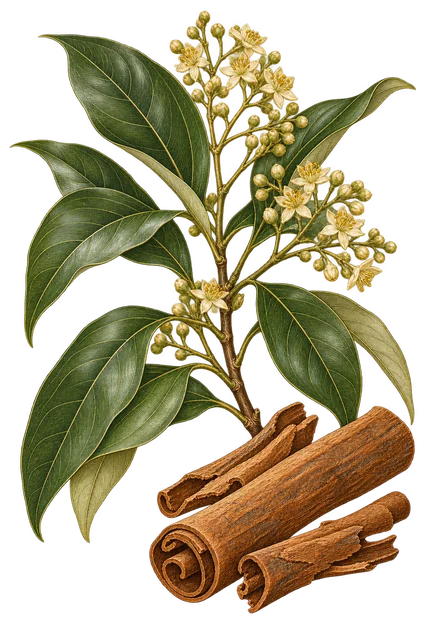
Key cautions
- Avoid prolonged large amounts or cassia supplements without medical review, especially with liver disease; variable coumarin content is the main concern.
- Do not swallow fragrance oil, apply concentrated oil to skin, or inhale dry cinnamon powder. Oil and powder can irritate; the cinnamon challenge can seriously harm the lungs.
What’s inside
Cinnamaldehyde is prominent in the aroma; bark also contains polyphenols, fibre and variable coumarin. Coumarin exposure can be appreciably higher in cassia than in Ceylon cinnamon. Oil contains concentrated volatile compounds but does not preserve the bark’s fibre and mineral profile.
Uses in brief

- Culinary flavouring from food-grade bark; historical aromatic pharmacy and perfumery.
- Studied for blood-sugar effects, but evidence does not establish cassia as a replacement for diabetes care.
In the King James Bible
In the King James Bible
Named material
Exodus names cassia among the holy-anointing ingredients, and Psalm 45 places its scent on royal garments alongside myrrh and aloes. The material is conventionally linked with aromatic Cinnamomum bark, while the exact ancient species remains uncertain.
And of cassia five hundred shekels, after the shekel of the sanctuary, and of oil olive an hin:
Exodus 30:24 (KJV)
All thy garments smell of myrrh, and aloes, and cassia, out of the ivory palaces, whereby they have made thee glad.
Psalm 45:8 (KJV)
Scripture and identification sources
Words & their stories
WORDS & THEIR STORIES
The name behind the KJV
Biblical Hebrew · Exodus 30:24 (KJV)
וְקִדָּהwəqiddāh
And cassia, a spice included in the anointing oil.
Dictionary form: קִדָּה · qiddāh
Wə- means “and.” BDB calls it a spice usually identified as cassia.
Biblical Hebrew · Psalm 45:8 (KJV); Psalm 45:9 in the Hebrew edition
קְצִיעוֹתqəṣīʿōt
Cassia, among the fragrances of royal garments.
Dictionary form: קְצִיעָה · qəṣīʿāh
This plural noun is a different Hebrew word from qiddāh.
What the language reveals
One English label, two Hebrew names
The KJV translates both qiddāh and qəṣīʿōt as “cassia.” That shared translation does not prove that both ancient materials had precisely the same botanical source.
The cassia association is traditional; the words do not fix a modern Cinnamomum species, chemical profile or essential oil.
History, folklore and reported uses
History, folklore and traditional uses
Cassia’s biblical story is the story of scent as a precious material. Exodus lists it in the holy anointing preparation, while Psalm 45 places it among the aromas of royal garments. These references show ceremonial and personal fragrance. The ancient name is usually associated with the cinnamon-bark trade, but the exact tree behind every biblical mention cannot be recovered with certainty.
Today the word also belongs to an everyday kitchen spice. Chinese cassia produces a robust, sweet-smelling bark and appears under both Cinnamomum aromaticum and Cinnamomum cassia in different sources. European pharmacy later used cassia-derived “cinnamon oil” to flavour preparations, while older physicians credited aromatic cinnamon preparations with digestive and other medicinal actions. Modern evaluation asks more specific questions: which species, which plant part, how much coumarin, and what evidence applies to that particular product?
Traditional, historical and reported uses
- Sacred anointing
Historical recordWhy this label?
Specific Exodus passage documents a ceremonial aromatic material.
Exodus 30:24 names cassia within the holy anointing preparation. This is a distinct ceremonial role for an aromatic trade material, not a general-purpose recipe for household oil.
- Perfuming garments
Historical recordWhy this label?
Specific Psalm documents fragrance in royal garments.
Psalm 45:8 associates cassia with myrrh and aloes in the fragrance of royal garments. The verse records personal and courtly scent, without identifying a modern distilled product.
- Cooking and spice blends
Food or household practiceWhy this label?
Food seasoning claim, despite an attached nutrient-database source.
Cassia bark became a widely used cinnamon-type flavouring. Identified food-grade bark continues to season sweet and savoury dishes.
- Flavouring apothecary preparations
Historical recordWhy this label?
The 1911 Pharmaceutical Codex records official flavouring preparations.
The 1911 British Pharmaceutical Codex lists cassia oil as a flavouring and as a substitute for true cinnamon oil in official aromatic waters and spirits. These historical pharmacy forms had purposes and controls different from a home fragrance bottle.
- Historical digestive medicine
Historical recordWhy this label?
Felter's 1922 account documents a historical apothecary distinction.
Felter’s 1922 account described cinnamon as an aromatic digestive and astringent remedy, while identifying the medicinal “oil of cinnamon” as cassia-derived. The entry preserves that apothecary practice and its distinction between bark and oil.
Story sources
- Kew Plants of the World Online: Cinnamomum aromaticum Nees
- NCCIH: Cinnamon, usefulness and safety
- British Pharmaceutical Codex (1911): Oil of Cassia
- Felter’s Eclectic Materia Medica (1922): Cinnamomum
- USDA Standard Reference 28: Spices and Herbs, cinnamon NDB 02010 and saffron NDB 02037
- Lytton John Musselman, Old Dominion University: Cassia and Cinnamon
- The King James Bible: Project Gutenberg ebook 10
Women’s Health: traditions, evidence and cautions
Historical use does not establish benefit or safety. Pregnancy, breastfeeding and fertility care require particular caution: food, tea, essential oil and concentrated extract are not interchangeable. These records are not treatment, dosing or pregnancy-management instructions. Discuss supplements with a qualified clinician or pharmacist; do not delay evaluation of persistent symptoms.
Cassia bark / rou gui
Cinnamomum cassia (L.) J.Presl (widely used pharmaceutical name; canonical card uses Cinnamomum aromaticum)
- Plant part / material
- Dried tree bark (Cinnamomi Cortex)
- Preparation studied or reported
- Bark as food spice or as a separate medicinal preparation; twig medicine gui zhi and distilled oils are distinct.
Rou gui is Chinese cassia bark, used within traditional warming patterns. It has a historical menstrual role that should not be transferred to every product marketed simply as cinnamon.
menstruation
Documented traditional use; clinical reproductive benefit not established here.
Reported or traditional useThe HKBU materia-medica record includes absent menstruation among its traditional indications.
What the evidence supportsThis establishes a traditional record, not an effective period-inducing or fertility treatment. Species and preparation variation prevent borrowing results from unspecified cinnamon products.
Ordinary food use differs from medicinal use. Cassia can contain substantial coumarin; prolonged concentrated use is a concern with liver disease. Medicinal pregnancy/lactation safety is insufficient.
- Do not swallow cinnamon or cassia essential oil.
- Pregnancy and breastfeeding safety is not established by this traditional record. Do not self-prescribe medicinal preparations when pregnant, trying to conceive, or breastfeeding; obtain clinician review.
Regional reading paths
These sourced notes describe cultivation, trade, food traditions or material history. A regional connection does not claim exclusive origin.
Asia
Cultivated and traded: Chinese cassia and related Southeast Asian commercial barks.
Bark seasoning; identify species rather than treating every cinnamon as equivalent.
Identity & detailed reference
Identity
Modern Chinese cassia is the aromatic bark of Cinnamomum aromaticum (Kew’s accepted name), widely called Cinnamomum cassia. Cassia-labelled trade products may involve other Cinnamomum species. Ancient biblical cassia is a fragrant material conventionally associated with this bark group, without secure species-level identification.
Ingredient details, preparation and research
Also known as: Chinese cassia; Cassia cinnamon; Chinese cinnamon; Cinnamomum cassia (trade/medicinal usage)
Source plant or material
Modern Chinese cassia is the aromatic bark of Cinnamomum aromaticum (Kew’s accepted name), widely called Cinnamomum cassia. Cassia-labelled trade products may involve other Cinnamomum species. Ancient biblical cassia is a fragrant material conventionally associated with this bark group, without secure species-level identification.
Plant family / material: Lauraceae (laurel family)
Forms and route
Food-grade bark sticks or ground bark; separately standardized extracts and supplements; distilled cassia oil, often from leaves and twigs, is a concentrated fragrance/flavour material. Bark, leaf/twig oil and biblical anointing compounds are not interchangeable.
Vitamins and minerals
USDA’s ground-cinnamon reference explicitly labels Cinnamomum aromaticum / cassia. A 2.6 g teaspoon provides approximately 6 kcal, 1.4 g fibre, 26 mg calcium and 0.45 mg manganese. This is a food-composition reference, not a daily medicinal recommendation; a light sprinkle contributes much less. Oil and filtered extracts do not supply the same nutrients.
Absorption and preparation
Ground bark is eaten with food; its nutrient amounts depend on the actual quantity swallowed. Extraction changes the balance of cinnamaldehyde, polyphenols and coumarin. No proven food pairing makes cassia a reliable diabetes treatment or removes coumarin-related risk.
Traditional and reported uses
- Culinary flavouring from food-grade bark; historical aromatic pharmacy and perfumery.
- Studied for blood-sugar effects, but evidence does not establish cassia as a replacement for diabetes care.
Contraindications and cautions
- Avoid prolonged large amounts or cassia supplements without medical review, especially with liver disease; variable coumarin content is the main concern.
- Do not swallow fragrance oil, apply concentrated oil to skin, or inhale dry cinnamon powder. Oil and powder can irritate; the cinnamon challenge can seriously harm the lungs.
- Use food amounts rather than medicinal amounts during pregnancy or breastfeeding unless a clinician advises otherwise; discuss supplements with any regular medicines.
Similar items and how they compare
- Ceylon cinnamon
Another Cinnamomum bark spice with a related flavour.
Cinnamomum verum usually has much less coumarin; it is not automatically interchangeable with a cassia extract.
- Senna / Cassia species
The shared word cassia can confuse plant labels.
Senna and botanical Cassia legumes are not the Cinnamomum bark spice in this card.
Modern and ancient identity
Kew accepts Cinnamomum aromaticum Nees, native from southeastern China to Vietnam. The familiar Cinnamomum cassia name remains widespread in commerce. The biblical word cannot verify the identity of a present-day species or product.
Bark and oil are separate forms
Ground bark retains fibre and minerals. Cassia oil is a distilled volatile fraction, historically prepared from Cinnamomum material including leaves and twigs. It is much more concentrated and cannot be used as a spoon-for-spoon or drop-for-spoon replacement.
Human research is inconclusive
NCCIH does not consider research sufficient to clearly support cinnamon for any health condition. Product species and plant parts vary across studies, so results from one extract should not be transferred to all cassia bark or oil.
Coumarin and liver risk
Cassia may contain substantially more coumarin than Ceylon cinnamon. Sensitive people, including those with liver disease, can face risk from prolonged consumption of coumarin-rich products. The amount differs between products, making a universal medicinal household dose unreliable.
Real nutritional contribution
USDA’s 2.6 g teaspoon of ground cinnamon/cassia contributes about 1.4 g fibre and 0.45 mg manganese, but only about 26 mg calcium. These figures describe food, not absorption or medical benefit. Filtered tea, extract and distilled oil require their own composition data.
Practical use limits
Ordinary food seasoning differs from long-term supplement use. Discuss medicinal amounts with a clinician when using medicines, pregnant or breastfeeding. Skin irritation and aspiration are different hazards from coumarin-related liver concerns.
Evidence limits
- Trade names can cover more than one Cinnamomum species.
- Ancient cassia is not verified to one modern species.
- Nutrient values are reference food data; coumarin levels require product-specific information.
Entry sources
- Kew Plants of the World Online: Cinnamomum aromaticum Nees
- NCCIH: Cinnamon, usefulness and safety
- British Pharmaceutical Codex (1911): Oil of Cassia
- Felter’s Eclectic Materia Medica (1922): Cinnamomum
- USDA Standard Reference 28: Spices and Herbs, cinnamon NDB 02010 and saffron NDB 02037
- Lytton John Musselman, Old Dominion University: Cassia and Cinnamon
- The King James Bible: Project Gutenberg ebook 10
- USDA FoodData Central: Ground cinnamon, SR Legacy FDC171320, scientific name Cinnamomum aromaticum
Reference entry 119 · Recorded content review: 2026-10-06 · Review scope and dates