


Key cautions
- Do not use an ornamental spider plant in place of this vegetable. Buy identified food greens; photographs and common names cannot establish edibility.
- Wash fresh leaves and discard spoiled material. Dried greens can be contaminated if handled poorly; use a food-grade product and follow its storage guidance.
What’s inside
Leaf fiber, protein and minerals with carotenoids and other plant compounds. Species, growth conditions, drying and cooking determine the final composition.
Uses in brief

- Cooked leafy vegetable
- Preserved leaf food
History, folklore and reported uses
History, folklore and traditional uses
Native/cultivated: East and Southern Africa; documented Kenyan vegetable traditions.
Traditional, historical and reported uses
- Cooked leafy vegetable
Food or household practiceWhy this label?
The source supports the named food, cosmetic or material practice; no treatment effect is inferred and the card’s form and safety limits remain attached.
A Kenyan interview study records widespread cultivation and consumption in Western and Nyanza communities. It documents food practice and preference rather than clinical benefit.
- Preserved leaf food
Food or household practiceWhy this label?
The source supports the named food, cosmetic or material practice; no treatment effect is inferred and the card’s form and safety limits remain attached.
The same study records sun drying as a preservation practice. That history does not guarantee hygiene of every dried batch; a food-grade product and suitable cooking remain important.
2 sourced featured uses; cultural or material records are not clinical efficacy evidence.
Historical-use additions reviewed 2026-10-09
Regional reading paths
These sourced notes describe cultivation, trade, food traditions or material history. A regional connection does not claim exclusive origin.
Africa
Native/cultivated: East and Southern Africa; documented Kenyan vegetable traditions.
Cooked leafy vegetable; not the ornamental Chlorophytum spider plant.
Identity & detailed reference
Identity
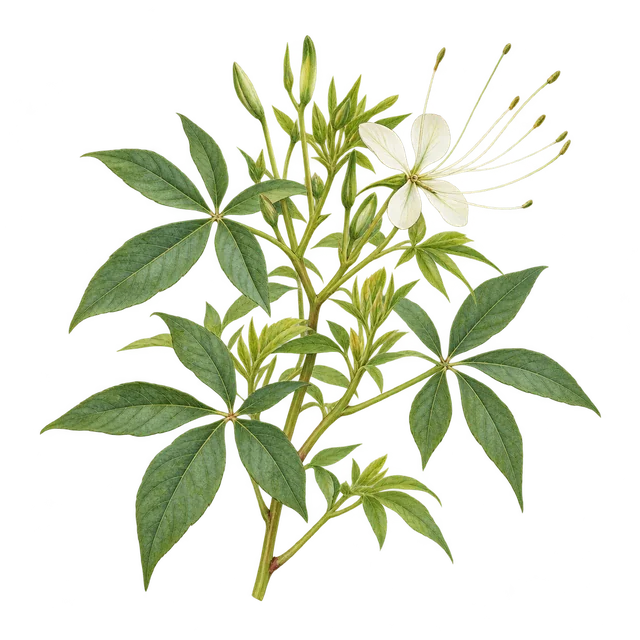
The edible leaves and tender shoots of Cleome gynandra, also called Gynandropsis gynandra. This vegetable is not Chlorophytum comosum, the common ornamental houseplant also named spider plant.
Ingredient details, preparation and research
Source plant or material
Cleome gynandra (syn. Gynandropsis gynandra)
Plant family / material: Cleomaceae
Forms and route
Identified fresh food greens, dried culinary leaves and cooked dishes. The card does not establish food use for any ornamental plant or concentrated extract sharing a common name.
Vitamins and minerals
The leaf supplies vegetable nutrients, but dry-leaf measurements are not a ready serving. A particular mineral assay does not establish identical content in all Kenyan varieties or cooking styles.
Absorption and preparation
Leaf matrices and antinutritional constituents can affect mineral availability. Total mineral concentration is not equivalent to human absorption or a reason to replace prescribed supplements.
Practical preparation
Use the identified culinary leaves in an established cooked recipe, with safe water and clean utensils. Follow storage guidance for purchased dried greens and refrigerate prepared dishes.
Traditional and reported uses
- Cooked leafy vegetable
- Preserved leaf food
Contraindications and cautions
- Do not use an ornamental spider plant in place of this vegetable. Buy identified food greens; photographs and common names cannot establish edibility.
- Wash fresh leaves and discard spoiled material. Dried greens can be contaminated if handled poorly; use a food-grade product and follow its storage guidance.
Evidence separates identity from benefit
Kew provides botanical identity and distribution; the Kenya survey provides use evidence. Analytical mineral research describes sampled vegetables, not a treatment trial or a nutritional ranking applicable to all spider-plant foods.
Evidence limits
Named food greens only; no houseplant substitution, wild-collection instruction or medicinal dose.
Entry sources
- Onyango et al.: Production, utilisation and indigenous knowledge of spider plant in Kenya
- Kew Plants of the World Online: Cleome gynandra
- X-ray fluorescence analysis of ten African indigenous leafy vegetables in Nairobi
Reference entry 333 · Recorded content review: 2026-10-09 · Review scope and dates