


Key cautions
- Do not swallow fragrance or essential oil, or substitute it for a studied root preparation. Safety is not established for unsupervised medicinal use in pregnancy, breastfeeding or children.
- Check medicinal use with a clinician if taking sedatives or blood-pressure medicines. Sedative effects are mainly experimental, while a small trial suggests blood-pressure activity; interaction magnitude in people is uncertain.
What’s inside
Rhizome research identifies varied sesquiterpenoid compounds; nardal, jatamansic acid and nardin have been isolated in one study. Other preparations contain different volatile and nonvolatile constituents. No single analytical profile can be assigned to the biblical ointment or to all modern oils.
Uses in brief

- Fragrant ointments, perfume and incense; traditional aromatic hair oils.
- Traditional calming and Unani cardiac use; limited modern studies concern particular oral preparations, not biblical ointment or aromatherapy.
In the King James Bible
In the King James Bible
Probable botanical identification
Song of Solomon evokes spikenard’s fragrance, and John describes Mary anointing Jesus’s feet with a costly ointment of spikenard. Nardostachys jatamansi is the traditional botanical identification. The ointment’s full ingredients and preparation remain unspecified, so it cannot be identified as a modern distilled essential oil.
While the king sitteth at his table, my spikenard sendeth forth the smell thereof.
Song of Solomon 1:12 (KJV)
Then took Mary a pound of ointment of spikenard, very costly, and anointed the feet of Jesus, and wiped his feet with her hair: and the house was filled with the odour of the ointment.
John 12:3 (KJV)
Scripture and identification sources
Words & their stories
WORDS & THEIR STORIES
The name behind the KJV
Biblical Hebrew · Song of Solomon 1:12 (KJV)
נִרְדִּיnirdī
My nard, rendered “my spikenard,” giving fragrance at the king’s table.
Dictionary form: נֵרְדְּ · nērd
The ending -ī means “my”; the dictionary form is nērd.
Koine Greek · John 12:3 (KJV)
νάρδουnárdou
Of nard, specifying the aromatic in Mary’s costly ointment.
Dictionary form: νάρδος · nárdos
The genitive form belongs with mýrou, “ointment/perfume.” Checked in Scrivener’s Greek.
What the language reveals
A perfume, not a modern bottle specification
John calls the preparation mýron, a perfumed ointment or aromatic oil. That description cannot be read as a modern steam-distilled essential-oil label.
The difficult adjective
John also uses πιστικῆς (pistikēs), often understood as genuine or pure; its exact force has been debated. The KJV renders the phrase as “ointment of spikenard.”
Nard is associated with the traditional spikenard aromatic, but the texts do not provide a complete botanical authentication or modern manufacturing method.
Language and identification bibliography
- Hebrew text: Song of Solomon 1 (Mechon-Mamre)
- Brown–Driver–Briggs: נֵרְדְּ (H5373; Bible Hub transcription)
- Greek text: John 12:3, Scrivener’s Textus Receptus 1894 (Bible Hub)
- Thayer’s Greek Lexicon: νάρδος (G3487; Bible Hub transcription)
- Thayer’s Greek Lexicon: μύρον (G3464; Bible Hub transcription)
- Thayer’s Greek Lexicon: πιστικός (G4101; Bible Hub transcription)
History, folklore and reported uses
History, folklore and traditional uses
Spikenard’s biblical story is unusually vivid: a costly ointment is opened, and its scent fills a house. John names Mary as the woman who anoints Jesus’ feet. The fragrant material is traditionally linked with Nardostachys jatamansi, a plant of the Himalayas and neighbouring high mountains. The distance between that habitat and the Gospel setting helps explain nard’s association with long-distance trade and value, without revealing the entire recipe of the ancient ointment.
In the plant’s own region, nard has other lives. Fieldwork among Tibetan people in Gyirong records roots burned as incense. South Asian traditions use the aromatic rhizome in hair oils and in calming or cardiac preparations. Present research has investigated root constituents, animal sedative effects and a small oral blood-pressure trial. Growing demand has also made species verification and responsible sourcing part of the modern story.
Traditional, historical and reported uses
- Perfumed ointment and anointing
Historical recordWhy this label?
Specific Gospel passage documents fragrant ointment and anointing.
John 12:3 describes Mary using costly spikenard ointment on Jesus’ feet, with its odour filling the house. The passage supports a fragrant ointment and act of anointing; its complete formula and extraction method are not given.
- Tibetan ritual incense
Food or household practiceWhy this label?
Ethnobotanical survey records ritual incense burning.
An ethnobotanical survey in Gyirong Valley records Nardostachys roots burned in incense burners. This is a specific local ritual use, separate from swallowing a medicinal preparation.
- Aromatic hair oils
Traditional accountWhy this label?
Traditional aromatic medicinal hair-oil use is the claim; experimentation is distinguished.
The introduction to the 2011 rhizome study describes traditional use as an aromatic addition to medicinal hair oils, associated with hair growth and darkening. Its subsequent experimental findings do not establish a proven treatment for human hair loss.
- Calming and sleep traditions
Mixed/contextual sourcesWhy this label?
Combines medicinal sleep tradition with explicit animal-study investigation.
Indian medical tradition has used jatamansi rhizome for insomnia and related nervous complaints. A modern experimental study investigated this traditional background in rats and mice; human insomnia evidence remains a separate question.
- Unani cardiac medicine
Mixed/contextual sourcesWhy this label?
Combines Avicenna's historical cardiac reputation with a modern human trial.
Bhat and Malik trace spikenard’s Unani cardiac reputation to Avicenna’s writings. Their later small hypertension trial explored one modern clinical question; it does not validate every historical cardiac indication or replace prescribed treatment.
Story sources
- Kew Plants of the World Online: Nardostachys jatamansi (D.Don) DC.
- An ethnobotanical study on wild plants used by Tibetan people in Gyirong Valley, Tibet, China (2022)
- Gottumukkala et al. (2011): Phytochemical investigation and hair-growth studies on Nardostachys rhizomes
- Central nervous system depressant activity of Jatamansi rhizome (2022)
- Bhat and Malik (2020): Nardostachys jatamansi in essential hypertension, randomized controlled study
- Secondary metabolite profiling and in-vitro activities of Nardostachys jatamansi (2019)
- Kew Medicinal Plant Names Services: Nardostachys jatamansi synonyms
- Lytton John Musselman, Old Dominion University: Spikenard
- The King James Bible: Project Gutenberg ebook 10
Regional reading paths
These sourced notes describe cultivation, trade, food traditions or material history. A regional connection does not claim exclusive origin.
Asia
Native and cultural: Himalaya to parts of China and northern Myanmar; field research in Tibet’s Gyirong Valley records aromatic roots used in incense rituals.
Aromatic root/rhizome and incense history. This does not establish medical efficacy or encourage wild harvesting.
Identity & detailed reference
Identity
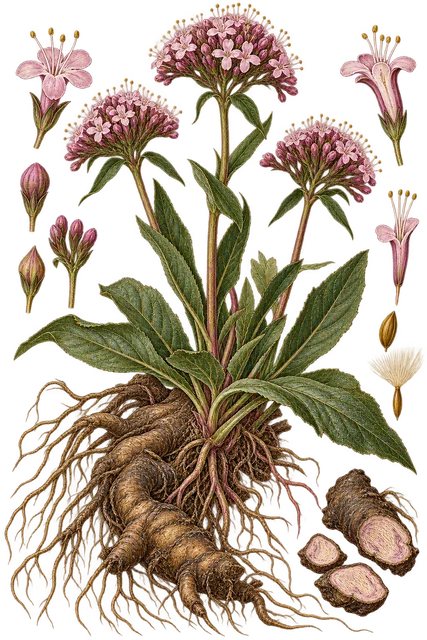
Indian/Himalayan spikenard is Nardostachys jatamansi, an aromatic high-mountain perennial whose rhizome and roots are used. It is traditionally identified with biblical nard. American spikenard (Aralia racemosa) and plants traded as Indian valerian are different species, and the ancient ointment’s full formula is unknown.
Ingredient details, preparation and research
Also known as: Nard; Indian spikenard; Himalayan spikenard; Jatamansi
Source plant or material
Indian/Himalayan spikenard is Nardostachys jatamansi, an aromatic high-mountain perennial whose rhizome and roots are used. It is traditionally identified with biblical nard. American spikenard (Aralia racemosa) and plants traded as Indian valerian are different species, and the ancient ointment’s full formula is unknown.
Plant family / material: Caprifoliaceae (honeysuckle family; older sources use Valerianaceae)
Forms and route
Dried rhizome and roots; traditional compound powders or extracts; infused cosmetic oils; incense; separately distilled essential oil and finished perfumes. The costly biblical ointment was a compounded fragrant material, not demonstrated to be neat modern essential oil.
Vitamins and minerals
Spikenard root, perfume and essential oil are not meaningful dietary nutrient sources. This review does not assign a nutritional serving or vitamin/mineral benefit. A rhizome extract’s biological activity is a pharmacological question, separate from nutrition.
Absorption and preparation
Human absorption data do not establish a general food-pairing or dosing rule for spikenard. Root powder, extracted fractions, infused hair oils and distilled essential oil differ; an animal study of an extract cannot establish the effect of inhaling perfume or using oil on skin.
Traditional and reported uses
- Fragrant ointments, perfume and incense; traditional aromatic hair oils.
- Traditional calming and Unani cardiac use; limited modern studies concern particular oral preparations, not biblical ointment or aromatherapy.
Contraindications and cautions
- Do not swallow fragrance or essential oil, or substitute it for a studied root preparation. Safety is not established for unsupervised medicinal use in pregnancy, breastfeeding or children.
- Check medicinal use with a clinician if taking sedatives or blood-pressure medicines. Sedative effects are mainly experimental, while a small trial suggests blood-pressure activity; interaction magnitude in people is uncertain.
- Verify the scientific name and traceable sourcing. Similar common names can refer to other plants, and wild rhizome demand has put pressure on spikenard populations.
- A topical hair product or perfume can still irritate skin; use only an appropriate finished formulation and stop if it causes a reaction.
Similar items and how they compare
- Valerian
A related aromatic-root tradition often discussed for calming.
Valeriana species and their clinical research are not interchangeable with Nardostachys jatamansi.
- American spikenard
It shares the English common name.
Aralia racemosa is a different plant and does not identify the nard of biblical perfumery.
Botanical identity and names
Kew accepts Nardostachys jatamansi in Caprifoliaceae, with N. grandiflora among its synonyms. Older sources place it in Valerianaceae. Trade names can overlap with other aromatic roots, so a common name alone is inadequate identification.
Root, ointment and oil
The medicinal and incense material is the aromatic underground portion. A finished ointment, an infused cosmetic oil, a root powder and a distilled essential oil are distinct preparations. The Gospel wording does not establish that the ointment was undiluted steam-distilled oil.
Constituent and hair research
A 2011 study isolated nardal, jatamansic acid and nardin and examined hair-growth activity experimentally. These chemical and animal findings provide a research lead, not a clinical demonstration that a commercial spikenard oil restores human hair.
Calming research is mainly experimental
A study using rhizome powder reported effects on activity and drug-induced sleep in rodents. It supports further investigation of CNS effects, while leaving the effectiveness, appropriate formulation and interaction risks in people unresolved.
A small blood-pressure trial
A four-week, single-blind placebo-controlled study enrolled 40 adults with stage 1 hypertension, some using antihypertensive medicines, and reported lower pressure with an oral Nardostachys preparation. Its size and duration limit conclusions. The findings do not apply to inhaled perfume or justify stopping medicines.
Nutrition, absorption and sourcing
No dietary serving or absorption-enhancing pairing is established. Modern studies use defined preparations rather than generic “nard.” Research authors also describe pressure from overharvesting and illegal rhizome trade; prefer authenticated, traceable material and responsible sourcing.
Evidence limits
- The traditional botanical identification does not recover the exact ancient ointment formulation.
- Human evidence is limited and preparation-specific; much mechanistic research is in animals or laboratories.
- Species authenticity and sustainable sourcing matter for the traded rhizome.
Entry sources
- Kew Plants of the World Online: Nardostachys jatamansi (D.Don) DC.
- An ethnobotanical study on wild plants used by Tibetan people in Gyirong Valley, Tibet, China (2022)
- Gottumukkala et al. (2011): Phytochemical investigation and hair-growth studies on Nardostachys rhizomes
- Central nervous system depressant activity of Jatamansi rhizome (2022)
- Bhat and Malik (2020): Nardostachys jatamansi in essential hypertension, randomized controlled study
- Secondary metabolite profiling and in-vitro activities of Nardostachys jatamansi (2019)
- Kew Medicinal Plant Names Services: Nardostachys jatamansi synonyms
- Lytton John Musselman, Old Dominion University: Spikenard
- The King James Bible: Project Gutenberg ebook 10
Reference entry 135 · Recorded content review: 2026-10-06 · Review scope and dates