


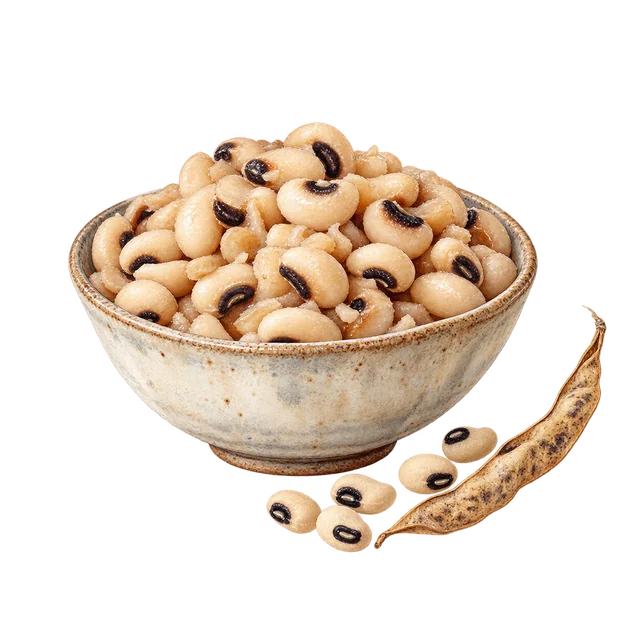
Key cautions
- Cook dried cowpeas fully using reliable food instructions; raw or incompletely cooked pulse is not equivalent to the ready food.
- Legume allergy is possible. Check canned or prepared products for sodium, other ingredients and cross-contact relevant to your needs.
What’s inside
Starch, protein, fiber and minerals, with phytate and other legume constituents affected by processing. Seed-coat color and variety do not alone establish nutrient quality.
Uses in brief

- Cooked beans
- Bean pastes and prepared foods
History, folklore and reported uses
History, folklore and traditional uses
African domestication/cultivation: Nigeria, Niger and wider sub-Saharan Africa.
A closer look at its history
A bean transformed into akara and moin-moin
West African cooks developed cowpea foods that depend on processing as much as on the bean itself. The National Research Council’s 2006 account describes dehulled seeds ground and combined with onion and spices, then fried as akara or steamed as moin-moin. Whole beans also enter soups accompanying cassava, yam or plantain. These named preparations give more historical specificity than saying only that cowpeas are boiled: removing the seed coat, grinding and choosing frying or steaming produce very different textures and eating occasions from the same field crop.
The harvest includes vegetables and dry-season fodder
The crop account also records fresh or dried leaves, green pods and immature seeds as foods, showing that mature black-eyed peas are only one part of cowpea’s culinary range. After seed harvest, stems and leaves could be dried, bundled and stored for livestock through dry months; in a poor-rainfall year that fodder could be especially valuable. The plant’s nitrogen-fixing role added another reason to keep it in farming systems. Cowpea’s history is thus one of several linked harvests and uses, rather than a single dried pulse appearing at market.
Additional history reviewed 2026-10-09
Traditional, historical and reported uses
- Cooked beans
Food or household practiceWhy this label?
The source supports the named food, cosmetic or material practice; no treatment effect is inferred and the card’s form and safety limits remain attached.
The National Research Council and IITA describe cowpea as a staple grain legume. Cooked beans can accompany cereals and vegetables as part of a varied meal.
- Bean pastes and prepared foods
Food or household practiceWhy this label?
The source supports the named food, cosmetic or material practice; no treatment effect is inferred and the card’s form and safety limits remain attached.
IITA records utilization beyond intact beans, while regional crop accounts describe flour and paste foods. Dehulling, frying or steaming creates different textures and changes the finished food’s fat and water content.
2 sourced featured uses; cultural or material records are not clinical efficacy evidence.
Historical-use additions reviewed 2026-10-09
Regional reading paths
These sourced notes describe cultivation, trade, food traditions or material history. A regional connection does not claim exclusive origin.
Africa
African domestication/cultivation: Nigeria, Niger and wider sub-Saharan Africa.
Cooked pulses, bean pastes and leaves in regional food traditions.
Identity & detailed reference
Identity
Cowpea, Vigna unguiculata, including black-eyed-pea grain types. The pulse is distinct from fava beans, common beans and pigeon peas; cowpea leaves and immature pods are additional food parts with different composition.
Ingredient details, preparation and research
Also known as: Cowpea; black-eyed pea
Source plant or material
Vigna unguiculata
Plant family / material: Fabaceae
Forms and route
Dried or fresh beans, canned cooked beans and prepared bean pastes. This card emphasizes the cooked pulse; leaf vegetables and long-pod vegetable cultivars should be labeled as separate forms.
Vitamins and minerals
Cowpeas contribute protein, carbohydrate and fiber; cooked weights are diluted by water compared with dry seeds. A bean paste fried in oil is not nutritionally identical to boiled whole cowpeas.
Absorption and preparation
Cooking improves access to the food matrix and reduces some antinutritional factors. Phytate can still influence mineral availability; protein quality is best considered within the whole diet.
Practical preparation
Sort and rinse food-grade dried beans and cook using a validated recipe or package instructions. Use canned beans as labeled and refrigerate opened cans and cooked leftovers promptly.
Traditional and reported uses
- Cooked beans
- Bean pastes and prepared foods
Contraindications and cautions
- Cook dried cowpeas fully using reliable food instructions; raw or incompletely cooked pulse is not equivalent to the ready food.
- Legume allergy is possible. Check canned or prepared products for sodium, other ingredients and cross-contact relevant to your needs.
Crop evidence is not a cure claim
IITA documents the crop’s agricultural and dietary importance, including adaptation to dry African environments. That supports food use and diversity, but not claims that cowpea cures disease or meets every nutritional need alone.
Evidence limits
Cooked pulse emphasis; no raw-legume recommendation, universal nutrient serving or equivalence among beans, leaves and pods.
Entry sources
- National Research Council, Lost Crops of Africa: Cowpea
- IITA: Cowpea crop profile
- IITA: Guide to cowpea production in northern Nigeria
Reference entry 325 · Recorded content review: 2026-10-09 · Review scope and dates