


Key cautions
- Use grain produced for food and cook it appropriately; this card does not establish edible use of stalks, young leaves or animal-feed material.
- Discard moldy grain. People who require gluten-free food should verify blends and milling cross-contact instead of relying only on the species name.
What’s inside
Starch, kafirin-family storage proteins, fiber and minerals, with polyphenol and tannin content varying by genotype and grain layers.
Uses in brief

- Cooked porridge
- Flatbreads and fermented cereal foods
History, folklore and reported uses
History, folklore and traditional uses
African domestication/cultivation: Sudan, Ethiopia and the Sahel.
A closer look at its history
Sorghum preserved inside ancient pottery
Pottery can preserve crop history even after the plant itself has disappeared. A 2020 archaeological study used micro-CT scans to examine organic inclusions inside sherds from Khashm el Girba 23 in Sudan. It identified sorghum dated to approximately 3700–2900 BCE, with both wild-type and domesticated, non-shattering spikelet bases. Non-shattering heads retain their grain for harvesting. The findings push back evidence for domesticated sorghum and reveal change under cultivation, but the authors do not claim that this one site settles the exact geographical origin of the entire crop.
Farmer-selected diversity and uses far beyond porridge
The National Research Council’s 1996 survey records more than a hundred named local sorghums in examples from Tanzania and Nigeria, reflecting generations of selection for different environments and food preferences. Its companion account of commercial sorghum shows another trajectory: nineteenth-century introduction into the United States was followed by expansion into the Great Plains, livestock feed and industrial materials. Grain-derived products entered foundry mold mixtures, charcoal briquettes and drilling mud as well as food and fuel markets. The same crop thus has histories of local culinary diversity and industrial standardization, neither of which describes every sorghum variety.
Additional history reviewed 2026-10-09
Traditional, historical and reported uses
- Cooked porridge
Food or household practiceWhy this label?
The source supports the named food, cosmetic or material practice; no treatment effect is inferred and the card’s form and safety limits remain attached.
The National Research Council records sorghum as a staple cereal. Whole grain or flour can form cooked porridges; water content and accompanying foods determine the meal’s nutrient density.
- Flatbreads and fermented cereal foods
Food or household practiceWhy this label?
The source supports the named food, cosmetic or material practice; no treatment effect is inferred and the card’s form and safety limits remain attached.
Sorghum supports regional bread traditions including Sudanese kisra. Fermented sheet-baked foods differ from unfermented gruels, rather than being interchangeable measures of the grain.
2 sourced featured uses; cultural or material records are not clinical efficacy evidence.
Historical-use additions reviewed 2026-10-09
Regional reading paths
These sourced notes describe cultivation, trade, food traditions or material history. A regional connection does not claim exclusive origin.
Africa
African domestication/cultivation: Sudan, Ethiopia and the Sahel.
Staple cereal used for porridge, flatbreads and beverages.
Identity & detailed reference
Identity
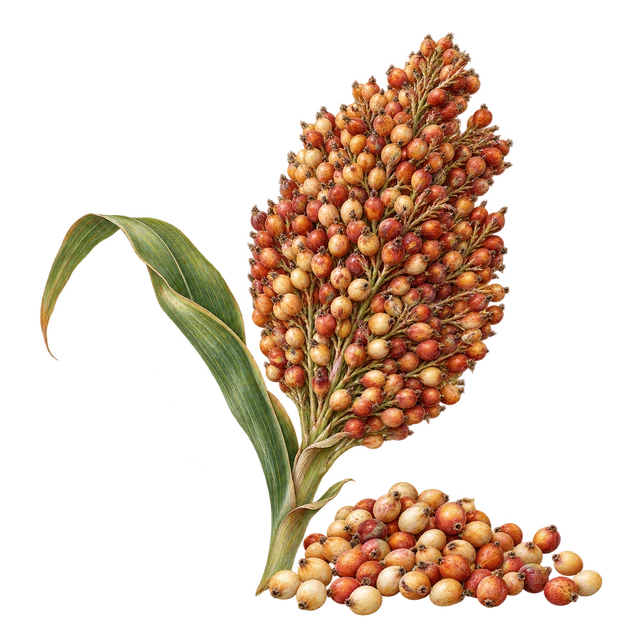
The food grain of Sorghum bicolor. This card concerns mature cultivated cereal grain, not sorghum grass, young leaves, syrup made from stalks or unverified wild relatives.
Ingredient details, preparation and research
Source plant or material
Sorghum bicolor
Plant family / material: Poaceae
Forms and route
Whole or decorticated grain, flour and cooked cereal foods. Grain color and tannin characteristics vary among varieties; fermented foods and malt are separately processed forms.
Vitamins and minerals
Sorghum contributes energy, some protein and minerals. Decortication changes fiber and mineral content, while a bowl of hydrated porridge is not a dry-flour serving.
Absorption and preparation
Protein digestibility is affected by the kafirin matrix and processing. Certain tannins and phytate can influence nutrient availability; no single absorption figure fits every variety and dish.
Practical preparation
Cook food-grade grain or flour according to a tested food recipe or package. Store dry material away from moisture and pests and chill cooked leftovers appropriately.
Traditional and reported uses
- Cooked porridge
- Flatbreads and fermented cereal foods
Contraindications and cautions
- Use grain produced for food and cook it appropriately; this card does not establish edible use of stalks, young leaves or animal-feed material.
- Discard moldy grain. People who require gluten-free food should verify blends and milling cross-contact instead of relying only on the species name.
Digestibility depends on preparation
An original study found different pepsin-digestibility results for raw flour, cooked gruel and fermented sheet-baked foods. An in-vitro enzyme assay is informative but cannot directly predict a person’s response or justify eating raw flour.
Evidence limits
Cultivated grain only; no general claim of superior digestibility, low glycemic response or medicinal benefit for all sorghum products.
Entry sources
- National Research Council, Lost Crops of Africa: Sorghum
- Original study: Digestibility of sorghum proteins
- FAO: Sorghum and millets in human nutrition, protein
Reference entry 321 · Recorded content review: 2026-10-09 · Review scope and dates