


Key cautions
- Follow hygienic rehydration and storage; refrigerate if overnight soaking is necessary.
- Use finished cosmetic products as directed; food preparations are not sterile wound treatments.
What’s inside
Polysaccharides are a central studied component. Sequential cold-water, hot-water, dilute-alkali and dilute-acid extraction yields chemically different fractions.
Uses in brief

- Culinary food
- Nourishing lung/stomach tradition
- Cosmetic ingredient
History, folklore and reported uses
History, folklore and traditional uses
Silver ear or snow fungus has an established place in Chinese food and medicine. Cooked gelatinous fruiting bodies appear in soups and sweet preparations, while traditional medical accounts connect the material with nourishing the lungs and stomach. Those traditional organ-system concepts are historical uses rather than demonstrated medical outcomes.
Modern interest extends to the material properties of its polysaccharides. Cosmetic research investigates moisturizing formulations, and food-science experiments investigate edible films. These applications depend on extracted and formulated ingredients. They do not imply that eating a sweet soup removes wrinkles or that a homemade preparation can preserve food safely.
A closer look at its history
Cultivating a relationship
Snow-fungus production has an unusual practical feature: cultivators manage it with a compatible companion fungus such as Annulohypoxylon stygium. Experimental culture studies examine the needs of both partners. The commercial crop is therefore a lesson in fungal relationships, not just growing one organism on sawdust.
Additional history reviewed 2026-10-09
Traditional, historical and reported uses
- Culinary food
Food or household practiceWhy this label?
The claim documents culinary food as a culinary, craft, gardening, or practical material use; it reports neither a treatment outcome nor measured nutrient content.
Gelatinous fruiting bodies are a food ingredient, often incorporated into soups and sweet preparations.
- Nourishing lung/stomach tradition
Traditional accountWhy this label?
The claim reports traditional lung/stomach nourishment concepts and weakness indications, not measured organ enhancement.
Traditional medicine used it to nourish lungs and stomach and address weakness; these are historical system-specific concepts.
- Cosmetic ingredient
Mixed/contextual sourcesWhy this label?
A dermatology review supports a topical-formulation research/application overview without a specific human or laboratory study setting in the exact claim.
Extracted polysaccharides are explored in moisturizers and barrier-support formulations. This is a topical formulation use, not evidence that eating it removes wrinkles.
- Experimental edible packaging films
Laboratory/animal researchWhy this label?
The claim expressly concerns experimental polysaccharide/chitosan films and food-preservation testing, a nonclinical materials experiment.
Researchers combine isolated Tremella polysaccharides with chitosan to make edible films and test them for food preservation. This is an emerging materials application, not an established household preservation method.
The documented roles here are culinary food, nourishing lung/stomach tradition, cosmetic ingredient, experimental edible packaging films. Fewer than five distinct uses are listed because additional medical claims are not needed to explain this fungus’s importance.
Story sources
- Review of Tremella polysaccharides and food/medicine applications, 2018
- Review: traditional Tremella applications, 2025
- Dermatology review: potential cutaneous benefits of Tremella, 2023
- Hong Kong CFS: Food Safety Bulletin, September 2024
- NCBI Taxonomy: Tremella fuciformis
- Primary study: sequentially extracted Tremella polysaccharides, 2023
- Lin et al.: chitosan–Tremella polysaccharide edible films, 2025
Features and lookalikes to study
Tremella fuciformis Berk.; not black wood ear.
Snow ear and silver ear usually refer to T. fuciformis in food trade; they do not encompass every white jelly fungus.
Morphology described in sources
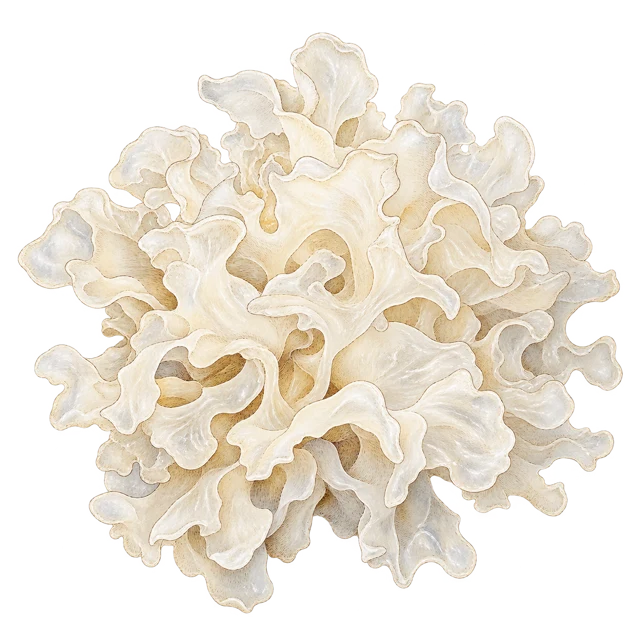
- T. fuciformis forms pale, translucent, gelatinous lobes on hardwood-associated substrates. The frond-like lobes differ from some more rounded jelly fungi, but whiteness and gelatinous texture are shared by multiple taxa.
- Habitat and substrate
- See the source-linked morphology and comparison notes below; a separate habitat summary has not been verified for this card.
- Geographic scope
- A complete regional range is not established here. Broad common names and commercial labels can span different species.
- Season in the cited region
- No region-specific fruiting season has been verified for this card. Do not infer a local season from trade availability.
Ductifera pululahuana
Ductifera is usually more blob-like and less translucent; its microscopic gloeocystidia help distinguish it from T. fuciformis.
Weather, age and hydration alter appearance, so lobe shape alone is not reliable.
Tremella reticulata in older literature
This comparison fungus is more coral-like and typically terrestrial rather than the thin-lobed, wood-associated snow-fungus pattern.
Jelly-fungus classifications change; habitat and outline do not replace microscopy when morphology is ambiguous.
Limits and regional differences
- Microscopy of basidia, spores and cystidial structures may be necessary. A wild white jelly fungus cannot be treated as the cultivated ingredient merely because a picture resembles it.
- Educational comparison only. Neither this card, an illustration, a photograph, a spore-print colour nor a checklist establishes that a wild collection is safe to eat. A qualified local mycologist must assess uncertain material; do not taste an unknown fungus. Cooking does not reliably eliminate mushroom toxins.
Regional reading paths
These sourced notes describe cultivation, trade, food traditions or material history. A regional connection does not claim exclusive origin.
Asia
Traditional food preparation: China.
Cooked until gelatinous in sweet soups, often with pear.
Identity & detailed reference
Identity
Tremella fuciformis Berk.; not black wood ear.
Ingredient details, preparation and research
Also known as: yin er / silver ear; bai mu er / white wood ear; snow mushroom
Source plant or material
Tremella fuciformis Berk.; Fresh or dried gelatinous fruiting bodies; separate isolated polysaccharides in oral, cosmetic and experimental film formulations.
Fungal family: Tremellaceae
Forms and route
Dried or fresh gelatinous fruiting bodies used as cooked food; extracted polysaccharides in supplements and finished cosmetic formulations are distinct.
Vitamins and minerals
The gelatinous fruiting body is a food ingredient with polysaccharides. Finished sweet soups also reflect added ingredients; no beauty effect or vitamin/mineral dose is established by eating them.
Absorption and preparation
Rehydrate dried food hygienically and cook; refrigerate overnight soaking. Cosmetic formulations and purified experimental polysaccharides cannot be reproduced by applying soup to skin or wounds.
Traditional and reported uses
- Gelatinous fruiting bodies are a food ingredient, often incorporated into soups and sweet preparations.
- Traditional medicine used it to nourish lungs and stomach and address weakness; these are historical system-specific concepts.
- Extracted polysaccharides are explored in moisturizers and barrier-support formulations. This is a topical formulation use, not evidence that eating it removes wrinkles.
- Researchers combine isolated Tremella polysaccharides with chitosan to make edible films and test them for food preservation. This is an emerging materials application, not an established household preservation method.
Contraindications and cautions
- Follow hygienic rehydration and storage; refrigerate if overnight soaking is necessary.
- Use finished cosmetic products as directed; food preparations are not sterile wound treatments.
- Concentrated oral extract safety, especially in pregnancy or with medicines, is insufficiently characterized.
- This card is not a foraging identification guide. Unknown wild mushrooms should not be eaten.
Similar items and how they compare
- Black wood ear
Both have culinary roles and need hygienic handling when rehydrated.
Snow fungus is Tremella fuciformis; the principal Chinese black wood ear is Auricularia heimuer.
Identity, fungal material and preparation
Tremella fuciformis Berk.; not black wood ear. Fresh or dried gelatinous fruiting bodies; separate isolated polysaccharides in oral, cosmetic and experimental film formulations. Rehydrate dried food hygienically and cook; refrigerate overnight soaking. Cosmetic formulations and purified experimental polysaccharides cannot be reproduced by applying soup to skin or wounds.
Constituents and food context
Polysaccharides are a central studied component. Sequential cold-water, hot-water, dilute-alkali and dilute-acid extraction yields chemically different fractions. The gelatinous fruiting body is a food ingredient with polysaccharides. Finished sweet soups also reflect added ingredients; no beauty effect or vitamin/mineral dose is established by eating them.
Traditional uses and evidence boundaries
Most proposed medical and skin effects remain based on laboratory or animal work. Cosmetic formulation and packaging studies concern specific extracted materials, not proven anti-aging or disease-treatment effects from eating the fungus.
Safety and product distinctions
Follow hygienic rehydration and storage; refrigerate if overnight soaking is necessary. Use finished cosmetic products as directed; food preparations are not sterile wound treatments. Concentrated oral extract safety, especially in pregnancy or with medicines, is insufficiently characterized.
Entry sources
- Review of Tremella polysaccharides and food/medicine applications, 2018
- Review: traditional Tremella applications, 2025
- Dermatology review: potential cutaneous benefits of Tremella, 2023
- Hong Kong CFS: Food Safety Bulletin, September 2024
- NCBI Taxonomy: Tremella fuciformis
- Primary study: sequentially extracted Tremella polysaccharides, 2023
- Lin et al.: chitosan–Tremella polysaccharide edible films, 2025
Reference entry 213 · Recorded content review: 2026-10-08 · Review scope and dates