


Key cautions
- Distilled oil and oral Boswellia extracts are different products
- Allergy is possible. Do not swallow essential oil.
What’s inside
Volatile terpenes such as alpha-pinene, limonene, ocimenes and alpha-thujene vary with species and batch; some materials contain heavier diterpenes. Nonvolatile boswellic acids belong primarily to the resin/extract fraction and are not established constituents of ordinary commercial distilled oil in therapeutically meaningful amounts.
Al-Harrasi and Al-Saidi (2008): Certified Omani Boswellia sacra resin-oil GC–MS analysis · Tisserand Institute: Frankincense oil and boswellic acid are not interchangeable
Uses in brief

- Woody, resinous fragrance for an optional meditation or comfort routine
- Cosmetic fragrance; medicinal skin and disease claims remain unproven
In the King James Bible
Source-resin connection: frankincense
Source plant or material; different preparation
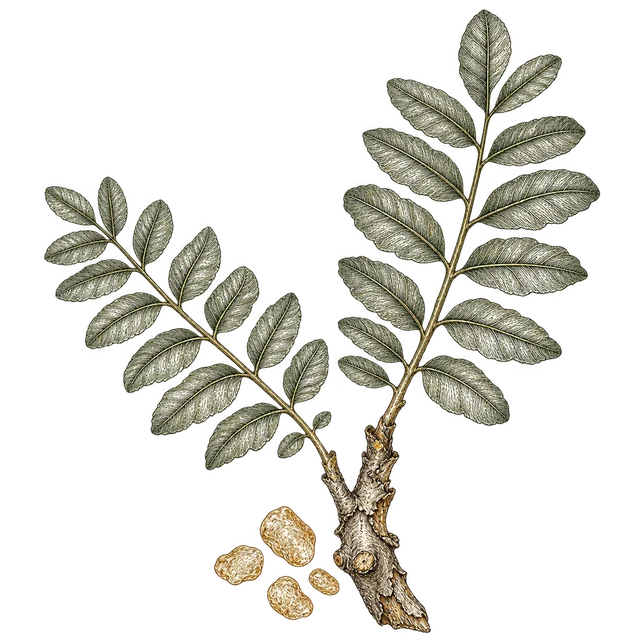
Frankincense is one of the gifts the wise men present to the young Jesus. The biblical material is aromatic Boswellia resin, the source of modern frankincense essential oil; the verse leaves the species unspecified and describes no distillation.
And when they were come into the house, they saw the young child with Mary his mother, and fell down, and worshipped him: and when they had opened their treasures, they presented unto him gifts; gold, and frankincense and myrrh.
Matthew 2:11 (KJV)
Scripture and identification sources
Words & their stories
WORDS & THEIR STORIES
The name behind the KJV
Koine Greek · Matthew 2:11 (KJV)
λίβανονlíbanon
Frankincense presented among the gifts to Jesus.
Dictionary form: λίβανος · líbanos
Líbanon is the accusative form of líbanos. Checked in Scrivener’s 1894 Textus Receptus, a later reconstruction of the KJV’s Greek textual basis.
What the language reveals
From gift to traded cargo
The same Greek form, λίβανον, appears in Revelation 18:13 among merchants’ cargo. Frankincense belonged to the world of valuable traded goods as well as worship.
The gift is aromatic frankincense resin. The passage does not identify a Boswellia species or describe the distilled essential oil on this card.
Language and identification bibliography
- Hebrew text: Exodus 30:34–35 (Mechon-Mamre)
- Greek text: Matthew 2:11, Scrivener’s Textus Receptus 1894 (Bible Hub)
- Brown–Driver–Briggs: לְבֹנָה / לְבוֹנָה, frankincense (H3828; Bible Hub transcription)
- Thayer’s Greek Lexicon: λίβανος, frankincense (G3030; Bible Hub transcription)
- Greek text: Revelation 18:13, Scrivener’s Textus Receptus 1894 (Bible Hub)
- Royal Botanic Gardens, Kew: Frankincense, resin with many stories
- Maurice A. Robinson: Introduction to the Scrivener 1894 Greek text (Scripture4All)
History, folklore and reported uses
Meditation and contemplative practice
AromaWeb’s founder explicitly describes using frankincense essential oil during meditation and in spiritual blends. This modern practice uses the distillate; ancient incense traditions used the solid resin.
AromaWeb: Frankincense essential oil, spiritual and practitioner uses
Emotional comfort in grief
Aromatherapist Kelly Holland Azzaro’s 2008 National Association for Holistic Aromatherapy article describes frankincense oil in practice intended to offer comfort during grief and sadness. This is a reported emotional-support use, not an established treatment for bereavement.
Kelly Holland Azzaro: NAHA Aromatherapy E-Journal 2008.3, pages 4–5, practitioner account
Cough and respiratory blends
AromaWeb records frankincense oil in cough preparations intended to help clear mucus, and includes bronchitis in its practitioner repertoire. These are modern aromatic uses of the resin distillate.
AromaWeb: Frankincense essential oil, spiritual and practitioner uses · National Cancer Institute: Aromatherapy with essential oils, professional PDQ
Scar and stretch-mark care
The AromaWeb profile, citing Julia Lawless, includes scars and stretch marks among frankincense oil’s topical aromatherapy purposes. These cosmetic uses concern oil-containing preparations, not boswellic-acid supplements.
AromaWeb: Frankincense essential oil, spiritual and practitioner uses
Room fragrance and personal perfume
AromaWeb’s founder uses frankincense in room-fragrance and perfume blends, valuing its resinous, warm scent. This everyday sensory role is one of the distilled oil’s main modern applications.
AromaWeb: Frankincense essential oil, spiritual and practitioner uses
Resin, caravan stops and ports
UNESCO’s Land of Frankincense in Oman brings together Boswellia sacra trees at Wadi Dawkah, the inland oasis of Shisr, and the coastal trading centres of Khor Rori and Al-Baleed. Solid drops of aromatic resin, often called tears, moved through this network and were warmed or burned for fragrance and ritual. Distilled essential oil carries part of the resin’s scent, but it was not the material transported along those ancient routes.
Regional reading paths
These sourced notes describe cultivation, trade, food traditions or material history. A regional connection does not claim exclusive origin.
Africa
Native/traded: Ethiopia, Eritrea, Sudan and Somalia frankincense supply regions.
Distilled volatile fragrance oil; not resin extract or a source of boswellic acids.
Identity & detailed reference
Identity
Volatile oil conventionally distilled from Boswellia oleo-gum-resin, commonly B. sacra Flück. (including the label synonym B. carteri) or B. serrata Roxb. ex Colebr., in Burseraceae. Specify species, extraction and batch; the common name covers chemically varied materials.
Ingredient details, preparation and research
Source plant or material
Boswellia trees; resin exuding from bark incisions is the starting material. B. sacra/B. carteri labels and B. serrata oils are common, but other species are traded.
Plant family / material: Burseraceae (incense family).
Forms and route
Steam/hydrodistilled essential oil for aroma or a finished topical product. Whole resin, burned incense, solvent/CO2 extracts and oral boswellic-acid supplements are distinct preparations. A product combining oil with added boswellic acids is also distinct from ordinary essential oil.
Food sources
Not applicable to the aromatic essential oil. Do not invent a food serving, nutrient Daily Value or edible dosing instruction.
Vitamins and minerals
Frankincense aroma or skin use provides no dietary vitamin, mineral or essential-fat serving. Boswellic acids are plant compounds, not vitamins, and essential oil is not a nutrient supplement.
Absorption and preparation
A scent can be perceived without a known therapeutic systemic dose. Skin uptake depends on individual constituents and the finished vehicle; no validated clinical absorption target exists for a household frankincense oil. Nonvolatile boswellic-acid absorption studies concern extracts, not ordinary inhaled or skin-applied oil.
Practical preparation
Choose a clearly labelled botanical source and finished aromatic/topical product. Follow the maker’s route, age, storage and exposure directions. Keep tightly closed and away from heat/light. Avoid neat skin application, smoke-heavy rooms and improvised ingestion; do not derive universal drop counts from another species or study.
Combination notes
Pairing woody or citrus notes is a fragrance choice rather than proven medical synergy. Frankincense oil plus added boswellic acids is a combination supplement; any result belongs to that formulation. Massage, quiet breathing, music and attention may themselves influence comfort in mixed interventions.
Traditional and reported uses
- Historical religious/cultural role: frankincense resin was traded and burned as incense in ritual and ceremonial settings. This is a history of resin, not a clinical trial of distilled oil.
- Modern aromatherapy practice: woody/resinous scent used during reflection, relaxation or meditation; some people describe it as grounding.
- Practitioner/anecdotal role: sensory comfort during grief or sadness. This is not proof of a specific antidepressant effect.
- Cosmetic practice: fragrance in finished skin products. Anti-wrinkle, scar-removal, pigmentation-treatment and cancer claims are not established by laboratory findings or research on oral resin extracts.
Contraindications and cautions
- Allergic contact dermatitis to frankincense oil has been reported. Stop for rash or persistent irritation; dilution cannot eliminate an existing fragrance allergy.
- Avoid eyes, mucosa and damaged skin. Do not swallow a household essential-oil product or apply it as a treatment to suspicious lesions.
- Scent and burning resin can aggravate sensitive airways. Avoid smoke exposure and stop aroma use if it causes headache, coughing or breathing symptoms.
- Pregnancy, breastfeeding, pediatric and long-term medicinal safety data for the actual distilled oil are inadequate. A resin-extract trial cannot clear the oil for these uses.
- Drug interactions of the distilled oil are not adequately characterized. Do not transfer extract interaction lists, food-pairing advice or doses to oil. People receiving cancer treatment should discuss complementary products with their oncology team and continue prescribed care.
Similar items and how they compare
- Cedarwood, Atlas essential oil
Both provide woody or resinous notes in contemplative blends, an overlap in fragrance practice rather than proven effects.
Atlas cedarwood is wood-derived and himachalene-rich; frankincense comes from Boswellia resin.
- Lemon essential oil
Some frankincense oils share limonene and pinene with lemon oil, giving their scents a partial bright, citrus-like overlap.
Lemon peel oil is usually limonene-dominant; frankincense composition varies markedly by species.
- Boswellia resin extract
Made from the same broad group of resin-bearing trees.
Extracts can concentrate nonvolatile boswellic acids; disease trials, absorption and dosing do not transfer to the distilled essential oil.
Botanical source and trade names
Kew accepts Boswellia sacra in Burseraceae and lists B. carteri as a synonym. The species is native to Oman, Yemen and parts of Somalia. These names do not guarantee identical commercial oils: provenance, resin grade and processing matter. Oil, resin and extract should remain separate labels even when they come from the same tree.
Resin history and present-day sensory use
UNESCO’s Land of Frankincense records the trees and trading settlements of southern Oman and their role in the ancient incense trade. That is strong support for cultural importance, not medicinal efficacy. Contemporary meditation and emotional-comfort use is retained as practitioner/sensory practice; a person may value the ritual without assigning a demonstrated disease effect to the oil. Kelly Holland Azzaro’s 2008 NAHA account specifically describes frankincense in meditation and grief-comfort practice; it is a practitioner account, not a controlled clinical finding.
Composition is not uniform
A GC–MS study of botanically verified Omani B. sacra oil found limonene and E-beta-ocimene predominating, with comparatively little alpha-pinene; other reports differ. This is a concrete warning against assigning one universal chemical percentage to all frankincense. A batch chromatogram identifies volatile composition but is not proof of clinical effectiveness.
Boswellic acids are a different fraction
Ordinary commercially distilled frankincense oil should not be described as supplying the resin’s nonvolatile boswellic acids. The current chemistry discussion found no reliable report of meaningful amounts from normal commercial distillation. Reports involving unusual vacuum distillation, long processing or heavy fractions do not make every bottle a boswellic-acid preparation. A claim of added acids or a CO2 extract requires its own analytical specification.
Human fatigue trial: an important negative result
A randomized trial assigned 70 chemotherapy patients to frankincense-containing oil or carrier control on the feet around treatment. It found no statistically significant between-group or time-related fatigue improvement. This does not rule out every comfort experience, but it directly fails to support that particular fatigue-treatment claim. It says nothing about killing cancer cells in people.
Cosmetic laboratory findings are not clinical skin outcomes
An incensole-enriched volatile material was studied with chemical analysis, zebrafish assays, antioxidant testing and network-pharmacology modelling. Those methods did not test wrinkle reduction, scar healing or pigmentation treatment in human cosmetic users. The experimental enriched material also cannot be assumed equivalent to an ordinary retail oil.
Why oral Boswellia studies do not answer this entry
NCCIH notes that most Boswellia studies are small or low quality and that stronger evidence is needed. Osteoarthritis and brain-edema discussions chiefly concern orally administered resin preparations. Even a favorable extract result cannot establish the effect of fragrance oil, and reduction in edema is not tumor treatment.
Allergy, absorption and interactions
A 2021 case report specifically documents allergic contact dermatitis from B. carterii oil. It establishes that the hazard exists, not its population frequency. Useful clinical pharmacokinetic targets and interaction data for typical aromatic/topical oil use are not established in the selected evidence. More exposure or penetration should not be assumed to produce more benefit.
Limits of newer research claims
A supplement trial registration or a manufacturer’s biomarker report is not equivalent to independently replicated clinical benefit. The registry NCT06488417 was identified during review, but its full results were not retrievable in this source pass; no efficacy claim or dosing advice has been drawn from it. Studies of biomarkers in healthy volunteers would in any event require careful separation from symptom treatment and from non-oral use.
Review and publication-status check
Reviewed 5 October 2026. PubMed/publisher records and targeted searches for the selected oil-composition and fatigue studies revealed no retraction notice in this check; this is not an exhaustive integrity audit. The direct allergy report and negative fatigue trial were retained. Cancer, anti-aging and grief-treatment claims were not inferred from cells, animals, cultural history or resin-extract findings.
Entry sources
- Kew Plants of the World Online: Boswellia sacra and synonym Boswellia carteri, Burseraceae
- UNESCO World Heritage Centre: Land of Frankincense, Oman
- Al-Harrasi and Al-Saidi (2008): Certified Omani Boswellia sacra resin-oil GC–MS analysis
- Tisserand Institute: Chemical distinction between commercial frankincense oil and boswellic-acid preparations
- NCCIH (April 2025): Boswellia preparations, evidence and safety
- Reis et al. (2023; online 2022): Randomized frankincense-oil trial for chemotherapy-related fatigue
- Buonomo and Hylwa (2021): Allergic contact dermatitis from frankincense oil
- Yan et al. (2024): Incensole-enriched frankincense volatile oil in zebrafish and laboratory pigmentation research
- ClinicalTrials.gov: NCT06488417, frankincense supplement biomarker study registry record
- National Cancer Institute: Aromatherapy with essential oils, professional PDQ
- NAHA Journal (2008.3): Kelly Holland Azzaro, practitioner account of frankincense and lemon aroma uses, pp. 4–5
Reference entry 39 · Recorded content review: 2026-10-05 · Review scope and dates