


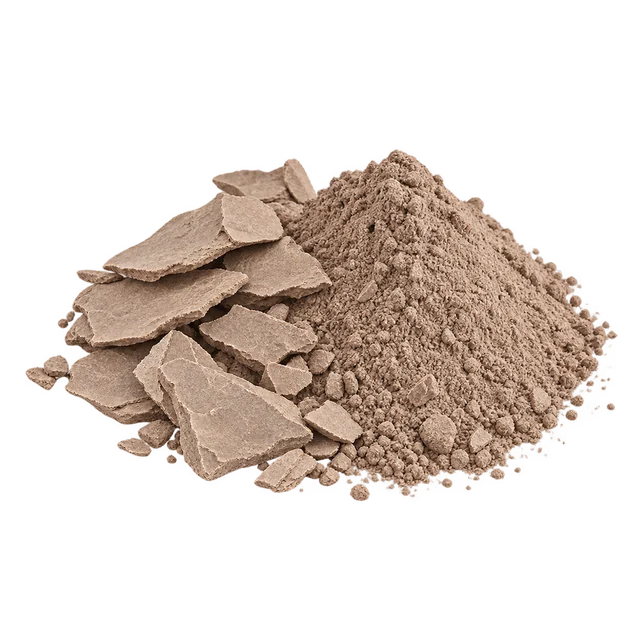
Key cautions
- Do not ingest clay or use it as an internal cleanse. Mineral origin does not rule out metals, microbes or other contamination.
- Avoid breathing dry dust and keep it out of eyes. Stop if a cosmetic causes burning or a rash, and do not use raw clay on broken skin.
What’s inside
Stevensite-rich mineral particles with variable accessory calcite, dolomite, quartz and other phases. Mineral formula and particle properties do not establish bioavailable nutrition.
Uses in brief

- Skin-cleansing formulations
- Hair-washing products
History, folklore and reported uses
History, folklore and traditional uses
Geological/traditional processing: Jbel Ghassoul, Morocco.
Traditional, historical and reported uses
- Skin-cleansing formulations
Food or household practiceWhy this label?
The source supports the named food, cosmetic or material practice; no treatment effect is inferred and the card’s form and safety limits remain attached.
The original Ghassoul surface-chemistry paper records its use in cosmetic cleansing products. Adsorption can describe a material property, but it does not demonstrate removal of toxins from the human body.
- Hair-washing products
Food or household practiceWhy this label?
The source supports the named food, cosmetic or material practice; no treatment effect is inferred and the card’s form and safety limits remain attached.
The same source notes shampoo applications. A finished product’s rinsability, particle size and formulation determine use; raw clay provenance alone does not establish safety.
2 sourced featured uses; cultural or material records are not clinical efficacy evidence.
Historical-use additions reviewed 2026-10-09
Regional reading paths
These sourced notes describe cultivation, trade, food traditions or material history. A regional connection does not claim exclusive origin.
Africa
Geological/traditional processing: Jbel Ghassoul, Morocco.
Cosmetic cleansing material; geological origin does not establish purity or ingestion safety.
Identity & detailed reference
Identity
Rhassoul or ghassoul is a Moroccan natural clay dominated by stevensite-type magnesium-rich smectite, with other minerals present. It is not pure magnesium, lava, kaolin or a nutritional mineral preparation.
Ingredient details, preparation and research
Also known as: Rhassoul; ghassoul clay
Source plant or material
Stevensite-rich natural clay mixture
Plant family / material: Not applicable; clay mineral mixture
Forms and route
Cosmetic-grade powder and finished rinse-off skin or hair products. Raw mine samples and clay sold for industrial adsorption are not interchangeable with tested cosmetics.
Vitamins and minerals
No dietary nutrient value is assigned. A magnesium-containing silicate does not provide the same preparation, exposure or evidence as a magnesium food or supplement.
Absorption and preparation
Laboratory ion exchange and adsorption in water are not studies of intestinal detoxification or nutritional absorption. No beneficial systemic delivery is inferred.
Practical preparation
Prefer a labeled finished cosmetic and follow its rinse-off instructions. Minimize dust when handling a permitted powder and do not store an unpreserved homemade water mixture.
Traditional and reported uses
- Skin-cleansing formulations
- Hair-washing products
Contraindications and cautions
- Do not ingest clay or use it as an internal cleanse. Mineral origin does not rule out metals, microbes or other contamination.
- Avoid breathing dry dust and keep it out of eyes. Stop if a cosmetic causes burning or a rash, and do not use raw clay on broken skin.
Mineralogy and surface tests
Independent mineralogical studies examine the stevensite-rich deposit and its crystal chemistry. The cited adsorption experiments concern controlled aqueous systems; they do not establish clinical treatment, antimicrobial protection or safe consumption.
Evidence limits
External-material reference only. No DIY cosmetic preservation method, ingestion clearance or medicinal effect is provided.
Entry sources
- Allaoui et al.: Interfacial electrochemical properties of natural Moroccan Ghassoul clay
- Amakrane et al.: Mineralogical and physicochemical characterization of Jbel Rhassoul deposit
- Elucidating the crystal-chemistry of Jbel Rhassoul stevensite
Reference entry 312 · Recorded content review: 2026-10-09 · Review scope and dates