


Key cautions
- Check mixed-tea labels if avoiding caffeine or a particular herb. Rooibos-based supplements are not interchangeable with a normal beverage.
- Do not use tea as a replacement for infant feeds, medicines or individualized fluid advice. Stop a product that causes an adverse reaction.
What’s inside
Polyphenols including aspalathin and nothofagin, with profiles altered by processing. Pure rooibos naturally lacks caffeine, but blended drinks may contain caffeine-bearing ingredients.
Uses in brief

- Herbal tea
- Cooking and drink flavor
History, folklore and reported uses
History, folklore and traditional uses
Native/cultivated: South Africa’s Western Cape and Cederberg.
A closer look at its history
Cederberg knowledge and the making of red tea
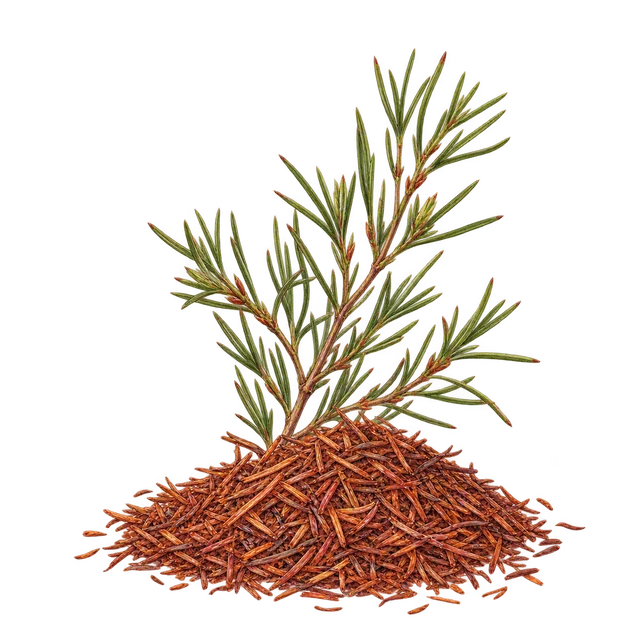
SANBI places rooibos tea’s roots among the Indigenous people of the Cederberg and describes the commercial crop as selected forms of a variable local shrub. Its characteristic red-brown cup depends on processing: young branches are cut, finely chopped and bruised, then allowed to develop color and flavor before sun-drying. The finished material is sorted and graded. That sequence helps explain why the tea is a cultural product of knowledge and labor as well as a wild plant; the recognizable beverage is not simply a bag of untreated green leaves.
Recognition of Khoi and San knowledge holders
On 1 November 2019, South Africa launched an industry-wide rooibos traditional-knowledge benefit-sharing agreement involving the National Khoisan Council, the San Council of South Africa and the rooibos industry. The government’s launch speech described a pilot levy of 1.5 percent of the farm-gate price, paid by processors for the use of associated traditional knowledge. This is a specific milestone in the commercial history, not evidence for an exact ancient invention date. It restores the knowledge holders to a story often reduced to later merchants, plantations and export brands.
Additional history reviewed 2026-10-09
Traditional, historical and reported uses
- Herbal tea
Food or household practiceWhy this label?
The source supports the named food, cosmetic or material practice; no treatment effect is inferred and the card’s form and safety limits remain attached.
SANBI records use by Indigenous people of the Cederberg and the development of a commercial tea crop. Brew a food product for flavor; the historical account is not infant-feeding or disease-treatment advice.
- Cooking and drink flavor
Food or household practiceWhy this label?
The source supports the named food, cosmetic or material practice; no treatment effect is inferred and the card’s form and safety limits remain attached.
SANBI records rooibos as a flavor in baking, cooking and mixed drinks. Sugar, alcohol or other ingredients determine the finished food’s composition, so the plain infusion cannot represent every product.
2 sourced featured uses; cultural or material records are not clinical efficacy evidence.
Historical-use additions reviewed 2026-10-09
Regional reading paths
These sourced notes describe cultivation, trade, food traditions or material history. A regional connection does not claim exclusive origin.
Africa
Native/cultivated: South Africa’s Western Cape and Cederberg.
Herbal infusion from processed young stems and leaves.
Identity & detailed reference
Identity
The processed leaves and fine stems of Aspalathus linearis, a South African legume-family shrub. Rooibos is not Camellia sinensis tea; red and green rooibos are processing forms of the same source plant.
Ingredient details, preparation and research
Source plant or material
Aspalathus linearis
Plant family / material: Fabaceae
Forms and route
Dried red, oxidized rooibos; green, minimally oxidized material; brewed drinks and foods flavored with the infusion. Concentrated extracts and sweetened blends are separate products.
Vitamins and minerals
A plain infusion is mainly water with extracted flavor and polyphenols. No meaningful vitamin or mineral serving amount is assigned; milk, sugar and fortified ingredients change the drink.
Absorption and preparation
A small human study detected metabolites after green-rooibos drinks, showing that ingested compounds are transformed. Detecting metabolites is not proof of an antioxidant health benefit.
Practical preparation
Prepare commercial food-grade tea with safe hot water according to the label. Refrigerate brewed tea promptly if keeping it for later, and handle sweetened or milk-containing versions as perishable drinks.
Traditional and reported uses
- Herbal tea
- Cooking and drink flavor
Contraindications and cautions
- Check mixed-tea labels if avoiding caffeine or a particular herb. Rooibos-based supplements are not interchangeable with a normal beverage.
- Do not use tea as a replacement for infant feeds, medicines or individualized fluid advice. Stop a product that causes an adverse reaction.
Human evidence has limits
A crossover experiment in healthy men examined flavonoid bioavailability and did not find a significant plasma antioxidant-capacity increase with its assay. Results for green rooibos and isolated fractions cannot establish disease treatment by every red tea.
Evidence limits
Beverage profile with limited formulation-specific research; no preventive or therapeutic claim or clinical dosing advice.
Entry sources
- SANBI PlantZAfrica: Aspalathus linearis
- Human crossover study of rooibos flavonoid bioavailability
- de Beer et al.: Isolation of rooibos aspalathin and nothofagin
Reference entry 303 · Recorded content review: 2026-10-09 · Review scope and dates