


Key cautions
- Do not swallow essential oil, put it in eyes or apply the neat oil to sensitive skin. Use a finished product intended for the route and follow its label.
- Fragrance can irritate skin or provoke allergy. Stop after a reaction and avoid exposure if scent triggers breathing symptoms; keep concentrated oil away from children.
What’s inside
Citronellol, geraniol and their esters are major aromatic constituents. Their relative amounts vary with cultivar, growing region, season and distillation.
Uses in brief

- Perfumery
- Formulated cosmetic use
History, folklore and reported uses
History, folklore and traditional uses
Cultivated: Egypt, Madagascar and Réunion; specify source cultivar.
Traditional, historical and reported uses
- Perfumery
Food or household practiceWhy this label?
The source supports the named food, cosmetic or material practice; no treatment effect is inferred and the card’s form and safety limits remain attached.
SANBI documents geranium oil as a perfume ingredient and alternative rose-like fragrance. The aromatic resemblance does not make it rose essential oil or transfer rose-product research.
- Formulated cosmetic use
Food or household practiceWhy this label?
The source supports the named food, cosmetic or material practice; no treatment effect is inferred and the card’s form and safety limits remain attached.
The Egyptian monograph describes externally formulated preparations. Its existence documents a recognized product class; this card does not reproduce medicinal indications or provide a home dilution recipe.
2 sourced featured uses; cultural or material records are not clinical efficacy evidence.
Historical-use additions reviewed 2026-10-09
Regional reading paths
These sourced notes describe cultivation, trade, food traditions or material history. A regional connection does not claim exclusive origin.
Africa
Cultivated: Egypt, Madagascar and Réunion; specify source cultivar.
Aerial-part distillate used in fragrance and formulated cosmetics.
Identity & detailed reference
Identity
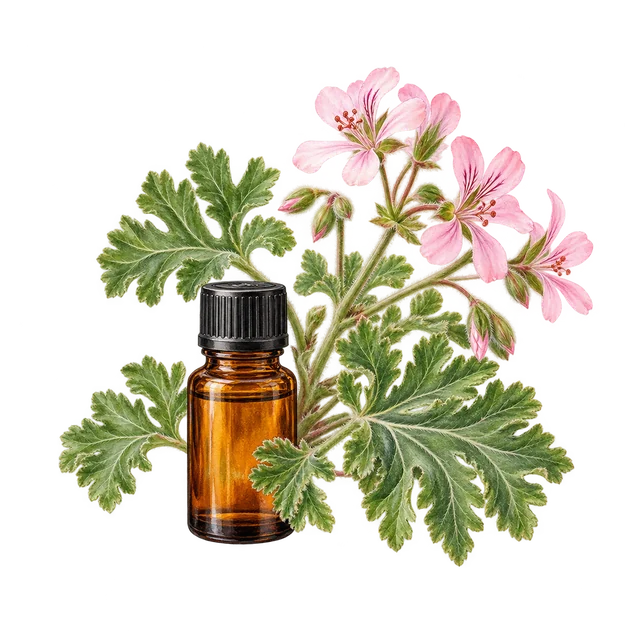
A volatile oil distilled from leaves and flowering aerial parts of rose-scented Pelargonium plants. Commercial oils commonly involve cultivars or hybrids labeled Pelargonium graveolens; true Geranium and rose-flower oils are different materials.
Ingredient details, preparation and research
Source plant or material
Pelargonium graveolens and commercial rose-scented Pelargonium hybrids
Plant family / material: Geraniaceae
Forms and route
Named essential oil and finished fragranced cosmetic or aromatherapy products. It is not a fixed cooking oil, leaf tea or ready-to-use undiluted skin treatment.
Vitamins and minerals
No dietary nutrient role is assigned. Citronellol and geraniol are fragrance molecules, not vitamins or a reason to ingest the product.
Absorption and preparation
Smelling, skin application and swallowing are different routes. Absorption and clinical findings from one formulation cannot be presumed for another.
Practical preparation
Choose a labeled finished fragrance or cosmetic preparation. Store tightly closed away from heat; do not use informal drops-in-water mixtures as a safe oral or skin dilution.
Traditional and reported uses
- Perfumery
- Formulated cosmetic use
Contraindications and cautions
- Do not swallow essential oil, put it in eyes or apply the neat oil to sensitive skin. Use a finished product intended for the route and follow its label.
- Fragrance can irritate skin or provoke allergy. Stop after a reaction and avoid exposure if scent triggers breathing symptoms; keep concentrated oil away from children.
Source and extraction matter
Published production work describes several growing regions and extraction approaches. A supercritical extract, a steam distillate and a finished cream differ, so laboratory composition or antimicrobial activity cannot establish treatment benefit from casual use.
Evidence limits
Fragrance/material scope; no medicinal dose, antimicrobial claim or equivalence among commercial chemotypes.
Entry sources
- Egyptian Drug Authority: Pelargonium graveolens essential-oil monograph
- Production of rose geranium oil using supercritical fluid extraction, cultivation context
- SANBI: Pelargonium graveolens
- NCCIH: Aromatherapy
Reference entry 302 · Recorded content review: 2026-10-09 · Review scope and dates