


Key cautions
- Patch-test and use the labeled route; do not swallow cosmetic oil
- Not a substitute for sunscreen or wound care; protect the oil from heat and light
What’s inside
Triglycerides rich in linoleic acid, alpha-linolenic acid and oleic acid; variable tocopherols, carotenoids and phytosterols. Species, ripeness, seed versus fruit fraction and extraction affect the profile. These are not standardized vitamin C or retinoid doses.
Grajzer et al. (2015): Composition and oxidative stability of two cold-pressed rosehip oils · Medveckienė et al. (2020): Fatty acids in organic rosehip seeds during ripening · Eren, Ok and Yılmaz (2024): Characterization of cold-pressed rosehip seed oil · NIH Office of Dietary Supplements: Vitamin C, health professional fact sheet
Uses in brief

- Cosmetic skin softening and conditioning
- Preliminary, product-specific research on scar and facial appearance
History, folklore and reported uses
Moisturizing dry skin
Givaudan markets Chilean rose seed oil as a moisturizing ingredient for face and body products. The use concerns seed-derived fixed oil, not rosewater or fragrant petal oil.
Givaudan: Rose seed oil from Chile, contemporary cosmetic claims
Soothing skin-care products
Givaudan also identifies soothing cosmetic applications for its Chilean rose seed oil. This is one of the oil’s contemporary natural-beauty purposes.
Givaudan: Rose seed oil from Chile, contemporary cosmetic claims
Scar-care routines
In her National Association for Holistic Aromatherapy carrier-oil teaching, Rose Chard includes rosehip oil in scar care and describes it as regenerative, meaning intended to support skin renewal. These are attributed practitioner purposes rather than established scar-removal effects.
Rose Chard, NAHA (2016): Carrier Oils for Aromatherapy, rosehip and carrier profiles
Mature skin and fine-line care
Chard also lists wrinkles and premature skin aging among rosehip oil’s cosmetic purposes, describing facial care intended to give skin a smoother appearance.
Rose Chard, NAHA (2016): Carrier Oils for Aromatherapy, rosehip and carrier profiles
Adding shine to hair
Givaudan lists hair-shine products among the uses of its Chilean rose seed oil. This carries the modern oil beyond facial care into hair grooming.
Givaudan: Rose seed oil from Chile, contemporary cosmetic claims
The rose after flowering
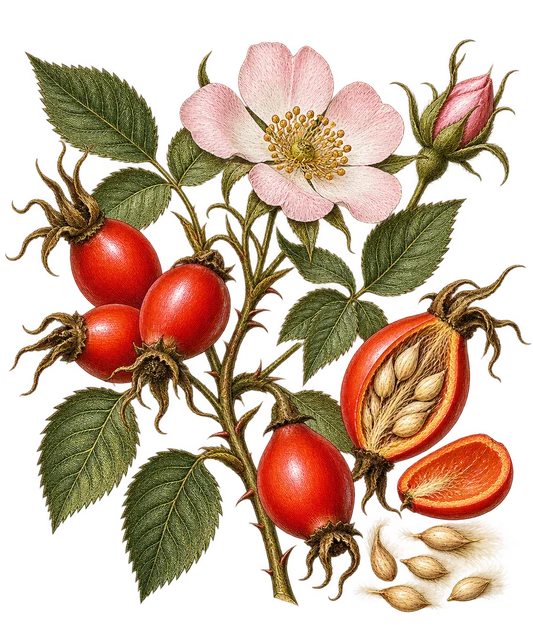
Rosehips develop after the petals fall. Their oil has a different history from fragrant rose-petal oil and rosewater. Kew records the use of vitamin-C-rich rosehip syrups during the Second World War. That nutritional history belongs to a fruit preparation, rather than establishing the same vitamin content for extracted seed oil.
Royal Botanic Gardens, Kew: Roses, including wartime rosehip syrup
From introduced roses to Chilean exports
The Netherlands’ Centre for the Promotion of Imports describes roses introduced to Chile by Spanish colonists becoming widespread. A twentieth-century export trade in rosehip foods, teas, oils and cosmetics supported harvesting families. Today’s beauty ingredient therefore carries a history of introduced plants, rural work and international demand, rather than evidence of an ancient tradition using the same extracted oil.
CBI, Netherlands Ministry of Foreign Affairs: Entering the European market for rosehip oil
Regional reading paths
These sourced notes describe cultivation, trade, food traditions or material history. A regional connection does not claim exclusive origin.
South America
introduced/traded and processed; Chile
Fixed seed oil in cosmetic products.
Identity & detailed reference
Identity
Fixed oil pressed or extracted from rose-hip seeds, commonly Rosa canina L., with other labeled Rosa species and fruit/pulp-containing oils also sold. Species, plant part and extraction define the material.
Ingredient details, preparation and research
Source plant or material
Rosa canina L. and other identified Rosa species. The hip is the fruit-like structure containing the seed-bearing achenes; seed oil and fruit/pulp-containing preparations should be labeled separately.
Plant family / material: Rosaceae (rose family).
Forms and route
Cold-pressed or refined cosmetic seed oil; skin/hair formulations; some products include fruit/pulp lipids or extracts. This differs from rosewater, volatile rose-petal essential oil, and edible whole-hip tea, powder or extract.
Food sources
Food-grade rosehip seed oils and separately prepared rosehip foods exist; their intended route and label must be verified. Whole-hip tea/powder and cosmetic oil are different preparations, so no whole-fruit nutrient value or serving is substituted here.
Vitamins and minerals
No dietary serving is assigned to cosmetic rosehip oil. Selected oils contain measurable tocopherols and carotenoids, but composition varies and topical use is not dietary intake. Vitamin C is water-soluble; values from vitamin-C-rich whole hips cannot be credited to their separated oil. Added nutrients need product-specific labels.
Absorption and preparation
Topical oil is used for local conditioning. The reviewed studies do not provide a reliable systemic bioavailability or deep-skin delivery value for ordinary rosehip oil. Nanocapsulation work tested formulation stability and oil oxidation; it did not establish better clinical absorption from an ordinary bottle.
Practical preparation
Check the botanical name, seed versus fruit/pulp fraction, extraction method, added ingredients and external-use labeling. Use according to the finished product directions. Keep tightly closed, protected from heat/light, and follow any refrigeration instruction; a trial protocol is not a universal skin-care recipe.
Combination notes
A cream can combine rosehip oil with humectants or other lipids, but its findings belong to the complete formula. There is no proven need to add essential oils, extra vitamin C or a retinoid. Do not equate “natural vitamin A” marketing with a measured retinol/tretinoin concentration.
Traditional and reported uses
- Contemporary cosmetic use: emollient skin care and conditioning of dry-feeling skin or hair.
- Empirical scar-care use has been studied with a specific commercial seed oil after suture removal; limitations prevent a general scar-removal claim.
- A small uncontrolled 2025 facial study reported changes in image-based skin scores. This is preliminary appearance research, not proof of sun protection or an acne cure.
Contraindications and cautions
- Use a cosmetic oil only by its labeled external route. Food-grade oils exist, but a cosmetic bottle is not an edible product or an oral rosehip supplement.
- Try a small area first and stop for itching, rash, redness or swelling. Added perfume, preservatives or active ingredients may alter tolerance.
- Do not use oil in place of sunscreen, established acne treatment, or assessment of infected or poorly healing skin. The scar study began after sutures were removed.
- Protect from heat and light and follow storage/expiry directions. Polyunsaturated oils can oxidize; reject an oil that has deteriorated.
- Do not borrow vitamin C content, oral dosing, arthritis findings or interaction claims from whole-hip powder/tea for the topical seed oil. An unstandardized carotenoid profile is not a known tretinoin dose.
Similar items and how they compare
- Jojoba oil
Both are used in external conditioning products.
Jojoba is mainly liquid wax esters; rosehip is mainly polyunsaturated triglycerides and has different oxidation behavior.
- Walnut oil
Both can contain appreciable linoleic and alpha-linolenic fatty acids.
Walnut has a separate tree-nut source/allergy profile; edible walnut oil does not make cosmetic rosehip oil edible.
- Rosewater and rose essential oil
They share the rose common name and appear in skin-care products.
Rosewater is an aqueous aromatic preparation and rose essential oil is a volatile flower oil; neither is the fixed oil of hip seeds.
Identity, plant part and extraction
Rosa canina is a Rosaceae species, but “rosehip oil” is not one fixed specification. Manufacturers may use different Rosa species, seeds, or seed-plus-fruit lipid fractions. Pressing, solvent extraction and refining select different mixtures. An aqueous rosewater, a fragrant volatile rose-petal oil and a whole-fruit extract require their own composition and evidence; shared rose branding is insufficient.
Fatty acids and minor constituents
In a two-season study of rose species/cultivars, seed fatty acids were approximately 74–80% polyunsaturated. The R. canina samples contained about 50–54% linoleic acid and 19–25% linolenic acid across ripening stages; these are percentages of analyzed fatty acids, not a guaranteed label composition. Separate analyses found tocopherols, carotenoids and phytosterols, with large preparation-dependent variation.
Vitamin C and retinoid claims need separate evidence
Whole hips can be rich in water-soluble vitamin C, but a separated fixed oil cannot inherit a fruit nutrient table. Analytical detection of carotenoids or tocopherols also does not establish an effective vitamin C serum or a standardized retinol/tretinoin treatment. A 2015 analysis measured two oils, not every commercial bottle; the 2025 facial pilot did not establish equivalence to a prescribed retinoid.
Human scar study: useful but limited
The 2015 single-center study initially included 160 people, allocated to Repavar seed oil or no treatment; 76 of 120 oil users and 32 of 40 controls completed 12-week follow-up. The paper says allocation was random, but gives limited randomization/blinding detail. Oil began after suture removal. Redness, discoloration and atrophy scores favored treatment at selected assessments; substantial attrition, subjective ratings and the absence of a vehicle control limit confidence. This does not establish removal of keloids or acne scars.
Recent facial pilot does not establish sunscreen or acne efficacy
In 2025, 27 volunteers used a selected cold-pressed R. canina seed oil for five weeks. Before/after VISIA imaging suggested improvements in some wrinkle, spot and other scores. There was no control group or blinding, follow-up was short, and responses varied. Imaging of UV-related spots is not an SPF test; porphyrin changes are not proof of bacterial eradication or successful acne treatment. The small pilot cannot establish a general anti-aging effect.
Laboratory and animal findings
A 2019 paper used experimental excisional wounds and carrageenan-induced paw edema, with tissue staining and macrophage-marker work. It reported improved wound-related outcomes and a shift in macrophage phenotype in animal models. These mechanistic findings are distinct from trials in people and do not justify placing ordinary cosmetic oil on open wounds.
Formulation, oxidation and absorption
Contri and colleagues developed polymeric rosehip-oil nanocapsules and incorporated them into chitosan gels/films. Encapsulation reduced UV-induced oxidation of the oil in laboratory testing. It was a formulation experiment, not evidence of better scar outcomes, systemic nutrient uptake or sun protection. A 2024 cold-pressed-oil analysis also flagged acidity/oxidation values and recommended improved storage, supporting attention to packaging and freshness.
Practical skin safety
Introduce a new product on a small test area and stop if it irritates. AAD distinguishes this from clinician-performed diagnostic patch testing. The scar trial excluded people with known rosehip allergy or abnormal healing histories; its absence of reported adverse events cannot establish safety for every skin condition. An infected lesion or poorly healing wound should be assessed rather than covered with a cosmetic experiment.
Food, nutrient accounting and related oils
Cosmetic use contributes no dietary serving. Any explicitly edible rosehip oil needs its own food label; the published composition of selected research oils is not a household nutrient guarantee. Walnut oil is a useful fatty-acid comparison but has a tree-nut source. Jojoba is a different wax material. Neither whole-hip nutritional research nor a multi-ingredient cream establishes the benefit of pure topical rosehip seed oil.
- Grajzer et al. (2015): Composition and oxidative stability of two cold-pressed rosehip oils
- Eren, Ok and Yılmaz (2024): Characterization of cold-pressed rosehip seed oil
- NIH Office of Dietary Supplements: Vitamin C, health professional fact sheet
- Cosmetic Ingredient Review (2008): Safety assessment of jojoba oil, wax and derivatives
Entry sources
- Kew Plants of the World Online: Rosa canina, accepted name and Rosaceae
- Grajzer et al. (2015): Composition and oxidative stability of two cold-pressed rosehip oils
- Valerón-Almazán et al. (2015): Post-surgical scars treated with Repavar rosehip seed oil
- Oargă et al. (2025): Open-label five-week facial rosehip-oil pilot, 27 volunteers
- Medveckienė et al. (2020): Fatty acids in organic rosehip seeds during ripening
- Eren, Ok and Yılmaz (2024): Characterization of cold-pressed rosehip seed oil
- Lei et al. (2019; online 2018): Rosehip oil in experimental wound-healing models
- Contri et al. (2016; online 2015): Rosehip-oil nanocapsules and UV-induced oil oxidation
- American Academy of Dermatology: How to test skin care products
- NIH Office of Dietary Supplements: Vitamin C, health professional fact sheet
- Cosmetic Ingredient Review (2008): Safety assessment of jojoba oil, wax and derivatives
Reference entry 31 · Recorded content review: 2026-10-05 · Review scope and dates