


Key cautions
- Wash the rind before cutting and refrigerate cut melon promptly; a knife can carry contamination from the outside into the flesh.
- Use a tested recipe for shelf-stable rind pickles rather than judging safety by taste.
What’s inside
Ripe flesh is mostly water with natural sugars, some vitamin C and potassium, and carotenoids. Red-fleshed cultivars contain lycopene; cultivar and flesh color affect levels. Seeds contain much more fat and protein than watery flesh, so they need separate nutrient data.
Uses in brief

- Use ripe sweet watermelon as a water-rich fruit serving.
- Seed kernels and preserved rind are distinct food materials with their own preparation and nutrient profiles.
- Serve the flesh in slices or fruit salad; use prepared edible seed kernels separately as a snack or soup ingredient.
In the King James Bible
In the King James Bible
Probable botanical identification
Numbers 11:5 says melons. Botanical-historical research commonly identifies the remembered Egyptian fruit with watermelon, but the verse does not name a modern species or cultivar. Modern edible watermelon flesh is the clearly labeled nutrition example; bitter colocynth and unidentified wild gourds are excluded.
We remember the fish, which we did eat in Egypt freely; the cucumbers, and the melons, and the leeks, and the onions, and the garlick:
Numbers 11:5 (KJV)
Scripture and identification sources
Words & their stories
WORDS & THEIR STORIES
The name behind the KJV
Biblical Hebrew · Numbers 11:5 (KJV)
הָאֲבַטִּחִיםhāʾăbaṭṭiḥīm
“The melons,” remembered among Egyptian foods.
Dictionary form: אֲבַטִּחִים · ʾăbaṭṭiḥīm
The article is attached to the plural noun. BDB’s headword itself is plural; the familiar avattihim uses another transliteration convention.
What the language reveals
Two separate cucurbit names
The verse lists qishu’im and avattihim separately. Modern historical-botanical research identifies the former as vegetable melons and the latter as watermelons.
An identification with a history
Paris combines Hebrew literature with images and botanical evidence when tracing watermelon history. The verse alone cannot identify sweetness, flesh color or a modern cultivar.
Watermelon is the leading interpretation of the KJV “melons.” The term does not identify today’s seedless dessert varieties or authorize eating unidentified wild gourds.
History, folklore and reported uses
History, folklore and traditional uses
The melons of Numbers are remembered as food from Egypt alongside cucumbers and other vegetables. Historical research draws on seeds, ancient images and language to identify watermelon as the leading candidate. It also distinguishes early watery fruits from the intensely sweet red cultivars familiar today. A modern serving can illustrate nutrition without claiming to recreate the taste or composition of an ancient harvest.
Watermelon’s usefulness has never depended only on sweetness. Kew records its importance as a source of water in dry landscapes, as well as the use of seed kernels in food and oil. The crop’s relatives have a complex history: ancient seeds associated with seed-eating need not come from the same dessert-watermelon form now sold for its flesh.
The fruit can also be used more completely. Rind has been pickled or candied, fruit made into syrup, and crop residues used as animal feed. These practices connect kitchens and farms, while each preparation creates a different food. A safe modern rind preserve follows tested acidity and processing guidance, not a recipe inferred from a Bible verse.
Traditional, historical and reported uses
- Water-rich fruit in dry regions
Food or household practiceWhy this label?
Practical fruit-food and water-supply use, without nutrient measurement data.
Kew records watermelon as food and a source of water in arid African settings. This is a practical dietary role, not a claim that fruit replaces safe drinking water or medical rehydration fluids.
- Seed kernels as a separate food
Food or household practiceWhy this label?
Seed kernels used as a distinct food material.
Watermelon seeds have been eaten dried or roasted and used in soups and ground preparations. Seed-food traditions involve a different plant part from the ripe flesh shown in the nutrient serving.
- Rind preservation
Food or household practiceWhy this label?
Food preservation through pickled and candied rind.
Pickled and candied rind extend use of the fruit beyond its red or yellow flesh. The National Center for Home Food Preservation supplies a tested modern rind-pickle method.
- Fruit syrup and fermented drinks
Food or household practiceWhy this label?
Juice processed into syrup and fermented beverages.
Kew records syrup-making in Eastern Europe and fermented watermelon drinks in parts of the former Soviet Union and elsewhere. These transform the juice and have different sugar or alcohol characteristics from fresh flesh.
- Fodder and crop by-products
Food or household practiceWhy this label?
Agricultural feed and crop-by-product uses.
Leaves, fruit and the cake remaining after seed-oil extraction have been used for livestock feed. This documents a farm use beyond the human dessert serving; it is not a recommendation to eat bitter forms.
Growing notes
Citrullus lanatus; edible seeded diploid dessert cultivars. This guide does not identify a biblical cultivar and does not cover egusi seed crops, bitter wild melons or colocynth.
- Climate, season and cultivar
- Frost-tender warm-season annual. Choose a cultivar whose maturity period fits local summer heat; short-season choices matter in cool regions. Full sun and a warm site help fruit develop sweetness. [1] [2]
- Soil and feeding
- Use well-drained soil, preferably around pH 6.0–6.5. Add finished compost and follow a soil test for fertilizer needs. Avoid excess nitrogen, which can reduce fruit yield and quality. [1] [2]
- Sowing and transplanting
- After frost danger passes and soil reaches about 65°F (18°C), direct-sow 1–2 inches deep. Or plant young transplants carefully without disturbing their roots. Seed-packet instructions and local extension advice take precedence for the cultivar and region. [3]
- Space and support
- Allow roughly 3–4 feet between plants and 6–7 feet between rows for vining types, adjusting to the cultivar. Vines may run 6–20 feet. Small-fruited types can use a sturdy trellis if each melon has a quick-drying support sling. [2]
- Water and mulch
- Water deeply; about 1–2 inches weekly is a starting point, adjusted for rain and soil. Drip irrigation limits wet foliage. Soil-warming mulch can help establishment; wait for warm soil before adding cooling organic mulch. Avoid drought stress while fruits develop. [3] [1]
- Flowers and pollination
- Bees move pollen from male to female flowers, including between flowers on the same seeded plant. Remove protective covers at flowering and protect pollinators. A separate diploid pollen source is necessary for triploid seedless plants; it is not an extra requirement for an ordinary seeded planting. [2] [1]
- Pests and disease
- Inspect for cucumber beetles, aphids, powdery mildew and wilting. Favor resistant cultivars and identify a disease before treating it. Keep weeds down without damaging shallow roots; avoid repeatedly planting cucurbits in the same ground. [3] [1]
- Harvest and storage
- Check several ripeness signs together: the tendril opposite the fruit dries, the ground spot turns yellow and the skin loses its shine. Fruit commonly matures 35–45 days after flowering, depending on weather and cultivar. Wash before slicing and refrigerate cut flesh. [3] [4]
- Saving seed
- Watermelon cultivars can cross; the change appears in plants grown from saved seed, not the flesh of this season’s fruit. For predictable results use identified seed rather than assuming seed from a bought melon will reproduce its characteristics. [3]
Growing sources and regional guidance
- University of Minnesota Extension: Growing melons in the home garden
- University of Maryland Extension: Growing Melons in a Home Garden
- Utah State University Extension: How to Grow Watermelon in Your Garden
- FDA: Selecting and Serving Produce Safely
- University of Georgia Extension: What Do Seedless Watermelons and Mules Have In Common?
- Alabama Cooperative Extension: Seedless Watermelons: Why Are Seeds Costly and Why Do They Produce Seeds Sometimes
Growing notes reviewed 2026-10-10
Regional reading paths
These sourced notes describe cultivation, trade, food traditions or material history. A regional connection does not claim exclusive origin.
Africa
Crop history: Kew documents African watermelon domestication research, including the Nile Valley and northern Sudan. Ancient seed-use evidence can concern different Citrullus species.
Ripe sweet watermelon flesh as food. The linked card preserves uncertainty about biblical melons and excludes bitter wild gourds.
Identity & detailed reference
Identity
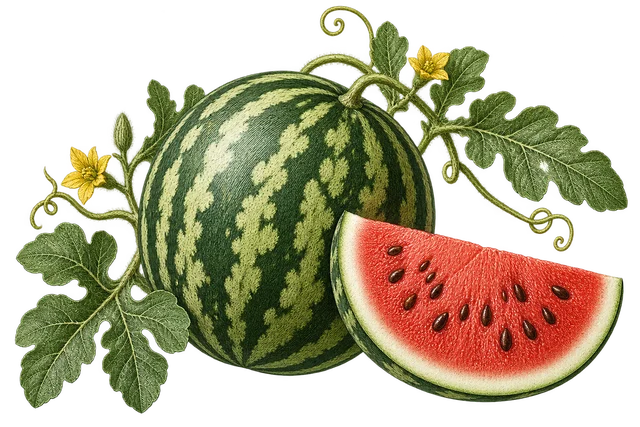
Modern culinary identity: seeded sweet dessert watermelon, Citrullus lanatus, grown for ripe flesh and mature seeds; this is not a claim about the cultivar eaten in biblical Egypt. Numbers 11:5 says melons. Botanical-historical research commonly identifies the remembered Egyptian fruit with watermelon, but the verse does not name a modern species or cultivar. Modern edible watermelon flesh is the clearly labeled nutrition example; bitter colocynth and unidentified wild gourds are excluded.
Ingredient details, preparation and research
Also known as: melons; Melons (biblical fruit; watermelon candidate); Seeded watermelon; Seeded watermelons; Watermelon; Citrullus lanatus
Source plant or material
Citrullus lanatus (Thunb.) Matsum. & Nakai (leading candidate); Modern ripe sweet watermelon flesh is used as the nutrition comparison for the probable biblical melon; exact cultivar identity remains uncertain.
Plant family / material: Cucurbitaceae (gourd family)
Forms and route
Seeded diploid dessert watermelon; mature seed kernels are edible when prepared as food. Ripe sweet watermelon flesh, cut pieces or juice; separately prepared edible seed kernels and tested pickled-rind products. Cantaloupe and honeydew are Cucumis melo. Wild bitter Citrullus fruits and concentrated extracts are not substitutes for ordinary dessert watermelon.
Food sources
Ripe sweet watermelon flesh, cut pieces or juice; separately prepared edible seed kernels and tested pickled-rind products. Cantaloupe and honeydew are Cucumis melo. Wild bitter Citrullus fruits and concentrated extracts are not substitutes for ordinary dessert watermelon.
Vitamins and minerals
One cup diced raw watermelon flesh (152 g, rind and seeds excluded) supplies about 46 kcal, 11.5 g carbohydrate, 9.4 g sugars, 0.7 g fiber, 0.9 g protein, 171 mg potassium, 15 mg magnesium, 12.3 mg vitamin C and 43 micrograms vitamin A RAE. USDA SR28 food 09326. This is modern dessert watermelon, not a reconstructed ancient melon or a seed-kernel serving. These generic raw-flesh values do not establish a nutritional advantage of seeded over seedless cultivars. Dried or roasted seed kernels need their own portion and composition data; added salt or oil also changes the serving.
Absorption and preparation
Watermelon can be eaten raw; cooking is not necessary for its lycopene to be absorbed. USDA-associated human research found an increase in circulating lycopene after uncooked watermelon juice, but that does not make juice therapeutically superior to fruit. No special fasting, fat-loading or supplement combination is established for an ordinary serving.
Traditional and reported uses
- Use ripe sweet watermelon as a water-rich fruit serving.
- Seed kernels and preserved rind are distinct food materials with their own preparation and nutrient profiles.
- Historical uses include fruit in dry regions, seed foods and the preservation of rind; none requires a medicinal claim.
- Serve the flesh in slices or fruit salad; use prepared edible seed kernels separately as a snack or soup ingredient.
Contraindications and cautions
- Wash the rind before cutting and refrigerate cut melon promptly; a knife can carry contamination from the outside into the flesh.
- Use a tested recipe for shelf-stable rind pickles rather than judging safety by taste.
- Do not eat bitter wild melons, colocynth or an unidentified gourd as if it were dessert watermelon.
- Juice, large bowls and sweetened preparations can add more carbohydrate than the single-cup serving shown here.
Similar items and how they compare
- Cantaloupe and honeydew
Other foods commonly called melons.
They are Cucumis melo and differ in carotenoid and vitamin content; watermelon values must not be copied to them.
- Snake melon
A possible identification of the cucumbers named beside melons.
An immature vegetable form of Cucumis melo, rather than ripe Citrullus lanatus flesh.
- Watermelon seed kernels
Come from a watermelon fruit.
A concentrated protein-and-fat food, not nutritionally equivalent to watery flesh.
- Seedless dessert watermelon
The same modern dessert-watermelon crop, bred to produce little mature seed.
Typically triploid rather than diploid; it still requires diploid pollen for fruit set. White seed traces do not make it a different fruit species.
The ancient identification remains qualified
Paris’s historical investigation supports a long northeastern African watermelon history and distinguishes selection for watery food from later sweet dessert forms. The KJV wording remains melons.
Lycopene can be absorbed from the raw form
Human feeding research summarized by USDA ARS found circulating lycopene after uncooked watermelon juice. This is absorption evidence, not proof of disease prevention, and it should not be extended to every proposed citrulline or rind supplement.
Separate food parts and preserve them safely
The USDA serving is flesh, not rind or seed. Cut-melon hygiene and temperature control are important; shelf-stable rind preservation needs a tested process.
Seeded and seedless describe different breeding types
Ordinary seeded dessert watermelons are diploid, with two chromosome sets. Commercial seedless types are triploid, with three, produced by crossing tetraploid and diploid breeding parents. The triploid plants still need pollen from a diploid watermelon to set fruit. Their soft white seed traces are undeveloped structures; occasional hard seeds can occur. The presence of seeds alone does not establish better flavor, greater nutrient content or medicinal benefit.
Three food materials, three kitchen uses
Enjoy the ripe flesh in wedges or fruit salad, removing mature seeds if preferred. Edible seed kernels can be dried or roasted for snacks or ground into foods, but are more concentrated in protein and oil than flesh. Use the pale rind in a tested pickle recipe; a fresh preparation and a shelf-stable canned preserve are not interchangeable. Egusi seed crops have their own entry and should not be identified solely from the word melon.
Clean the outside before slicing
Rinse the intact melon under running water and scrub with a clean produce brush before cutting; do not wash it with soap. Use clean hands, utensils and a cutting surface kept separate from raw meat. Refrigerate cut fruit at 40°F (4°C) or below.
Evidence limits
- Explicit KJV fruit category; watermelon is the leading identification
- Watermelon is a botanical interpretation of the KJV melons, not identification of a modern cultivar.
Entry sources
- Paris (2015): Origin and emergence of the sweet dessert watermelon, Citrullus lanatus
- Kew Plants of the World Online: Citrullus lanatus, taxonomy and recorded uses
- Royal Botanic Gardens, Kew (2022): Ancient watermelon genome from 6,000-year-old seeds
- National Center for Home Food Preservation: Watermelon Rind Pickles
- USDA ARS: Human absorption of lycopene from uncooked watermelon juice and processed tomato juice
- FDA: Selecting and Serving Produce Safely
- USDA SR28: Watermelon, raw, food 09326, PDF page 919
- Numbers 11:5 (King James Version)
- University of Georgia Extension: What Do Seedless Watermelons and Mules Have In Common?
- Alabama Cooperative Extension: Seedless Watermelons: Why Are Seeds Costly and Why Do They Produce Seeds Sometimes
- University of Maryland Extension: Growing Melons in a Home Garden
- Utah State University Extension: How to Grow Watermelon in Your Garden
- University of Minnesota Extension: Growing melons in the home garden
Reference entry 150 · Recorded content review: 2026-10-10 · Review scope and dates