


Key cautions
- Use identified, ripe fruit; avoid unripe fruit and sap.
- Leaf supplements are separate from fruit.
- Use tested preservation instructions.
What’s inside
Fruit contains sugars and organic acids; sampled Morus alba fruits also contain vitamin C and phenolic compounds. Dark cultivars contain anthocyanin pigments, whose amounts vary. Laboratory antioxidant capacity is not a measured health outcome.
Uses in brief

- Ripe fruit food
- Pies, jelly and syrup
- Sweet fruit syrup
History, folklore and reported uses
History, folklore and traditional uses
Mulberry is a group of food trees, not one origin story. Red mulberry is native to eastern North America, whereas white mulberry comes from China and spread widely, including through silk production. In Britain, the RHS highlights black mulberry as a garden fruit for fresh eating and jam.
Kew places black mulberry’s native range in western and southwestern Iran. The IUCN assessment cautions that long cultivation makes the original wild distribution uncertain. Introduced trees, regional food use and native origin should therefore remain separate claims.
A closer look at its history
A fruit tree carried by hopes of a silk industry
White mulberry’s American history is tied to sericulture: USDA’s historical review records a 1624 Virginia requirement for male residents to plant at least four trees. In the 1830s, speculative planting in the eastern United States became known as “mulberry mania”; cold winters and disease helped end the boom. These were leaf crops for silkworms, a different purpose from selecting today’s trees for fruit.
Why colonial silk did not displace tobacco
Historic Jamestowne’s account describes the labor-intensive work of rearing silkworms and preparing their cocoons. It attributes Virginia’s unsuccessful silk industry to the specialized labor needed, the worms’ limited enthusiasm for native mulberry foliage and tobacco’s greater success as a cash crop. The story helps explain why mulberries were moved and planted for reasons beyond their berries.
Additional history reviewed 2026-10-09
Traditional, historical and reported uses
- Fresh ripe fruit
Food or household practiceWhy this label?
This documents an identified culinary practice or food-processing preparation, not a treatment effect; preparation and safety limits remain attached.
The RHS describes ripe black mulberries as soft, juicy and sweet-tart. NC State also records edible ripe white-mulberry fruit, including pale and dark forms. The species name white mulberry is not a promise of white fruit.
- Red-mulberry pie filling
Food or household practiceWhy this label?
This documents an identified culinary practice or food-processing preparation, not a treatment effect; preparation and safety limits remain attached.
Alabama Extension records red mulberry as a fruit for pies. Cooking it in pastry is a distinct culinary use; the resulting dish also reflects its sweetener and pastry ingredients.
- Mulberry jelly
Food or household practiceWhy this label?
This documents an identified culinary practice or food-processing preparation, not a treatment effect; preparation and safety limits remain attached.
The National Center for Home Food Preservation publishes a mulberry-juice jelly recipe using lemon juice and liquid pectin, with specified canning procedures. Use the complete tested directions for preservation rather than treating this short description as a recipe.
- Sweet mulberry syrup
Food or household practiceWhy this label?
This documents an identified culinary practice or food-processing preparation, not a treatment effect; preparation and safety limits remain attached.
A Korean food-science study documents syrup made with mulberry fruit, sugar and citric acid while investigating pigment changes. It supports a specific food-processing use, not a claim that syrup prevents disease or retains every property of fresh fruit.
Distinct documented food practices are featured without filling a quota. Place-specific accounts preserve culinary heritage; none is evidence of a cure.
Historical-use additions reviewed 2026-10-09
Story sources
- NC State Extension: Morus alba, white mulberry
- NC State Extension: Morus rubra, red mulberry
- Kew POWO: Morus nigra, black mulberry
- IUCN Red List (2024): Morus nigra, uncertain native wild distribution
- RHS: How to Grow Mulberries, including harvesting and food uses
- Alabama Cooperative Extension: Native Fruits, Red Mulberry
- National Center for Home Food Preservation: Mulberry Jelly with Liquid Pectin
- Chen and colleagues (2022): Chemical composition of Morus alba fruits from different varieties in China
- Kim and Lee (2020): Mulberry anthocyanin profiles and changes during syrup processing
- Riche and colleagues (2017): Mulberry leaf extract randomized placebo-controlled pilot study
- NIH NCCIH: White Mulberry Leaf, usefulness and safety
- FDA: Selecting and Serving Produce Safely
Growing notes
Morus rubra, M. alba and M. nigra are distinct species. Named fruiting cultivars and hybrids require their own nursery provenance, hardiness and fertility information.
- Choose species and climate
- Red mulberry (M. rubra): NC State lists USDA 4–9; white (M. alba): 4–8. Black (M. nigra): RHS lists H6, −20 to −15°C under UK conditions, not a USDA equivalence. Verify cultivar identity and local suitability. [1] [2] [3]
- Habitat and responsible planting
- White mulberry is invasive in parts of North America and hybridizes with native red mulberry. Check local restrictions before planting. These spreading deciduous trees need generous space; some named selections are compact. [4] [5] [6] [7]
- Site and care
- Choose sun and deep, well-drained soil. Water during establishment and drought; containers need closer attention. Use soil-test recommendations for nutrients. Plant dormant bare-root stock in the locally appropriate cool season. [6] [8] [9]
- Pollination
- Red and white are wind-pollinated, usually with male and female flowers on separate trees. Confirm a cultivar’s pollen requirements. Black fruiting cultivars are generally self-fertile; do not extend that advice to every mulberry. [4] [5] [6]
- Time to fruit and harvest
- Red seedlings commonly reach seed-bearing around 10 years, sometimes earlier. Black trees may take about 8 years; cultivars can be earlier. For white cultivars, ask the supplier about first-bearing age. Regional examples: red June–August; white June in North Carolina; black August–September in Britain. [10] [2] [6]
- Wildlife, neighbors and upkeep
- Birds relish fruit; avoid placing staining crops beside paving. Choose neighbors with enough room for the mature canopy. Prune minimally while dormant, removing dead or crossing wood; RHS specifies late autumn to early winter for black mulberry. Watch for scale, leaf spots and white-mulberry popcorn disease. [1] [6] [8] [3]
Growing sources and regional guidance
- NC State Extension Plant Toolbox: Morus rubra
- NC State Extension Plant Toolbox: Morus alba
- Royal Horticultural Society: Morus nigra (F), black mulberry
- USDA Forest Service, Fire Effects Information System: Morus alba, white mulberry (Katharine R. Stone, 2009)
- Environment and Climate Change Canada: Red mulberry (Morus rubra), COSEWIC assessment and status report 2014
- Royal Horticultural Society: How to Grow Mulberries
- Wisconsin Department of Natural Resources: White mulberry, invasiveness and restrictions
- University of Georgia Cooperative Extension: Minor Fruits and Nuts in Georgia, Bulletin 992, mulberry section (p. 19)
- University of Maryland Extension: Fertilizing Trees and Shrubs and Nutrient Deficiency Symptoms
- USDA Forest Service: Silvics of North America, Red Mulberry
- National Park Service, Historic Jamestowne: Silk Production in the Seventeenth Century
Growing notes reviewed 2026-10-09
Regional reading paths
These sourced notes describe cultivation, trade, food traditions or material history. A regional connection does not claim exclusive origin.
Asia
Native and cultivated regional example: white mulberry, Morus alba, is native to China and is widely cultivated there. Other species in the linked fruit card have different origins.
Ripe, identified mulberry fruit eaten fresh, dried or in preserves. Silk production is source-tree context using leaves, not a use of the fruit.
Identity & detailed reference
Identity
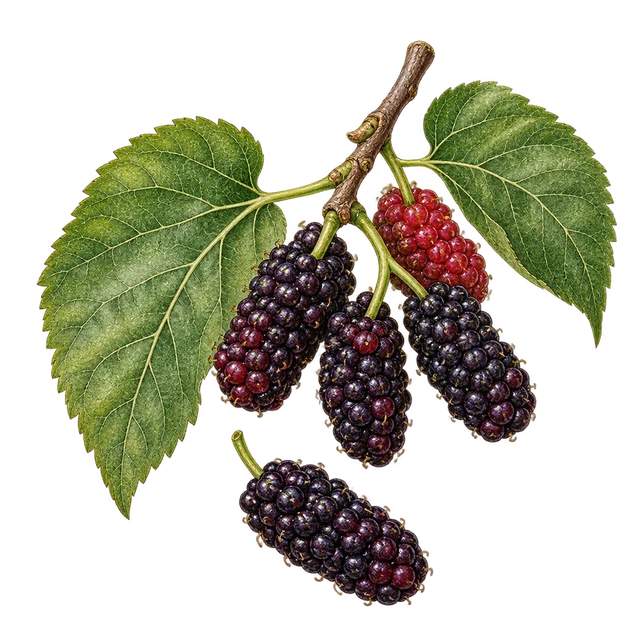
Ripe edible mulberry fruits from identified Morus species, especially white mulberry (M. alba), red mulberry (M. rubra) and black mulberry (M. nigra). Fruit color alone cannot identify the species: M. alba can bear pale, pink or dark fruit. Leaf teas, bark and supplements are separate materials.
Ingredient details, preparation and research
Also known as: Mulberries; Morus fruit; White mulberry fruit; Red mulberry fruit; Black mulberry fruit; Morus alba fruit; Morus rubra fruit; Morus nigra fruit
Source plant or material
Morus alba L., Morus rubra L. and Morus nigra L.
Plant family / material: Moraceae
Forms and route
Fresh ripe fruit, frozen fruit, cooked pie filling, jam, jelly and syrup. Dried products vary by species and processing; leaf powder and standardized leaf extract are not fruit servings.
Vitamins and minerals
No serving-specific nutrient or copper value is assigned. Chemical analyses of particular cultivars cannot represent all Morus fruits. Whole fruit, strained jelly, sweetened syrup and dried fruit differ; leaf-supplement composition does not apply to fruit.
Absorption and preparation
No special nutrient-absorption advantage is established for this food. Laboratory extract results are not measurements of absorption from a fruit serving.
Practical preparation
Sort ripe, identified fruit, remove debris and stems, rinse gently and refrigerate. For jelly, use a tested mulberry-specific procedure rather than changing acid, sugar, pectin or processing on your own.
Combination context
No medicinal combination or required nutrient-absorption pairing is established.
Combination notes
Combine with ordinary foods to taste. Sweeteners, salt, pastry and other ingredients change the finished food; no medicinal pairing is implied.
Traditional and reported uses
- Ripe fruit food
- Pies, jelly and syrup
- Sweet fruit syrup
Contraindications and cautions
- Eat only correctly identified, ripe fruit. NC State cautions against unripe fruit and milky sap; do not use leaf or bark preparations as substitutes for the fruit.
- Color alone is not a ripeness or identification rule across Morus species and cultivars. Some M. alba fruits remain pale when ripe.
- Refrigerate perishable fruit, wash before eating, and discard rotten fruit. Do not gather fruit from an unidentified or contaminated site.
- For shelf-stable jelly, follow the full tested recipe, including its acid, pectin and processing requirements. Fruit syrup is not automatically shelf-stable.
- Mulberry-leaf extracts can affect blood glucose and cause digestive upset. Discuss supplements with a clinician, especially with diabetes medicines; fruit food does not establish their safety.
Similar items and how they compare
- Blackberry
Both have clusters of small juicy units.
Blackberries belong to Rubus; resemblance does not identify a wild fruit.
- Mulberry leaf tea or extract
May come from the same Morus alba tree.
Leaf preparations have different chemistry, exposure and evidence. They are not interchangeable with ripe fruit.
Fruit composition varies across cultivars
Chen and colleagues analyzed 25 Morus alba fruit samples from six Chinese provinces, measuring anthocyanins, vitamin C, sugars and acidity. The variation matters: a laboratory ranking of samples does not establish a superior treatment or a standard amount in every serving.
A leaf-extract trial did not test fruit
A 2017 randomized pilot trial enrolled 24 adults with type 2 diabetes; 17 completed it. The tested standardized leaf extract lowered some post-meal glucose readings, but there was no between-group HbA1c difference and creatinine increased. This small trial does not validate fruit as diabetes treatment or authorize a home leaf preparation.
Supplement safety is a separate question
NCCIH describes limited and mixed human evidence for white-mulberry leaf products, digestive side effects and possible low blood sugar with diabetes medicines. It also notes insufficient reliable safety information for white-mulberry berries; a history of food use is not a quantified long-term or high-dose safety assessment.
Evidence limits
This overview covers identified ripe food fruits and selected preparation-specific studies. It is not a comprehensive clinical review, a foraging guide or a supplement dosing guide. It does not assume equal nutrient content, origin or safety evidence across Morus species.
Entry sources
- NC State Extension: Morus alba, white mulberry
- NC State Extension: Morus rubra, red mulberry
- Kew POWO: Morus nigra, black mulberry
- IUCN Red List (2024): Morus nigra, uncertain native wild distribution
- RHS: How to Grow Mulberries, including harvesting and food uses
- Alabama Cooperative Extension: Native Fruits, Red Mulberry
- National Center for Home Food Preservation: Mulberry Jelly with Liquid Pectin
- Chen and colleagues (2022): Chemical composition of Morus alba fruits from different varieties in China
- Kim and Lee (2020): Mulberry anthocyanin profiles and changes during syrup processing
- Riche and colleagues (2017): Mulberry leaf extract randomized placebo-controlled pilot study
- NIH NCCIH: White Mulberry Leaf, usefulness and safety
- FDA: Selecting and Serving Produce Safely
Reference entry 289 · Recorded content review: 2026-10-09 · Review scope and dates