


Key cautions
- Cook thoroughly; raw sprouts are a food-poisoning risk.
- High-risk groups: avoid all raw or undercooked sprouts.
- Washing and home growing do not sterilize sprouts.
What’s inside
Water, fiber, carbohydrate, protein, vitamins and plant compounds vary widely by seed species, growing conditions and preparation. There is no shared composition for all sprouts.
Uses in brief

- Cooked mung-bean dishes
- Cooked soybean-sprout soup
- Recorded salad and sandwich use
History, folklore and reported uses
History, folklore and traditional uses
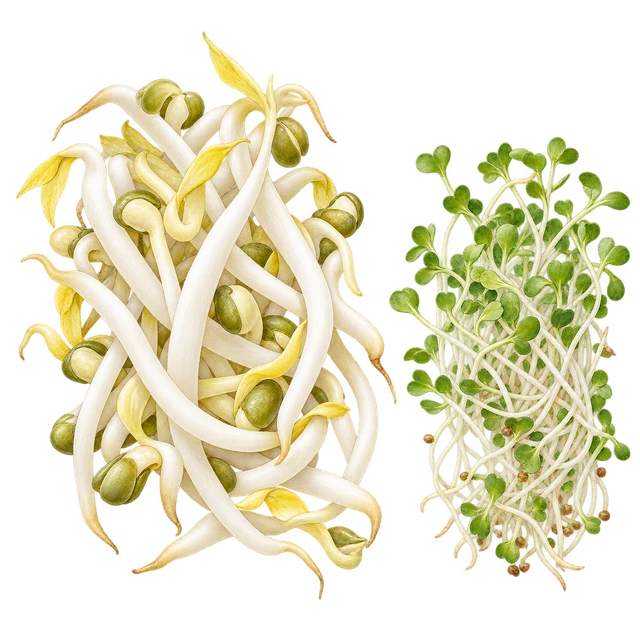
Sprouting is a preparation stage shared by different food crops, not a botanical family. Distinct culinary traditions include stir-fried mung sprouts in Chinese food and cooked soybean-sprout soup in Korean home cooking.
Salad and sandwich sprout use is also documented, particularly for fine alfalfa sprouts. Recording that practice is not an endorsement of raw serving; modern public-health guidance is central to this card.
Traditional, historical and reported uses
- Chinese-style cooked mung sprouts
Food or household practiceWhy this label?
The specific claim documents a food preparation or recorded culinary practice; safety qualifications remain attached and no treatment effect is inferred.
NParks records stir-fried mung-bean sprouts as a vegetable accompaniment. They are Vigna radiata, not soybeans. Cook thoroughly rather than using a raw garnish at the end.
- Korean soybean-sprout soup
Food or household practiceWhy this label?
The specific claim documents a food preparation or recorded culinary practice; safety qualifications remain attached and no treatment effect is inferred.
Korean recipe author Maangchi documents kongnamul-guk as an everyday soup made by cooking soybean sprouts in broth. Kongnamul identifies soybean sprouts and should not be silently equated with mung sprouts.
- Recorded salad and sandwich toppings
Food or household practiceWhy this label?
The specific claim documents a food preparation or recorded culinary practice; safety qualifications remain attached and no treatment effect is inferred.
Colorado State documents use of fine alfalfa and broccoli sprouts in salads and sandwiches. Because such raw serving carries microbial risk, choose thoroughly cooked sprouts or omit them; high-risk groups should avoid raw sprouts.
3 supported featured uses; food practices are not claims of treatment benefit.
Historical-use additions reviewed 2026-10-09
Story sources
- FDA: Selecting and Serving Produce Safely
- FoodSafety.gov: People at Risk of Food Poisoning
- Health Canada: Food safety tips for sprouts
- Colorado State University Food Source Information: Sprouts
- Singapore NParks: Vigna radiata
- Maangchi: Non spicy soybean sprout soup
- Kew POWO: Vicia lens, including Lens culinaris
- FDA: Sample Labels of Chicago Indoor Garden Sprout Products
- NC State Extension: Glycine max
- FDA: Reducing Microbial Food Safety Hazards in the Production of Seed for Sprouting
- CDC: Infections Associated with Eating Seed Sprouts: An International Concern
- Penn State Extension: Ensuring Food Safety in Microgreens Production
- AAAAI: Food Allergy
Identity & detailed reference
Identity
Germinated seeds of specified food crops, including mung bean, alfalfa, broccoli, radish, lentil and soybean. This is a food-form overview, not one species or permission to sprout arbitrary seeds.
Ingredient details, preparation and research
Also known as: Sprouts; Various sprouts; Edible sprouts; Bean sprouts (check species); Mung bean sprouts; Alfalfa sprouts; Broccoli sprouts; Radish sprouts; Lentil sprouts; Soybean sprouts; Kongnamul (soybean sprouts)
Source plant or material
Vigna radiata; Medicago sativa; Brassica oleracea (broccoli cultivars); Raphanus sativus; Vicia lens (syn. Lens culinaris); Glycine max
Plant family / material: Fabaceae and Brassicaceae
Forms and route
Food-grade sprouts served thoroughly cooked. Commercial or home-grown raw sprouts retain a foodborne-illness risk. Microgreens, mature vegetables, dry pulses and extracts are separate forms.
Vitamins and minerals
No single nutrient number or superiority ranking is assigned. Mung, soybean, alfalfa, broccoli, radish and lentil sprouts are different foods; dry-seed, mature-vegetable and extract values must not be relabeled as a cooked-sprout serving.
Absorption and preparation
Sprouting changes seeds, but this review establishes no universal increase in nutrient absorption across species. Potential nutrient or enzyme claims do not justify skipping the cooking advised for food safety.
Practical preparation
Buy refrigerated, correctly labeled food sprouts and check recalls. Keep chilled, rinse before cooking and cook thoroughly throughout. Do not rely on appearance, rinsing or a brief blanch as proof of safety; discard recalled or spoiled material.
Combination context
No nutrient-preserving pairing overrides the food-safety advice.
Combination notes
Add fully cooked mung or soybean sprouts to a cooked meal. A cold sauce, salad dressing or splash of hot broth does not sanitize raw sprouts.
Traditional and reported uses
- Cooked mung-bean dishes
- Cooked soybean-sprout soup
- Recorded salad and sandwich use
Contraindications and cautions
- Raw or lightly cooked sprouts can carry Salmonella, pathogenic E. coli or Listeria. Cook sprouts thoroughly to reduce the risk; a quick warming or adding raw sprouts to a finished hot dish is not a reliable cooking step.
- Pregnant people, children younger than 5, adults 65 and older, and people with weakened immune systems should avoid raw or undercooked sprouts of any kind. Ask restaurants to leave them out unless thoroughly cooked.
- Washing, clean-looking sprouts and home growing do not guarantee safety. Bacteria on or inside seeds can multiply during sprouting; no home rinse or disinfectant step is presented as sterilization.
- Use correctly identified seed specifically suitable for food sprouting from a reputable supplier. Do not substitute treated planting seed, unknown wild seed or arbitrary beans. Sprouting does not by itself establish edibility or remove the need to cook legumes.
- Check current recalls. Never eat recalled sprouts or use recalled seed; return or discard as directed. Keep unrecalled sprouts refrigerated and prevent cross-contamination.
- Soybean sprouts remain soy and can cause reactions in someone with soy allergy. Other sprout species have their own allergy risks; alfalfa supplements and concentrated broccoli products are outside this food overview.
Similar items and how they compare
- Microgreens
Also young plants used as food.
Usually grown longer and harvested as shoots above the growing medium; sprouts are commonly eaten with seed and young root. Microgreens are not risk-free, and the terms should not be interchanged.
- Dry lentils or soybeans
Seeds of some of the same crops.
Cooking and composition differ. Germination alone is not evidence that a legume is ready to eat raw.
- Broccoli-sprout extract
May contain selected compounds from broccoli material.
Concentration and processing differ from food; research on an extract does not set a food dose.
Six food identities, kept separate
Mung bean is Vigna radiata; alfalfa is Medicago sativa; broccoli sprouts come from broccoli cultivars of Brassica oleracea; radish is Raphanus sativus. Lentil is Vicia lens, widely called Lens culinaris; soybean is Glycine max. These names identify the food sources, not a seed-recognition test.
Lentil sprouts are one named form, not all legumes
FDA’s historical sprout-product labels include lentil, supporting its presence in the food category. That archived recall material is not a recommendation of the product, supplier or raw preparation.
Why a clean kitchen cannot make raw sprouts sterile
FDA explains that a small amount of seed contamination can expand in the warm, moist sprouting environment. CDC’s sprout review describes limits of disinfection. Safety advice therefore focuses on thorough cooking and avoiding recalled products.
Sprouts are not microgreens
Penn State distinguishes earlier whole sprouts from later young shoots cut above the substrate. Both require food-safety controls; this distinction is not a claim that raw microgreens are sterile.
Evidence limits
No raw-edibility guarantee, home-decontamination recipe, supplement dose, cancer-prevention claim or universal nutrient enhancement is established. This overview covers the six named common foods, not every seed capable of germinating.
Entry sources
- FDA: Selecting and Serving Produce Safely
- FoodSafety.gov: People at Risk of Food Poisoning
- Health Canada: Food safety tips for sprouts
- Colorado State University Food Source Information: Sprouts
- Singapore NParks: Vigna radiata
- Maangchi: Non spicy soybean sprout soup
- Kew POWO: Vicia lens, including Lens culinaris
- FDA: Sample Labels of Chicago Indoor Garden Sprout Products
- NC State Extension: Glycine max
- FDA: Reducing Microbial Food Safety Hazards in the Production of Seed for Sprouting
- CDC: Infections Associated with Eating Seed Sprouts: An International Concern
- Penn State Extension: Ensuring Food Safety in Microgreens Production
- AAAAI: Food Allergy
Reference entry 286 · Recorded content review: 2026-10-09 · Review scope and dates